LLM & AI Agent Applications with LangChain and LangGraph — Part 29: Model Agnostic Pattern and LLM API Gateway
Author(s): Michalzarnecki Originally published on Towards AI. Hi! In this part we’re moving from experiments and prototyping into the real world — production deployments. Because the truth is: building a working notebook or a proof-of-concept is only the beginning. The real challenges …
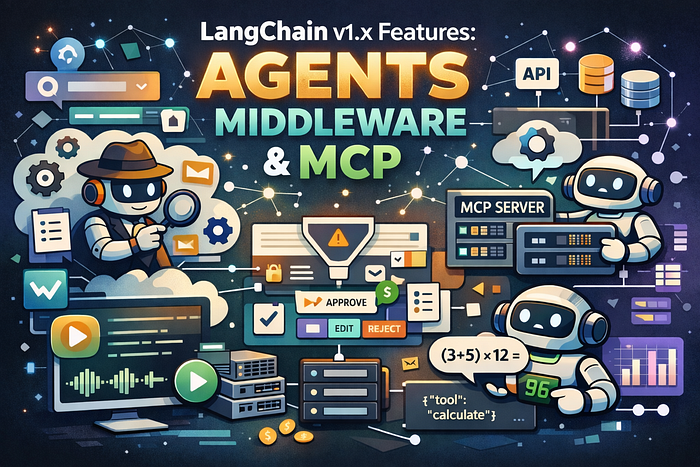
LangChain v1.x Features: Agents, Middleware, Streams, and MCP
Author(s): Michalzarnecki Originally published on Towards AI. Hi. This article covers important features and syntax from new releases of LangChain library since v1.0.0. For more examples and explanations related to LangChain and LangGraph libraries see my dedicated article series. For more features …

LLM & AI Agent Applications with LangChain and LangGraph — Part 28: Multi-Agent Discussion Panel (Researcher, Expert, Critic, Moderator)
Author(s): Michalzarnecki Originally published on Towards AI. Hi. In this part I’ll present a multi-agent application. It will be a discussion panel with four roles: Researcher — has access to a search tool and brings facts and sources into the conversation. Expert …
LLM & AI Agent Applications with LangChain and LangGraph — Part 27: The Publisher Agent (News → Summary → Article → Critic → Improve)
Author(s): Michalzarnecki Originally published on Towards AI. Hi. In this part I’ll run and demonstrate a publisher agent — a system that autonomously aggregates news from the web, summarizes the most important points, and then generates an article based on that material. …
LLM & AI Agent Applications with LangChain and LangGraph — Part 25: AI Agents architectures(and How to Organize Them)
Author(s): Michalzarnecki Originally published on Towards AI. Hi! In this article I’ll demonstrate different types of AI agents. This topic is useful because it helps you understand how many ways “intelligent agents” can behave and be organized — from simple reactive systems …

LLM & AI Agent Applications with LangChain and LangGraph — Part 26: RAG AI Agent in LangGraph
Author(s): Michalzarnecki Originally published on Towards AI. Hi. So far in this series we’ve built a basic graph, and then a graph with an LLM and a conditional loop. We also covered different types of AI agents. Now we’ll do a practical …
LLM & AI Agent Applications with LangChain and LangGraph — Part 22: Building a RAG Chatbot in Streamlit
Author(s): Michalzarnecki Originally published on Towards AI. Hi! In this chapter we’ll build a simple, but fully working chatbot application based on RAG. It will load content from a few files containing website text and answer user questions in the context of …
LLM & AI Agent Applications with LangChain and LangGraph — Part 24: Connecting LangGraph with LLMs
Author(s): Michalzarnecki Originally published on Towards AI. Hi. In the previous part we built a simple graph that performed math operations step by step. That’s a good start — but the real power of LangGraph appears when we connect graph nodes with …

LLM & AI Agent Applications with LangChain and LangGraph — Part 23: Introduction to LangGraph
Author(s): Michalzarnecki Originally published on Towards AI. Hi! Welcome to the next article of the LLM-based application development series. In this part we will jump into LangGraph and build a simple graph showed below. So far we’ve learned about chains in LangChain. …
LLM & AI Agent Applications with LangChain and LangGraph — Part 20: Retrieval-Augmented Generation (RAG)
Author(s): Michalzarnecki Originally published on Towards AI. Hi! Welcome to next part of series related to LLM-based applications developments dedicated to Retrieval-Augmented Generation, or simply RAG. RAG is a pattern that very quickly became the foundation of many LLM-based applications. Why? Because …
LLM & AI Agent Applications with LangChain and LangGraph — Part 19: Guardrails (Safety Barriers for LLMs)
Author(s): Michalzarnecki Originally published on Towards AI. Hi! In this chapter we’ll move to another topic that is just as practical — and in many real applications, absolutely critical: Guardrails, a safety-barrier system for language models. Guardrails are simply a set of …
LLM & AI Agent Applications with LangChain and LangGraph — Part 16: String Evaluators (BLEU, ROUGE, METEOR)
Author(s): Michalzarnecki Originally published on Towards AI. Hi. Welcome to the next episode. The first category of evaluation techniques I want to cover is String Evaluators. Unlike semantic evaluators — which analyze meaning using embeddings — String Evaluators compare outputs at the …
LLM & AI Agent Applications with LangChain and LangGraph — Part 18: Trajectory Evaluator
Author(s): Michalzarnecki Originally published on Towards AI. Hi! The next evaluation technique we’ll discuss in this part is the Trajectory Evaluator. This tool doesn’t look only at the final answer produced by the model. Instead, it focuses on the entire reasoning process …

LLM & AI Agent Applications with LangChain and LangGraph — Part 17: Criteria Evaluator
Author(s): Michalzarnecki Originally published on Towards AI. Hi! The next evaluation technique that we will learn in this part is the Criteria Evaluator. The idea is simple, but extremely powerful: the answer generated by your model is passed to another, typically stronger …

LLM & AI Agent Applications with LangChain and LangGraph — Part 14: 5 Rules of Effective Prompt Engineering
Author(s): Michalzarnecki Originally published on Towards AI. Hi! This time we’ll focus on something that, in practice, often decides whether your work with large language models will be impressive… or disappointing: prompt engineering. Even the best model — and even the most …
Recent Posts