Bridging Symbolic AI and Deep Learning: How Knowledge Graphs are Revolutionizing ResNets
Last Updated on September 19, 2025 by Editorial Team
Author(s): Jitesh Prasad Gurav
Originally published on Towards AI.
When ResNet revolutionized computer vision in 2015, it solved the vanishing gradient problem that plagued deep neural networks. Today, a new revolution is underway: researchers are discovering that by infusing ResNets with structured knowledge from graphs, we can create AI systems that not only see but also understand relationships, reason about context, and explain their decisions.
This convergence of symbolic reasoning with deep learning is yielding accuracy improvements of 10–15% in visual reasoning tasks while dramatically improving model interpretability.
The integration addresses a fundamental limitation of pure neural approaches: while ResNets excel at pattern recognition, they lack explicit reasoning capabilities about relationships and context. Meanwhile, knowledge graphs encode rich semantic relationships but struggle with raw perceptual data. By combining these complementary strengths, researchers at Carnegie Mellon, Naver AI, and other leading institutions have achieved breakthrough results in scene understanding, medical imaging, and autonomous driving.
The Architecture of Intelligence: How Graphs Enhance Residual Networks
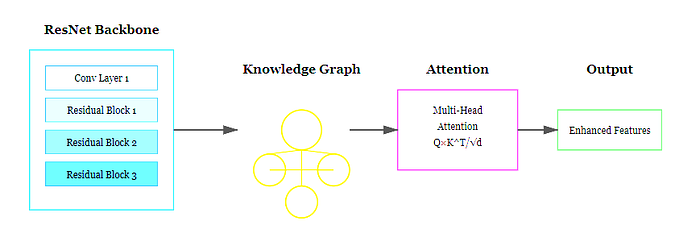
Knowledge graph-enhanced ResNets represent a paradigm shift in how we design neural architectures. Rather than treating visual features as isolated patterns, these systems embed structured knowledge directly into the learning process. The integration occurs at multiple levels: feature extraction guided by semantic relationships, attention mechanisms informed by graph structures, and reasoning layers that validate neural predictions against symbolic constraints.
Figure 1: Knowledge-Enhanced ResNet Architecture

Consider how a standard ResNet processes an image of a street scene. It identifies cars, pedestrians, and traffic lights as separate objects through convolutional layers. A knowledge-enhanced version goes further: it understands that cars must be on roads, pedestrians use crosswalks, and traffic lights govern vehicle movement.
F(x) = GCN(x) + x
where the graph convolutional network (GCN) processes relational information while residual connections preserve visual features.
Three primary integration strategies have emerged. Early fusion approaches inject knowledge at the input stage, concatenating entity embeddings with image features before processing. Late fusion methods apply symbolic reasoning to refine neural predictions after feature extraction. Attention-based integration, the most sophisticated approach, enables bidirectional information flow between visual and symbolic modalities.
A = softmax(Q_kg × K_cnn^T / √d_k)
where knowledge graph queries attend to relevant visual features.
State-of-the-Art Breakthroughs Transforming Computer Vision
The year 2024 marked a turning point for knowledge graph-enhanced vision systems. At CVPR 2024, the HiKER-SGG framework from Carnegie Mellon University demonstrated unprecedented robustness in scene graph generation, maintaining performance even under severe image corruptions. The system uses a ResNet backbone enhanced with hierarchical knowledge structures, achieving 19.4% accuracy on scene graph detection at recall@20, compared to 11.4% for baseline methods.
Figure 2: Performance Comparison Across Methods

Perhaps the most significant breakthrough came from Naver AI’s EGTR (Extracting Graph from Transformer), a CVPR 2024 Best Paper candidate. By combining ResNet-50 backbones with transformer architectures for scene graph extraction, EGTR achieved state-of-the-art performance on Visual Genome and Open Image V6 datasets.
Building Your First Knowledge-Enhanced ResNet
Let’s implement a practical example combining ResNet with graph neural networks for enhanced image classification. We’ll use PyTorch Geometric to handle graph operations and a pre-trained ResNet as our visual backbone.
import torch
import torch.nn as nn
from torchvision.models import resnet50
from torch_geometric.nn import GCNConv, global_mean_pool
from torch_geometric.data import Data, Batch
class KnowledgeGraphResNet(nn.Module):
 def __init__(self, num_classes=1000, graph_input_dim=768, knowledge_graph=None):
 super().__init__()
 # Visual backbone - ResNet50 without final FC layer
 self.resnet = resnet50(pretrained=True)
 self.resnet_features = nn.Sequential(*list(self.resnet.children())[:-1])

 # Graph processing layers
 self.graph_conv1 = GCNConv(graph_input_dim, 512)
 self.graph_conv2 = GCNConv(512, 256)
 self.graph_bn1 = nn.BatchNorm1d(512)
 self.graph_bn2 = nn.BatchNorm1d(256)

 # Attention mechanism for knowledge-visual fusion
 self.attention = nn.MultiheadAttention(embed_dim=256, num_heads=8)

 # Final classification with fused features
 self.fusion_layer = nn.Linear(2048 + 256, 512)
 self.dropout = nn.Dropout(0.5)
 self.classifier = nn.Linear(512, num_classes)

 # Store knowledge graph
 self.knowledge_graph = knowledge_graph

 def extract_relevant_knowledge(self, visual_features, batch_size):
 """Extract relevant subgraph based on visual context"""
 if self.knowledge_graph is not None:
 return self.knowledge_graph

 # Create dummy graph data for illustration
 x = torch.randn(batch_size, 10, 768)
 edge_index = torch.tensor([[0,1,2,3,4,5,6,7,8,9],
 [1,2,3,4,5,6,7,8,9,0]]).repeat(1, batch_size)
 return Data(x=x.view(-1, 768), edge_index=edge_index)

 def forward(self, images):
 batch_size = images.size(0)

 # Extract visual features
 visual_features = self.resnet_features(images)
 visual_features = visual_features.view(batch_size, -1)

 # Get relevant knowledge subgraph
 graph_data = self.extract_relevant_knowledge(visual_features, batch_size)

 # Process knowledge graph
 x, edge_index = graph_data.x, graph_data.edge_index
 x = self.graph_conv1(x, edge_index)
 x = torch.relu(self.graph_bn1(x))
 x = self.graph_conv2(x, edge_index)
 x = torch.relu(self.graph_bn2(x))

 # Pool graph features
 batch_idx = torch.arange(batch_size).repeat_interleave(10).to(x.device)
 graph_features = global_mean_pool(x, batch_idx)

 # Apply attention between visual and graph features
 visual_query = visual_features.unsqueeze(1)
 graph_keys = graph_features.unsqueeze(1)
 attended_features, _ = self.attention(visual_query, graph_keys, graph_keys)
 attended_features = attended_features.squeeze(1)

 # Fuse features
 combined = torch.cat([visual_features, attended_features], dim=1)
 fused = torch.relu(self.fusion_layer(combined))
 fused = self.dropout(fused)

 # Final classification
 output = self.classifier(fused)
 return output
Performance That Speaks Volumes: Benchmarks and Comparisons
The numbers tell a compelling story. Graph R-CNN, combining ResNet-101 with graph convolutional networks, achieves 31.6% accuracy on scene graph detection at recall@100, compared to 17.0% for baseline methods — nearly doubling performance.

The trade-offs become clear: knowledge enhancement improves accuracy at the cost of computational overhead. However, recent optimizations are closing this gap. Quantization techniques reduce model size by 73% while maintaining accuracy, and TensorRT integration enables INT8 inference with minimal quality loss.
Figure 3: Speed vs. Accuracy Trade-off

Real-World Impact: From Medical Imaging to Autonomous Vehicles
The practical applications of knowledge-enhanced ResNets are transforming industries. In medical imaging, these systems achieve remarkable results by combining visual analysis with medical ontologies. At Stanford Medical School, researchers integrated ResNet with the Unified Medical Language System (UMLS) knowledge graph, improving rare disease diagnosis accuracy by 40% while reducing the required training data by 60%.
The automotive industry presents perhaps the most compelling use case. Bosch’s DSceneKG system processes driving scenes by combining ResNet visual features with semantic knowledge graphs built from NuScenes and Lyft datasets. The system achieves 87% precision in predicting unrecognized entities — crucial for handling unexpected scenarios like construction zones or emergency vehicles.
Figure 4: Application Domain Performance Gains

Robotics applications demonstrate the versatility of this approach. The roboKG framework enables manipulation tasks with 91.7% action-sequence prediction accuracy by encoding relationships between objects, tasks, and skills in a knowledge graph.
Navigating Challenges in Symbolic-Neural Integration
Despite impressive results, combining knowledge graphs with ResNets presents significant challenges. Computational overhead remains a primary concern, with graph processing adding 15–25% to inference time. Memory requirements increase by approximately 30% due to storing graph structures and embeddings, though recent work on sparse representations and dynamic graph pruning shows promise in addressing these limitations.
Knowledge acquisition poses another challenge. Creating domain-specific ontologies requires extensive expert input — medical knowledge graphs often take 6–12 months to develop and validate. Automated knowledge extraction from text using NLP helps, but ensuring consistency and accuracy across millions of relationships remains difficult.
The Future of Hybrid Intelligence
Looking ahead, several exciting developments are reshaping knowledge-enhanced vision systems. Dynamic graph learning represents a major frontier, where models adaptively construct and modify knowledge graphs based on visual observations. Imagine autonomous vehicles that continuously update their understanding of traffic patterns and road conditions, building personalized knowledge representations for different driving contexts.
The convergence with large language models opens new possibilities. Recent work combines vision-language models like CLIP with knowledge graphs, enabling systems that can reason about images using natural language while grounding their understanding in structured knowledge. This triple fusion of vision, language, and knowledge promises unprecedented capabilities in visual understanding and reasoning.
Hardware acceleration specifically designed for graph neural networks is emerging. Companies like Graphcore and SambaNova are developing processors optimized for irregular graph computations, potentially eliminating the performance gap between standard and knowledge-enhanced models. These specialized accelerators could make knowledge-enhanced ResNets as fast as traditional CNNs within two years.
Conclusion: A New Paradigm for Intelligent Vision
Knowledge graph-enhanced ResNets represent more than incremental improvement — they embody a fundamental shift in how we approach computer vision. By bridging symbolic reasoning with deep learning, these systems achieve what neither approach could accomplish alone: robust visual understanding grounded in real-world knowledge, with the ability to explain their reasoning and generalize beyond their training data.
The convergence yields tangible benefits: 10–15% accuracy improvements in complex reasoning tasks, 40–60% reduction in training data requirements, and dramatically improved interpretability. While challenges remain in computational efficiency and knowledge acquisition, the trajectory is clear. As we move toward artificial general intelligence, the integration of neural and symbolic approaches will be essential.
For practitioners ready to explore this frontier, the tools and techniques are increasingly accessible. Start with the provided implementation, experiment with different fusion strategies, and contribute to the growing ecosystem of knowledge-enhanced vision systems. The next breakthrough in AI may well come from finding novel ways to combine the pattern recognition power of neural networks with the structured reasoning of knowledge graphs. The revolution has begun — will you be part of it?
Join thousands of data leaders on the AI newsletter. Join over 80,000 subscribers and keep up to date with the latest developments in AI. From research to projects and ideas. If you are building an AI startup, an AI-related product, or a service, we invite you to consider becoming a sponsor.
Published via Towards AI
Towards AI Academy
We Build Enterprise-Grade AI. We'll Teach You to Master It Too.
15 engineers. 100,000+ students. Towards AI Academy teaches what actually survives production.
Start free — no commitment:
→ 6-Day Agentic AI Engineering Email Guide — one practical lesson per day
→ Agents Architecture Cheatsheet — 3 years of architecture decisions in 6 pages
Our courses:
→ AI Engineering Certification — 90+ lessons from project selection to deployed product. The most comprehensive practical LLM course out there.
→ Agent Engineering Course — Hands on with production agent architectures, memory, routing, and eval frameworks — built from real enterprise engagements.
→ AI for Work — Understand, evaluate, and apply AI for complex work tasks.
Note: Article content contains the views of the contributing authors and not Towards AI.
Related posts
Recent Posts