The Builder’s Notes: Your Payer is Using AI to Deny You — Here is the Agentic Architecture to Fight Back
Author(s): Piyoosh Rai Originally published on Towards AI. Traditional denial management (left) vs. agentic pre-authorization architecture (right): The difference between manual appeals and algorithmic precision. The CFO showed me the quarterly RCM report. $2.3M in denied claims. 847 appeals pending. Average time …
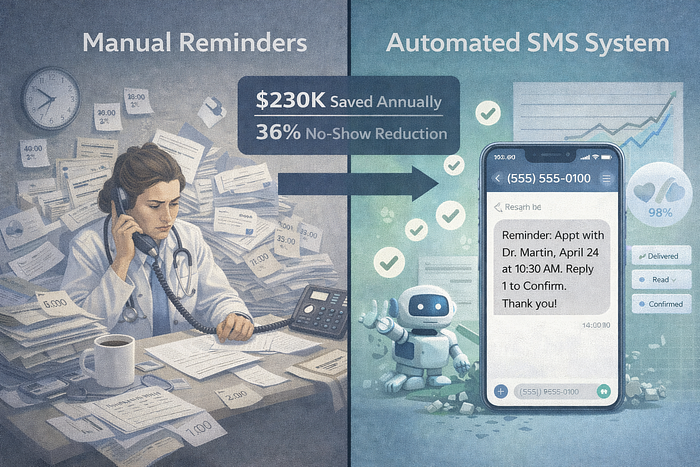
The Builder’s Notes: No-Show Rate Costs Practices $150K/Year — Here’s the Automation That Pays Back in 2 Months
Author(s): Piyoosh Rai Originally published on Towards AI. Manual reminder calls: 260 hours of staff time quarterly, 38% failure rate, $6,500 cost. Automated SMS reminders: 3 seconds per patient, 98% delivery rate, $0.02 cost. The family practice in this case study recovered …
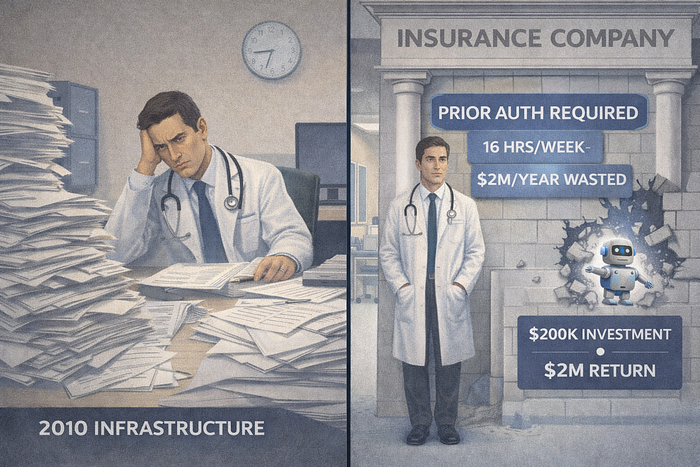
The Builder’s Notes: Prior Authorization Wastes 16 Hours Per Week Per Physician. Here’s What It Actually Costs.
Author(s): Piyoosh Rai Originally published on Towards AI. Physicians spend 16 hours/week fighting insurance companies for treatment approval. That’s $70K/year per doctor in lost productivity. For a 10-physician practice: $2M in time spent on paperwork instead of patients. Here’s the math that …

The Builder’s Notes: I Tested 5 De-Identification Tools on 10,000 Clinical Notes. Most Failed on the Same 3 Edge Cases
Author(s): Piyoosh Rai Originally published on Towards AI. Presidio caught 94% of patient names. The 6% it missed included the only patient who could actually be re-identified. Here’s how to benchmark de-identification tools before they break in production. 99% accuracy on benchmarks. …

The Builder’s Notes: Your CFO Just Called — Except It’s a $2.4M Deepfake and Your AI Approved It
Author(s): Piyoosh Rai Originally published on Towards AI. The fraud alert came through at 3:47 AM. $2.4M wire transfer approved. Biometric voice authentication: passed. Multi-factor authentication: passed. Behavioral analysis: no anomalies detected. The system flagged nothing. By 8:00 AM, the security team …
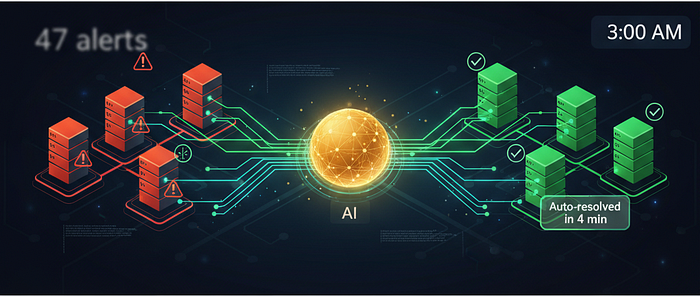
The Builder’s Notes: How We Built Self-Healing AI Infrastructure (Without Burning $2M)
Author(s): Piyoosh Rai Originally published on Towards AI. Our DevOps admin woke up to 47 Slack alerts. By the time she opened her laptop, the system had already fixed itself. Here’s the architecture that makes 3 AM pages disappear. Traditional monitoring alerts …

The Boardroom Brief: The Accountability Gap — Your AI Made the Decision, Now Who Gets Sued?
Author(s): Piyoosh Rai Originally published on Towards AI. Nobody wants to be responsible for AI decisions until something goes catastrophically wrong. Then everyone wants plausible deniability. Here’s why that strategy will destroy your company — and the framework that actually works. When …

The Builder’s Notes: Why AI Systems Break in Production (The Infrastructure No One Talks About)
Author(s): Piyoosh Rai Originally published on Towards AI. Your monitoring stack shows green. Your infrastructure is on fire. This is why 30% of AI projects fail after deployment — not because of the models, but because of the invisible infrastructure no one …

The Unseen Biases Lurking in Generative AI and How They Could Affect You
Author(s): Piyoosh Rai Originally published on Towards AI. Picture this: you ask an AI to create an image of a CEO. It gives you a clean-cut white man in a suit. Ask for a “businesswoman,” and you get a smiling, conventionally attractive …

Universal Deep Research: Beyond Search Engines
Author(s): Piyoosh Rai Originally published on Towards AI. The fundamental difference: Search engines retrieve documents linearly, while deep research systems orchestrate specialized agents across multiple sources, synthesizing evidence and validating findings through interconnected intelligence networks. Why your AI research assistant is just …
Recent Posts