Who Do Autonomous Agents Answer To? The Identity & Governance Problem
Author(s): Manni Arora Originally published on Towards AI. This is Part 2 of a two-part series on Agentic Identity. Part 1: Identity Management for Agentic AI: Making Authentication & Authorization Digestible https://medium.com/towards-artificial-intelligence/identity-management-for-agentic-ai-making-authentication-authorization-digestible-0fc5bb212862 TL;DR Agentic AI challenges traditional IAM by introducing autonomous actors …

Go vs Python vs TypeScript — Which is The Most Efficient in LLM-Assisted Programming?
Author(s): Vikas Tiwari Originally published on Towards AI. Source: Image by the author TypeScript is the most popular language when it comes to LLM assisted programming. In the last year or so TypeScript has been the go to language when it comes …

VI. FastAPI Dependency Injection: The Clean Code Secret
Author(s): Mahimai Raja J Originally published on Towards AI. Dependency Injection sounds standard? In FastAPI, it’s practical magic Today, we will see how to use dependency injection efficiently. I would refere dependency injection as DI sometimes and is more commanly used in …

Reference Architecture for Private AI on Azure: Designing Secure, Compliant, Hybrid LLM Systems
Author(s): Sandip Patel Originally published on Towards AI. Introduction: The Rise of Private AI Over the past two decades working in cloud architecture, I’ve witnessed several technology waves, but Private AI marks a fundamental shift in how enterprises will operate for the …

Visualizing Risk: A Latent World Model for Financial Crisis Hedging
Author(s): Chase Metoyer Originally published on Towards AI. Introduction Financial markets have traditionally been understood through parametric models and stochastic calculus. From Black-Scholes to Heston, quantitative finance relies on mathematical frameworks that treat volatility either as a scalar parameter or as an …
Deploying a TensorFlow Model with TensorFlow Serving and Docker
Author(s): Samith Chimminiyan Originally published on Towards AI. TensorFlow Serving is a powerful tool for deploying machine learning models in a production environment. It allows for easy scaling and management of models, as well as the ability to serve multiple models at …
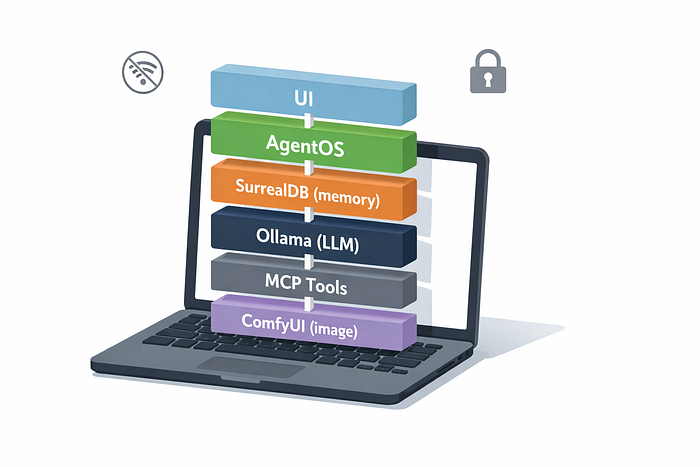
How to Run AI Agents Fully Locally: Memory, Tools, and Models on Your Laptop
Author(s): Luna Originally published on Towards AI. How to Run AI Agents Fully Locally: Memory, Tools, and Models on Your Laptop If you’ve ever tried to build an “agent” that helps with real work (not just a demo), you usually hit the …

LAI #110: Fixing Context Rot and Rethinking How Agents Reason
Author(s): Towards AI Editorial Team Originally published on Towards AI. Good morning, AI enthusiasts, This week, we’re looking at why agent systems drift, confuse themselves, or quietly break when tasks get long. I unpack the real cause of “random” agent degradation: context …

The Context Window Paradox: Engineering Trade-offs in Modern LLM Architecture
Author(s): Shashwata Bhattacharjee Originally published on Towards AI. Introduction: Beyond the Marketing Numbers The AI industry has entered a curious arms race. Anthropic announces 200K tokens. Google counters with 1M. Meta teases 10M. Each announcement generates headlines, yet beneath this numerical escalation …

The Builder’s Notes: Prior Authorization Wastes 16 Hours Per Week Per Physician. Here’s What It Actually Costs.
Author(s): Piyoosh Rai Originally published on Towards AI. Physicians spend 16 hours/week fighting insurance companies for treatment approval. That’s $70K/year per doctor in lost productivity. For a 10-physician practice: $2M in time spent on paperwork instead of patients. Here’s the math that …
Recent Posts