🧠This One Data Science Concept Separates Juniors From Experts
Last Updated on December 2, 2025 by Editorial Team
Author(s): Dewank Mahajan
Originally published on Towards AI.
🧠This One Data Science Concept Separates Juniors From Experts
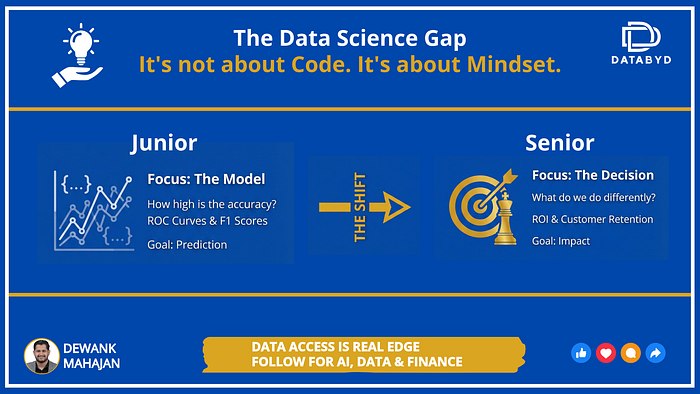
Most people entering data science assume the gap between junior and senior roles is purely technical — that seniors know more algorithms, write cleaner Python, understand modeling at a deeper level, or have stronger math fundamentals. And yes, technical mastery matters; it’s not what actually separates the two.
After years working across banking, fintech, fraud, churn, and AI teams, I learned something surprising: the real divide isn’t technical, it’s mindset.
⭐ The Mindset Shift That Changes Everything
Early in my career, I thought being a “good” data scientist meant building technically impressive models. If the features were engineered well, the metrics looked strong, and the notebook was clean, I believed I was doing great work.
Then one day, during a churn project, everything changed.
I had spent days refining the pipeline — tightening validation, optimizing the threshold, polishing the ROC curve. By the time I presented it to the business team, I felt confident. I expected questions about model accuracy or maybe curiosity about the techniques I used.
Instead, someone on the business side asked a single question that caught me off guard:
“So… what are we supposed to do differently because of this?”
I didn’t have an answer.
I could tell them who was likely to churn, but I couldn’t explain what action the business should take or why it mattered. I had built something technically solid, but strategically empty. That moment hit me hard — not because the model was wrong, but because I was focused on the wrong goal. If your work doesn’t change a decision, it doesn’t create value.

📉 The Junior Way vs. 📈 The Expert Way — A Churn Story
Juniors believe their job is to build models.
Experts understand their job is to shape decisions.
That sounds subtle, but it completely changes how you work, communicate, and create impact. When I first started tackling churn, I approached it exactly how a junior is “supposed to.” I treated it like a modeling competition. My entire mindset was focused on building the best model possible.
I obsessed over accuracy. I tuned hyperparameters like it was a sport. I studied feature importance, validation techniques, ROC curves — all the typical checkpoints.
I walked into the stakeholder meeting ready to “wow” them with metrics.
I said proudly: “We reached 74% recall and improved AUC by 0.05.”
Instead of excitement, I got silence. Business stakeholders asked:
“Okay… but who should we actually target?”
other one said :
“Looks good… but what decisions does this model actually change?”
I had no answer. Because my entire perspective was wrong.
That moment changed everything.
Experts don’t see churn as a prediction problem.
Experts see churn as a decision problem.
A junior sees churn as: positive class = 1.
An expert sees customers in meaningful strategic segments:
- Customers who will churn and won’t respond → don’t waste effort
- Customers who won’t churn but might accept an offer → money wasted
- Customers who will churn and will respond → the ROI segment
- Customers who were never at risk → noise
Once you start thinking like that, accuracy becomes secondary.
The goal isn’t to predict churn.
The goal is to reduce churn.
If I could redo that meeting, the expert version of me would’ve said:
“We found N customers who are high-risk and highly responsive.
Targeting them can reduce churn by 12–15% and protect ~$$$,k in quarterly revenue.
The model doesn’t need to be perfect — it needs to be actionable.”
Same data. Same code. But a completely different impact.
That’s when I realized the real difference:
Juniors talk about models.
Experts talk about decisions.
Stakeholders don’t care about ROC curves or F1 scores — they care about:
- How many customers we can save
- How much they’re worth
- What the offer costs
- How much capacity the team has
- What the ROI looks like
- How confident we are in recommending an action
The model isn’t the hero.
The decision it enables is.
Once I internalized that, my entire approach changed — my conversations, my influence, and my results.
🚀 Why This One Concept Separates Juniors From Experts
Experts walk into every problem with one mental filter:
“How does this influence a real-world decision?”
Everything else the model, the data cleaning, the dashboard, the features becomes a tool to support that decision, not the goal.
And in 2025, when AI can write code, tune hyperparameters, generate pipelines, and even draft baseline models, the one skill that will never be automated is decision thinking 🤝.
That’s why seniors rise faster.
That’s why leaders trust them sooner.
That’s why they get better projects and bigger responsibilities.
They’re not just coding — they’re shaping direction.
They’re not just analyzing — they’re reducing uncertainty.
They’re not just producing outputs — they’re driving outcomes.
🌱 You just need to start every project with a different question:
“What decision is this going to change?”
When you think like that, everything else becomes clearer.
Your work becomes more strategic.
And your career starts moving faster not because you’re working harder, but because you’re thinking smarter.
🌱 That’s the concept that separates juniors from experts.
Once you learn to think this way, your career changes forever.
🚀 Let’s Connect
👉 Follow me here on Medium for more ML insights & case studies.
💡 Join me on LinkedIn for professional takes.
🐦 X • 🎥 TikTok • 📸 Instagram → daily drops & quick hits.
Join thousands of data leaders on the AI newsletter. Join over 80,000 subscribers and keep up to date with the latest developments in AI. From research to projects and ideas. If you are building an AI startup, an AI-related product, or a service, we invite you to consider becoming a sponsor.
Published via Towards AI
Towards AI Academy
We Build Enterprise-Grade AI. We'll Teach You to Master It Too.
15 engineers. 100,000+ students. Towards AI Academy teaches what actually survives production.
Start free — no commitment:
→ 6-Day Agentic AI Engineering Email Guide — one practical lesson per day
→ Agents Architecture Cheatsheet — 3 years of architecture decisions in 6 pages
Our courses:
→ AI Engineering Certification — 90+ lessons from project selection to deployed product. The most comprehensive practical LLM course out there.
→ Agent Engineering Course — Hands on with production agent architectures, memory, routing, and eval frameworks — built from real enterprise engagements.
→ AI for Work — Understand, evaluate, and apply AI for complex work tasks.
Note: Article content contains the views of the contributing authors and not Towards AI.
Related posts
Recent Posts