
Data Normalization in ML
Last Updated on October 11, 2025 by Editorial Team
Author(s): Amna Sabahat
Originally published on Towards AI.
In the realm of machine learning, data preprocessing is not just a preliminary step; it’s the foundation upon which successful models are built. Among all preprocessing techniques, normalization stands out as one of the most critical and frequently applied methods.
Whether you’re building a simple linear regression or a complex ensemble model, understanding and properly implementing normalization can make the difference between model failure and outstanding performance.
This comprehensive guide explores normalization specifically in the context of traditional machine learning, covering its mathematical foundations, practical implementations, and strategic applications across different algorithms.

What is Normalization?
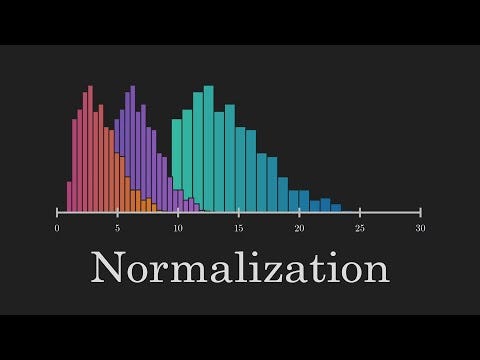
Normalization is the process of scaling numerical data to a standard range or distribution, ensuring that all features (the individual measurable properties or characteristics of the data) contribute equally to the model’s learning process without any single feature dominating due to its inherent scale.

The Fundamental Problem
Consider a customer dataset containing:
Age: 18-65 yearsAnnual Income: $25,000-$150,000Purchase Frequency: 1-20 times per month
Without normalization, distance-based algorithms would assign 1000 times more weight to Annual income differences compared to purchase frequency, resulting in biased models.
Why Normalization is Essential in Machine Learning?
The Problem Without Normalization
Machine learning models will perceive these features based on their raw numerical values. The massive difference in scales causes two major issues:
1. Problem for Distance-Based Algorithms (K-NN, K-Means, SVM)
Imagine we have two customers:
- Customer A: [Age=25, Income=$30,000, Frequency=15]
- Customer B: [Age=60, Income=$140,000, Frequency=5]


Let’s calculate the Euclidean Distance between them:
Distance = √( (25-60)² + (30000-140000)² + (15-5)² )
= √( (-35)² + (-110,000)² + (10)² )
= √( 1225 + 12,100,000,000 + 100 )
≈ √(12,100,000,000) ≈ 110,000
What’s the issue?
The distance is almost entirely determined by the income feature (110,000² = 12.1 billion). The contributions from Age (1225) and Frequency (100) are completely negligible; they are literally one-millionth of the size.
The model will effectively ignore Age and Purchase Frequency, building its logic solely on Income. This is disastrous if Purchase Frequency is actually the most important predictor for your business goal!
2. Problem for Gradient-Based Algorithms (Linear/Logistic Regression, Neural Networks)
These models assign a weight to each feature during training.
- A small change in Income(e.g., +$1,000) leads to a large numerical change in the model's output.
- A large change in Purchase Frequency (e.g., +5 times/month) leads to a relatively small numerical change.
To compensate, the model must assign a tiny weight to Income and a very large weight to Frequency. This creates an unstable, elongated “error valley” that makes the model’s training process (gradient descent) oscillate wildly. This uneven scale makes it difficult for the algorithm to converge (find the optimal solution) efficiently, causing it to learn very slowly, if at all.
The Solution With Normalization
Let’s apply Standardization (a common normalization technique) which rescales data to have a mean of 0 and a standard deviation of 1.
Note: ‘Normalization’ is often used as a general term for scaling techniques. Standardization is one specific, and very common, type of normalization.

After standardization, the data would look something like this:
- Age: Values might range from approx. -1.5 to +1.5
- Annual Income: Values might range from approx. -1.5 to +1.5
- Purchase Frequency: Values might range from approx. -1.5 to +1.5
Now, let’s recalculate the distance between our two customers after standardization:
- Customer A (Standardized): [Age=-0.8, Income=-1.3, Frequency=1.2]
- Customer B (Standardized): [Age=1.2, Income=1.4, Frequency=-0.7]
Distance = √( (-0.8 - 1.2)² + (-1.3 - 1.4)² + (1.2 - (-0.7))² )
= √( (-2.0)² + (-2.7)² + (1.9)² )
= √( 4 + 7.29 + 3.61 ) = √(14.9) ≈ 3.86
The Result:
Now, all three features contribute meaningfully to the distance!
- Age contributed: 4
- Income contributed: 7.29
- Frequency contributed: 3.61
The model can now find natural patterns and similarities based on a balanced combination of all three features, not just the one with the largest dollar values.
Conclusion
Normalization is not merely a technical step but a fundamental prerequisite for building robust and effective machine learning models. As we’ve seen, raw, unscaled data can severely misguide algorithms, causing distance-based models to become biased towards high-magnitude features and gradient-based models to suffer from unstable and inefficient training.
By transforming features onto a common scale, we ensure that each variable contributes equitably to the learning process, allowing the model to uncover the true underlying patterns in the data.
While this article has focused on the critical why behind normalization, the practical how — including detailed explorations of techniques like Min-Max Scaling, Standardization, and Robust Scaling — is a vital next step.
In the following article, we will dive deep into these specific methods, guiding you on when to use each one and how to implement them effectively in your machine learning pipelines.
Join thousands of data leaders on the AI newsletter. Join over 80,000 subscribers and keep up to date with the latest developments in AI. From research to projects and ideas. If you are building an AI startup, an AI-related product, or a service, we invite you to consider becoming a sponsor.
Published via Towards AI
Towards AI Academy
We Build Enterprise-Grade AI. We'll Teach You to Master It Too.
15 engineers. 100,000+ students. Towards AI Academy teaches what actually survives production.
Start free — no commitment:
→ 6-Day Agentic AI Engineering Email Guide — one practical lesson per day
→ Agents Architecture Cheatsheet — 3 years of architecture decisions in 6 pages
Our courses:
→ AI Engineering Certification — 90+ lessons from project selection to deployed product. The most comprehensive practical LLM course out there.
→ Agent Engineering Course — Hands on with production agent architectures, memory, routing, and eval frameworks — built from real enterprise engagements.
→ AI for Work — Understand, evaluate, and apply AI for complex work tasks.
Note: Article content contains the views of the contributing authors and not Towards AI.
Related posts
Recent Posts