Building and Deploying a RAG Application: From PDF Processing to Production
Last Updated on October 11, 2025 by Editorial Team
Author(s): Ashutosh Malgaonkar
Originally published on Towards AI.
Overview
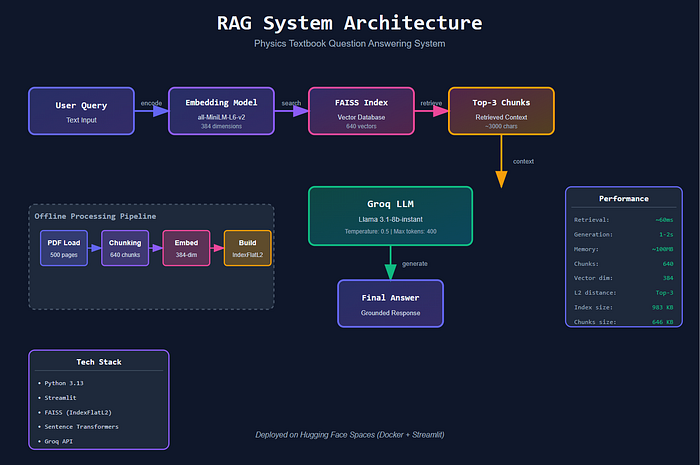
I built a Retrieval-Augmented Generation (RAG) system that answers physics questions by retrieving relevant passages from an AP Physics textbook and generating responses using an LLM. The application processes 500 pages of Electricity chapters content, creates vector embeddings, stores them in a FAISS index, and serves answers through a Streamlit interface deployed on Hugging Face Spaces.
The article describes the development and deployment of a Retrieval-Augmented Generation (RAG) application that efficiently answers physics questions using a customized system. It outlines the entire process, starting from document processing and creating embeddings to search retrieval and answer generation, detailing technical choices such as the tech stack used, including Python, FAISS, and Streamlit. Additionally, the article highlights the importance of accurate prompt engineering to ensure reliable answers and discusses performance characteristics observed during testing on Hugging Face Spaces.
Read the full blog for free on Medium.
Join thousands of data leaders on the AI newsletter. Join over 80,000 subscribers and keep up to date with the latest developments in AI. From research to projects and ideas. If you are building an AI startup, an AI-related product, or a service, we invite you to consider becoming a sponsor.
Published via Towards AI
Towards AI Academy
We Build Enterprise-Grade AI. We'll Teach You to Master It Too.
15 engineers. 100,000+ students. Towards AI Academy teaches what actually survives production.
Start free — no commitment:
→ 6-Day Agentic AI Engineering Email Guide — one practical lesson per day
→ Agents Architecture Cheatsheet — 3 years of architecture decisions in 6 pages
Our courses:
→ AI Engineering Certification — 90+ lessons from project selection to deployed product. The most comprehensive practical LLM course out there.
→ Agent Engineering Course — Hands on with production agent architectures, memory, routing, and eval frameworks — built from real enterprise engagements.
→ AI for Work — Understand, evaluate, and apply AI for complex work tasks.
Note: Article content contains the views of the contributing authors and not Towards AI.
Related posts
Recent Posts