How is Google Aiming At a Trillion Parameter Model (PaLM): Page-by-Page Review
Last Updated on July 17, 2023 by Editorial Team
Author(s): Dr. Mandar Karhade, MD. PhD.
Originally published on Towards AI.
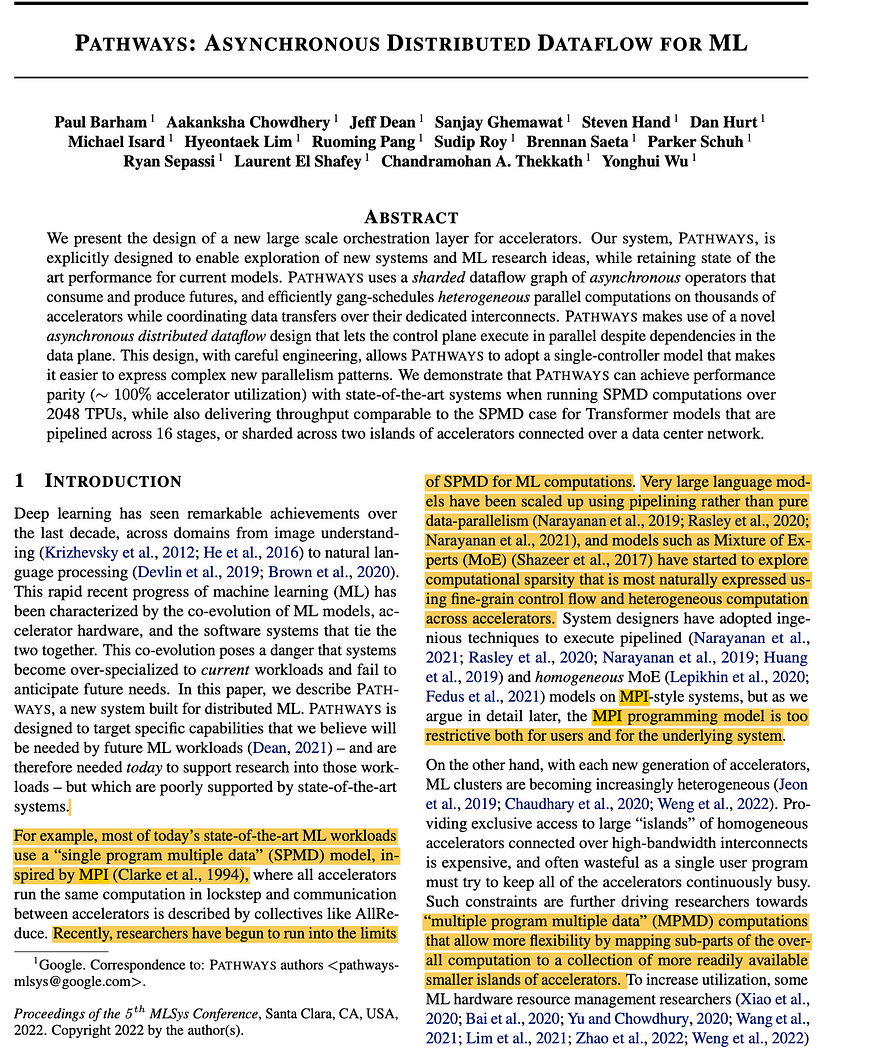
PATHWAYS: ASYNCHRONOUS DISTRIBUTED DATAFLOW FOR ML and Scaling Language Modeling with Pathways
This time I was going to deviate from a usual 1 paper 1 review approach to 2 papers 1 review. The reason is that the Pathways paper (Pathways: Asynchronous Distributed Dataflow for ML) is too technical, while the paper (PaLM: Scaling Language Modeling with Pathways) discusses the application of this architecture into the actual Language Model. The applied paper is good for discussion and has a lot of interesting information. However, after seeing that my article is now 15 minutes long, I decided to split these two into 1 paper per review.
Pathways: Asynchronous Distributed Dataflow for ML
We present the design… Read the full blog for free on Medium.
Join thousands of data leaders on the AI newsletter. Join over 80,000 subscribers and keep up to date with the latest developments in AI. From research to projects and ideas. If you are building an AI startup, an AI-related product, or a service, we invite you to consider becoming a sponsor.
Published via Towards AI
Towards AI Academy
We Build Enterprise-Grade AI. We'll Teach You to Master It Too.
15 engineers. 100,000+ students. Towards AI Academy teaches what actually survives production.
Start free — no commitment:
→ 6-Day Agentic AI Engineering Email Guide — one practical lesson per day
→ Agents Architecture Cheatsheet — 3 years of architecture decisions in 6 pages
Our courses:
→ AI Engineering Certification — 90+ lessons from project selection to deployed product. The most comprehensive practical LLM course out there.
→ Agent Engineering Course — Hands on with production agent architectures, memory, routing, and eval frameworks — built from real enterprise engagements.
→ AI for Work — Understand, evaluate, and apply AI for complex work tasks.
Note: Article content contains the views of the contributing authors and not Towards AI.
Related posts
Recent Posts