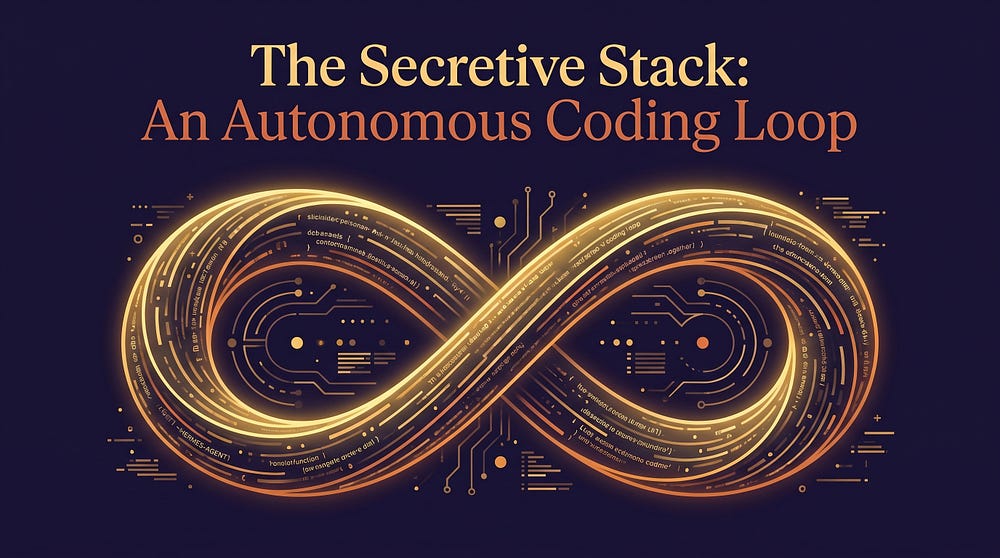
The Secretive Stack: An Autonomous Coding Loop From Four Famous Tools
Last Updated on May 29, 2026 by Editorial Team
Author(s): Anup Karanjkar
Originally published on Towards AI.
Hermes Agent v0.14.0 + Claude Code + Sequential Thinking MCP + Forrest Chang’s Karpathy CLAUDE.md — the combo that ships PRs while you sleep, with the cron template you can run tonight
Nous Research shipped, Hermes Agent v0.14.0 — the Foundation Release. Buried in the 1,393 changed files was a small skill at skills/autonomous-ai-agents/claude-code/SKILL.md that lets Hermes delegate coding work directly to Claude Code via the terminal.
After introducing the thesis that autonomous coding’s bottleneck is now “the wiring,” the article outlines a four-part stack: Hermes Agent (orchestration, scheduling, memory persistence, Telegram gateway), Claude Code (terminal executor that writes/runs/tests/opens PRs), Sequential Thinking MCP (structured, branching reasoning to prevent catastrophic mistakes in unattended runs), and Forrest Chang’s Karpathy CLAUDE.md (a discipline file that constrains behavior with explicit principles). It explains two key integration points: Hermes v0.14.0 includes a bundled Claude Code delegation skill enabling print-mode one-shot tasks from cron, and both Hermes and Claude Code load the same CLAUDE.md discipline principles from the repo for consistent behavior. The piece then provides an end-to-end loop diagram (GitHub issue selection → Claude Code execution in print mode → JSON output parsing → Telegram summary) and shares three nights of observed results (PRs opened, merged vs rejected, wall-clock time, and average inference cost), plus a 90-day projection emphasizing that economics can be defensible with a human review gate. Finally, it documents surprise configuration failure modes (CLAUDE.md conflicts, too-short terminal timeouts, MCP cold-start latency) and gives a practical “ship by Tuesday” checklist: update/install components, add the reasoning discipline section, configure Hermes cron with constraints/budgets/timeouts, tag scoped issues, run a dry run, and set an initial review gate; it concludes with monitoring signals (merge rate, adjacency violations, cost per merged PR) and a projected verdict if discipline holds.
Read the full blog for free on Medium.
Join thousands of data leaders on the AI newsletter. Join over 80,000 subscribers and keep up to date with the latest developments in AI. From research to projects and ideas. If you are building an AI startup, an AI-related product, or a service, we invite you to consider becoming a sponsor.
Published via Towards AI
Towards AI Academy
We Build Enterprise-Grade AI. We'll Teach You to Master It Too.
15 engineers. 100,000+ students. Towards AI Academy teaches what actually survives production.
Start free — no commitment:
→ 6-Day Agentic AI Engineering Email Guide — one practical lesson per day
→ Agents Architecture Cheatsheet — 3 years of architecture decisions in 6 pages
Our courses:
→ AI Engineering Certification — 90+ lessons from project selection to deployed product. The most comprehensive practical LLM course out there.
→ Agent Engineering Course — Hands on with production agent architectures, memory, routing, and eval frameworks — built from real enterprise engagements.
→ AI for Work — Understand, evaluate, and apply AI for complex work tasks.
Note: Article content contains the views of the contributing authors and not Towards AI.
Related posts
Recent Posts