How to Run AI Agents Fully Locally: Memory, Tools, and Models on Your Laptop
Last Updated on January 20, 2026 by Editorial Team
Author(s): Luna
Originally published on Towards AI.
How to Run AI Agents Fully Locally: Memory, Tools, and Models on Your Laptop
If you’ve ever tried to build an “agent” that helps with real work (not just a demo), you usually hit the same wall quickly: your data leaves the machine, costs become unpredictable, and the whole setup is hard to reproduce, even for yourself a week later.
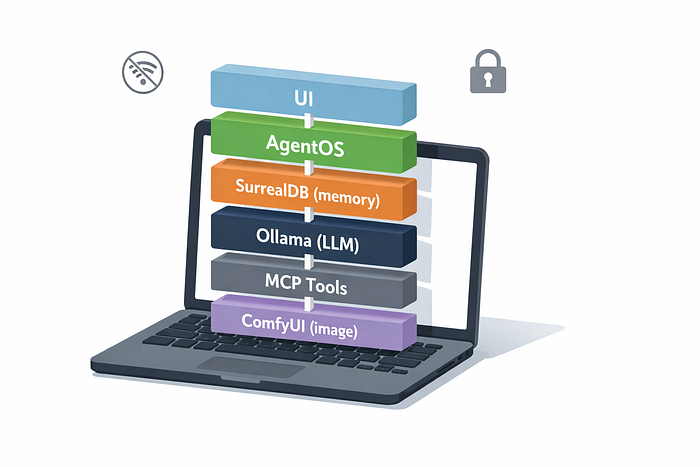
This article presents an approach to creating a full-local agent stack that runs models, stores memory, and separates tools, allowing for predictable performance, privacy, and the ability to run operations offline. It discusses the architecture and components required to set up such a stack, including Agno for orchestration, SurrealDB for memory management, and Ollama for local LLM serving, along with practical use cases for user memory, document handling, and multimodal workflows using ComfyUI. The article underscores the significance of clear boundaries in the system to ensure safety and maintain a manageable codebase.
Read the full blog for free on Medium.
Join thousands of data leaders on the AI newsletter. Join over 80,000 subscribers and keep up to date with the latest developments in AI. From research to projects and ideas. If you are building an AI startup, an AI-related product, or a service, we invite you to consider becoming a sponsor.
Published via Towards AI
Towards AI Academy
We Build Enterprise-Grade AI. We'll Teach You to Master It Too.
15 engineers. 100,000+ students. Towards AI Academy teaches what actually survives production.
Start free — no commitment:
→ 6-Day Agentic AI Engineering Email Guide — one practical lesson per day
→ Agents Architecture Cheatsheet — 3 years of architecture decisions in 6 pages
Our courses:
→ AI Engineering Certification — 90+ lessons from project selection to deployed product. The most comprehensive practical LLM course out there.
→ Agent Engineering Course — Hands on with production agent architectures, memory, routing, and eval frameworks — built from real enterprise engagements.
→ AI for Work — Understand, evaluate, and apply AI for complex work tasks.
Note: Article content contains the views of the contributing authors and not Towards AI.
Related posts
Recent Posts