Top 20 Regularization Interview Questions and Answers
Last Updated on December 29, 2025 by Editorial Team
Author(s): Shahidullah Kawsar
Originally published on Towards AI.
Machine Learning Interview Preparation Part 03 Solution
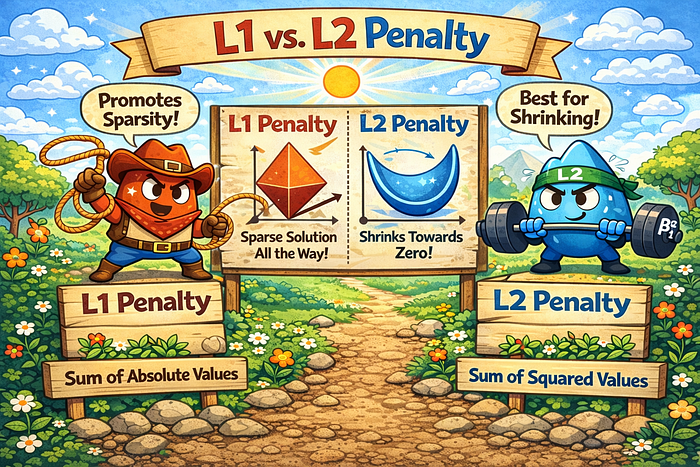
Regularization in machine learning means putting limits on a model so it does not become too complicated. It is like guardrails on a road that help keep a car on track. These limits stop the model from memorizing the training data and instead help it learn useful patterns. As a result, the model works better on new data it has never seen before and is more reliable in real-world use.
This article provides a set of 20 regularization-related interview questions and answers aimed at helping candidates prepare for machine learning interviews. It explains key concepts related to Ridge and Lasso regression, including their definitions, advantages, and correct interpretations of their parameters. Each question is followed by a concise explanation of the correct answer, elucidating how regularization techniques can help mitigate overfitting and improve model performance.
Read the full blog for free on Medium.
Join thousands of data leaders on the AI newsletter. Join over 80,000 subscribers and keep up to date with the latest developments in AI. From research to projects and ideas. If you are building an AI startup, an AI-related product, or a service, we invite you to consider becoming a sponsor.
Published via Towards AI
Towards AI Academy
We Build Enterprise-Grade AI. We'll Teach You to Master It Too.
15 engineers. 100,000+ students. Towards AI Academy teaches what actually survives production.
Start free — no commitment:
→ 6-Day Agentic AI Engineering Email Guide — one practical lesson per day
→ Agents Architecture Cheatsheet — 3 years of architecture decisions in 6 pages
Our courses:
→ AI Engineering Certification — 90+ lessons from project selection to deployed product. The most comprehensive practical LLM course out there.
→ Agent Engineering Course — Hands on with production agent architectures, memory, routing, and eval frameworks — built from real enterprise engagements.
→ AI for Work — Understand, evaluate, and apply AI for complex work tasks.
Note: Article content contains the views of the contributing authors and not Towards AI.
Related posts
Recent Posts