This Python Package Makes Differentiable Physics Simulations Practical
Last Updated on January 2, 2026 by Editorial Team
Author(s): Gowtham Boyina
Originally published on Towards AI.
It’s from NVIDIA, it's not CUDA
I’ve spent way too long fighting with CUDA just to prototype a simple physics simulation. You either hand-roll low-level kernels in C++ — which breaks your Python workflow — or you accept glacial performance from NumPy or pure PyTorch. Neither option feels right if you’re iterating fast in research or building spatial computing pipelines.
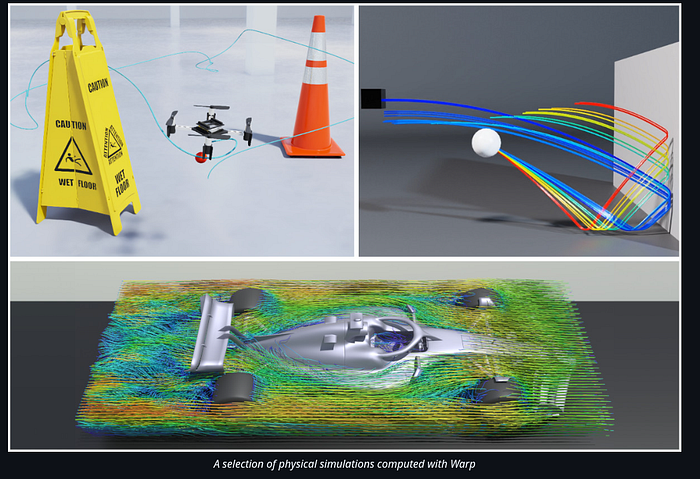
Warp is a Python framework that enables high-performance, differentiable physics simulations without the typical hassle of CUDA programming. It provides a domain-specific language with a Just-In-Time (JIT) compiler that translates Python functions into optimized CPU or GPU kernels, allowing for seamless integration with existing machine learning frameworks. Warp is particularly effective for applications in robotics, geometry processing, and spatial computing, offering built-in geometric primitives and advanced differentiability features that enhance simulation capabilities and ease the prototyping process for researchers and developers working in these domains.
Read the full blog for free on Medium.
Join thousands of data leaders on the AI newsletter. Join over 80,000 subscribers and keep up to date with the latest developments in AI. From research to projects and ideas. If you are building an AI startup, an AI-related product, or a service, we invite you to consider becoming a sponsor.
Published via Towards AI
Towards AI Academy
We Build Enterprise-Grade AI. We'll Teach You to Master It Too.
15 engineers. 100,000+ students. Towards AI Academy teaches what actually survives production.
Start free — no commitment:
→ 6-Day Agentic AI Engineering Email Guide — one practical lesson per day
→ Agents Architecture Cheatsheet — 3 years of architecture decisions in 6 pages
Our courses:
→ AI Engineering Certification — 90+ lessons from project selection to deployed product. The most comprehensive practical LLM course out there.
→ Agent Engineering Course — Hands on with production agent architectures, memory, routing, and eval frameworks — built from real enterprise engagements.
→ AI for Work — Understand, evaluate, and apply AI for complex work tasks.
Note: Article content contains the views of the contributing authors and not Towards AI.
Related posts
Recent Posts