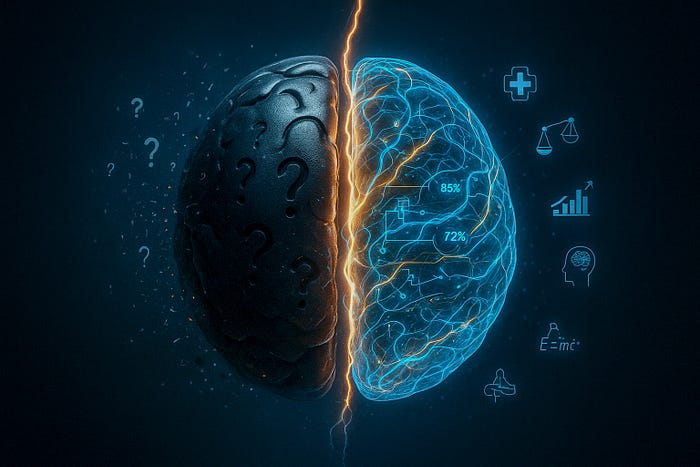
The Next AI Revolution: When Machines Learn to Think About Thinking
Last Updated on October 18, 2025 by Editorial Team
Author(s): Rohan Mistry
Originally published on Towards AI.
What happens when AI catches its own lies before you do?
ChatGPT just gave you a wrong answer.
You ask it why.
This article explores the significant limitations of current AI systems, particularly their inability to reflect on their own reasoning and catch mistakes. It discusses the emerging concept of Metacognitive AI, which aims to enable machines to understand and improve their thought processes, leading to self-awareness and enhanced performance in various applications, including medical diagnosis, legal analysis, and financial advisory. The author emphasizes the importance of transparency, trust, and collaboration between humans and AI in the future of technology, ultimately positioning Metacognitive AI as a transformative leap in artificial intelligence.
Read the full blog for free on Medium.
Join thousands of data leaders on the AI newsletter. Join over 80,000 subscribers and keep up to date with the latest developments in AI. From research to projects and ideas. If you are building an AI startup, an AI-related product, or a service, we invite you to consider becoming a sponsor.
Published via Towards AI
Towards AI Academy
We Build Enterprise-Grade AI. We'll Teach You to Master It Too.
15 engineers. 100,000+ students. Towards AI Academy teaches what actually survives production.
Start free — no commitment:
→ 6-Day Agentic AI Engineering Email Guide — one practical lesson per day
→ Agents Architecture Cheatsheet — 3 years of architecture decisions in 6 pages
Our courses:
→ AI Engineering Certification — 90+ lessons from project selection to deployed product. The most comprehensive practical LLM course out there.
→ Agent Engineering Course — Hands on with production agent architectures, memory, routing, and eval frameworks — built from real enterprise engagements.
→ AI for Work — Understand, evaluate, and apply AI for complex work tasks.
Note: Article content contains the views of the contributing authors and not Towards AI.
Related posts
Recent Posts