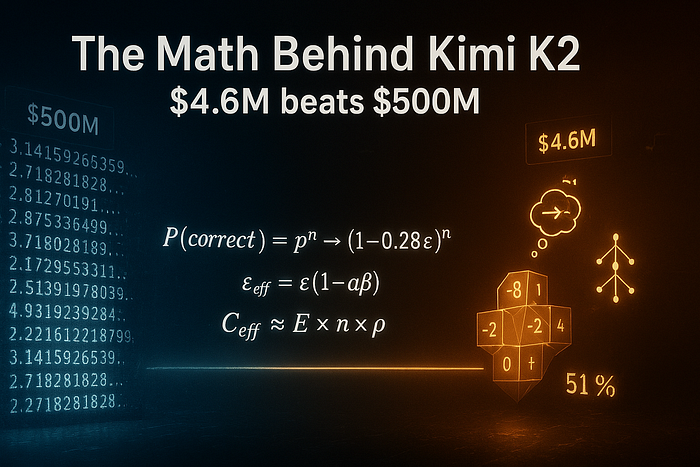
The Math Behind Kimi K2: How a Chinese Startup Beat Silicon Valley at 1% of the Cost
Last Updated on November 13, 2025 by Editorial Team
Author(s): DrSwarnenduAI
Originally published on Towards AI.
A complete mathematical breakdown of three architectural innovations that let $4.6M beat $500M — with proofs, intuition, and the blueprint for understanding
I’ve spent the last 72 hours obsessively reverse-engineering Kimi K2’s architecture.
The article explains how the Kimi K2 model, designed by a Chinese startup, outperforms larger models like GPT-5 on crucial AI tests while significantly reducing costs. It discusses the underlying mathematics and architectural innovations that enable Kimi K2 to work effectively, including interleaved thinking, quantization, and expert routing systems. The piece emphasizes the importance of process over mere scaling in AI, proposing that thoughtful design leads to more efficient models compared to simply increasing the number of parameters or computational resources.
Read the full blog for free on Medium.
Join thousands of data leaders on the AI newsletter. Join over 80,000 subscribers and keep up to date with the latest developments in AI. From research to projects and ideas. If you are building an AI startup, an AI-related product, or a service, we invite you to consider becoming a sponsor.
Published via Towards AI
Towards AI Academy
We Build Enterprise-Grade AI. We'll Teach You to Master It Too.
15 engineers. 100,000+ students. Towards AI Academy teaches what actually survives production.
Start free — no commitment:
→ 6-Day Agentic AI Engineering Email Guide — one practical lesson per day
→ Agents Architecture Cheatsheet — 3 years of architecture decisions in 6 pages
Our courses:
→ AI Engineering Certification — 90+ lessons from project selection to deployed product. The most comprehensive practical LLM course out there.
→ Agent Engineering Course — Hands on with production agent architectures, memory, routing, and eval frameworks — built from real enterprise engagements.
→ AI for Work — Understand, evaluate, and apply AI for complex work tasks.
Note: Article content contains the views of the contributing authors and not Towards AI.
Related posts
Recent Posts