Tencent Built a Billion-Parameter Model That Generates 3D Motion From Text
Last Updated on January 3, 2026 by Editorial Team
Author(s): Gowtham Boyina
Originally published on Towards AI.
And It’s the First to Scale DiT This Far
I’ve watched text-to-motion generation struggle with the same problem for years: models either understand prompts decently but generate stiff, unnatural movement, or they produce smooth motion but can’t follow complex instructions. The trade-off has been frustrating — you get one or the other, rarely both.
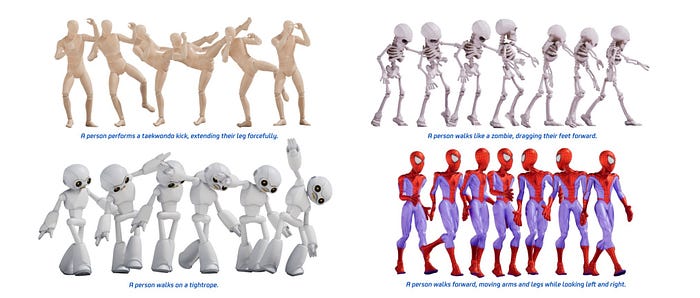
Tencent’s release of HY-Motion 1.0 introduces a significant advancement in text-to-motion generation by utilizing a billion-parameter Diffusion Transformer (DiT) model that excels in both motion quality and instruction following. The architecture employs a unique three-stage training process to enhance performance, where initial broad training on extensive datasets is followed by fine-tuning and reinforcement learning from human feedback. This allows the model to generate naturalistic 3D animations, revolutionizing applications in game development, film production, and AI companions, while also highlighting hardware limitations and focusing on humanoid characters exclusively.
Read the full blog for free on Medium.
Join thousands of data leaders on the AI newsletter. Join over 80,000 subscribers and keep up to date with the latest developments in AI. From research to projects and ideas. If you are building an AI startup, an AI-related product, or a service, we invite you to consider becoming a sponsor.
Published via Towards AI
Towards AI Academy
We Build Enterprise-Grade AI. We'll Teach You to Master It Too.
15 engineers. 100,000+ students. Towards AI Academy teaches what actually survives production.
Start free — no commitment:
→ 6-Day Agentic AI Engineering Email Guide — one practical lesson per day
→ Agents Architecture Cheatsheet — 3 years of architecture decisions in 6 pages
Our courses:
→ AI Engineering Certification — 90+ lessons from project selection to deployed product. The most comprehensive practical LLM course out there.
→ Agent Engineering Course — Hands on with production agent architectures, memory, routing, and eval frameworks — built from real enterprise engagements.
→ AI for Work — Understand, evaluate, and apply AI for complex work tasks.
Note: Article content contains the views of the contributing authors and not Towards AI.
Related posts
Recent Posts