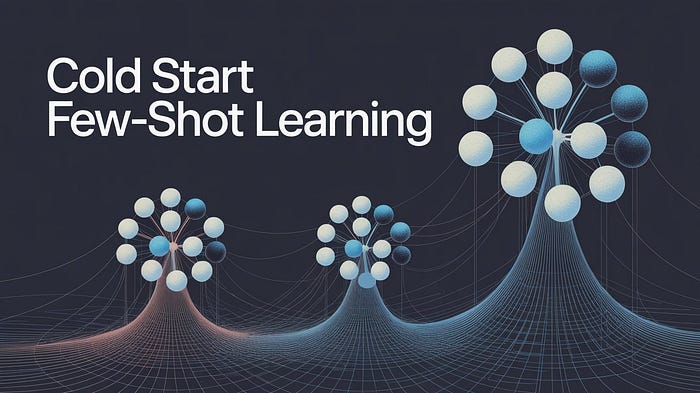
Solving the Cold-Start Problem in Few-Shot Learning: From Prototypes to Production
Last Updated on May 29, 2026 by Editorial Team
Author(s): Akash Dogra
Originally published on Towards AI.
Solving the Cold-Start Problem in Few-Shot Learning: From Prototypes to Production
Your model has three images. Your boss wants 99% accuracy. Here’s the engineering playbook that actually works.

The Factory That Couldn’t Wait
Picture this: a brand-new aerospace manufacturing facility. Optical sorters, freshly calibrated, scanning machined turbine blades for microscopic defects. Then something unexpected happens — a sudden shift in ambient humidity triggers a novel type of thermal micro-fracture that nobody has seen before.
The quality team captures exactly three images of this defect.
Three.
The deep learning model powering the inspection line needs to detect this fracture immediately. The alternative? Waiting for ten thousand defective parts to roll through the line, scrapping millions of dollars in material and risking catastrophic downstream failures.
This isn’t a hypothetical. This is the cold-start problem and it’s one of the most painful, least-discussed failure modes in production machine learning.
Standard supervised learning assumes you have abundance. Thousands of labeled examples, identically distributed, carefully curated. Deep neural networks with their millions of parameters are essentially massive function approximators that need enormous datasets to carve out robust decision boundaries.
Hand them three images, and they do what any desperate student with a cheat sheet does: memorize. They overfit to pixel noise, lighting conditions, background artifacts — everything except the semantic core of the defect class.
Even transfer learning, the go-to lifeline, breaks down here. A ResNet-50 pretrained on ImageNet has learned to distinguish golden retrievers from German shepherds. Those feature extractors — optimized for fur textures, ear shapes, and grassland backgrounds — are actively counterproductive when diagnosing metallic micro-fractures on titanium alloy surfaces.
The cascading failure modes are brutal:
- Severe overfitting: brittle representations that shatter on real-world query data.
- Catastrophic miscalibration: the model outputs 99% confidence on completely wrong predictions.
- Domain collapse: even slight environmental drift from support-set conditions destroys performance.
This reframes the entire challenge. The question isn’t “how do I train with more data?” — it’s:
How do I build a model that can generalize from almost nothing?
Three Families, Three Philosophies
The field of few-shot learning (FSL) has developed three fundamentally different answers to that question. These aren’t just algorithmic variations — they represent distinct philosophies about where the capacity for generalization lives.

1. Metric-Based: “Generalization is geometry”
The bet: if a neural network can map complex inputs into a structured embedding space where similar things cluster together, then classification becomes simple distance measurement. No retraining needed — just store the new class’s prototype and compute nearest neighbors.
Strengths: Dead simple in production. Zero gradient updates at inference. Weakness: The learned metric is fragile, domain shifts destroy the geometric structure. Key methods: Siamese Networks, Matching Networks, Prototypical Networks.
2. Optimization-Based: “Generalization is momentum”
The bet: instead of learning a static space, learn the optimal starting position in parameter space an initialization so good that a handful of gradient steps on any new task yields a strong classifier.
Strengths: Universal. Works with any architecture and any differentiable loss. Weakness: Computationally nightmarish. Second-order gradients. Notoriously unstable. Key methods: MAML, Reptile, FOMAML
3. Augmentation/Representation-Based: “Generalization is structure”
The bet: learn incredibly robust, invariant representations without labels. If a model can recognize that an object remains the same despite heavy blurring, color jitter, and cropping, it has internalized the actual physical properties of the subject.
Strengths: Profound domain robustness. Transfers beautifully. Weakness: Requires massive unlabeled data and enormous compute for pretraining. Key methods: SimCLR, MoCo, BYOL
Deep Dive: Prototypical Networks — The Geometry of Generalization
Of all metric-based methods, Prototypical Networks have earned the widest adoption in production. The reason is elegance: they formalize the intuition that every class has an ideal representative point — a prototype — in embedding space.

Here’s how it works:
Step 1: Pass every support image through a shared encoder f_θ, producing embeddings in ℝ^M.
Step 2: For each class k, compute the prototype c_k as the mean of that class’s support embeddings:

Step 3: For a new query x, embed it and compute the squared Euclidean distance to each prototype.
Step 4: Apply softmax over the negative distances to get classification probabilities:

Why squared Euclidean instead of cosine similarity? It’s a Bregman divergence which guarantees the mean is the optimal cluster representative for exponential family distributions.
A Worked Example
Let’s make this concrete with a 3-way, 2-shot problem in 2D space in pytorch:
import torch
import torch.nn.functional as F

def compute_prototypes(support_embeddings, labels, num_classes):
 """Compute class prototypes by averaging support embeddings."""
 prototypes = []
 for k in range(num_classes):
 class_mask = (labels == k)
 class_embeddings = support_embeddings[class_mask]
 prototype = class_embeddings.mean(dim=0)
 prototypes.append(prototype)
 return torch.stack(prototypes)

def classify_query(query_embeddings, prototypes):
 """Classify queries via squared Euclidean distance to prototypes."""
 # Broadcast: [Q, 1, dim] vs [1, C, dim]
 q = query_embeddings.unsqueeze(1)
 p = prototypes.unsqueeze(0)
 distances = torch.sum((q - p) ** 2, dim=2) # [Q, C]
 return F.softmax(-distances, dim=1)
The main limitation? Prototypical Networks assume classes form perfect, isotropic Gaussian clusters. Under severe domain shift, this assumption shatters — clusters overlap, prototypes become meaningless, and classification degrades to random guessing.
Deep Dive: MAML — Training Models That Learn to Learn
While metric learning creates a static embedding space, Model-Agnostic Meta-Learning (MAML) takes a fundamentally different approach: it doesn’t learn representations — it learns the optimal starting position for gradient descent.

The core idea: if a model is initialized at exactly the right point in parameter space, then just one or two gradient steps on a tiny support set should produce a highly accurate task-specific classifier.
MAML achieves this through episodic training with two nested loops:
1. The Inner Loop (Task Adaptation): For each sampled task T_i, take the global parameters θ and adapt them using the task’s support set:

This creates a temporary, task-specific branch — it doesn’t permanently alter θ.
2. The Outer Loop (Meta-Optimization): Evaluate how well that adaptation worked by computing the loss on the task’s query set using θ’_i. Then update the global θ to minimize this evaluation loss across all tasks:

The outer loop asks: “How should I shift the starting weights so that the inner-loop update on any small dataset yields maximum performance?”
The Second-Order Gradient Challenge
Here’s where it gets computationally intense. Since θ’_i is itself a function of θ (through the inner gradient step), the outer-loop derivative requires differentiating through the gradient — computing a Hessian matrix. In PyTorch, this demands create_graph=True during the inner backward pass.
import torch
from torch.autograd import grad

def meta_train_step(model, task_batch, alpha, beta, optimizer, loss_fn):
 meta_loss = 0.0
 theta = list(model.parameters())
 for task in task_batch:
 support_x, support_y = task['support']
 query_x, query_y = task['query']
 # === INNER LOOP ===
 support_preds = model(support_x)
 inner_loss = loss_fn(support_preds, support_y)
 # create_graph=True → enables 2nd-order differentiation
 inner_grads = grad(inner_loss, theta, create_graph=True)
 theta_prime = [p - alpha * g for p, g in zip(theta, inner_grads)]
 # === OUTER LOOP ===
 query_preds = functional_forward(model, theta_prime, query_x)
 meta_loss += loss_fn(query_preds, query_y)
 optimizer.zero_grad()
 meta_loss.backward() # Second-order gradients computed here
 optimizer.step()
First-Order MAML (FOMAML) drops the Hessian entirely, treating inner gradients as constants. Reptile goes further — just run SGD on each task for a few steps, then interpolate global weights toward the task-specific ones. Both are dramatically cheaper to train.
The production reality: MAML is notoriously difficult to tune. If your application requires repeated, real-time personalization (adapting to individual users’ behavior), the episodic structure shines. But if you just need to recognize a few new visual classes? Metric methods almost always win on deployment stability and engineering simplicity.
The Reality Check: Why Few-Shot Models Fail in Production
Here’s the uncomfortable truth that most few-shot learning papers gloss over: academic benchmarks lie.
Datasets like Omniglot and miniImageNet enforce a closed-world assumption — the training and test tasks come from the exact same statistical distribution. In production, this assumption is almost always violated.

This is domain shift — the primary assassin of few-shot systems in the wild.
Formally, let P_s(X,Y) be the source distribution and P_t(X,Y) be the target distribution. When P_s ≠ P_t, everything breaks. The most common variant is covariate shift: the features change (P_s(X) ≠ P_t(X)) even though the underlying label logic stays the same.
A model trained on bright, high-resolution natural images gets deployed to classify dark, low-contrast medical scans. Same task, completely different visual statistics.
How Each Method Collapses
Prototypical Networks: The encoder produces corrupted embeddings in the target domain. Prototypes fall into arbitrary coordinates. Queries project into overlapping, indistinguishable regions → near-random accuracy.
MAML: The meta-learned initialization θ was carefully positioned as a saddle point in the source loss landscape. Target-domain gradients point in entirely wrong directions → the model descends into catastrophic parameter configurations.
Confidence calibration: Under domain shift + few-shot constraints, models output near-100% confidence on completely wrong predictions. The metric space contracts unnaturally, and the system cannot assess its own uncertainty.
This isn’t a minor performance degradation. It’s structural collapse. And fixing it requires going beyond supervised learning entirely.
The First Fix: Contrastive Pretraining — Features That Survive the Shift
The key insight: supervised pretraining is the problem, not the solution.
A model trained via cross-entropy on 1,000 ImageNet categories dedicates massive parameter capacity to distinguishing minute differences between dog breeds and car models. Deploy that model to classify industrial X-rays, and those “golden retriever vs. labrador” feature channels activate chaotically on metallic textures.
Contrastive pretraining — methods like SimCLR, MoCo, and BYOL — takes the opposite approach. It throws away labels entirely. Instead, the model learns to recognize that an object remains the same object despite heavy Gaussian blurring, severe color jitter, random cropping, and missing patches.

The InfoNCE Loss
The mathematical engine is the InfoNCE (Noise Contrastive Estimation) loss:

Where:
- z_i = embedding of the anchor image
- z_i⁺ = embedding of a heavily augmented version of the same image (positive pair)
- z_j = embeddings of different images in the batch (negatives)
- sim(·,·) = cosine similarity
- τ = temperature (controls separation strictness)
The temperature isn’t just a scaling factor. Lower τ forces the model to heavily penalize the hardest negatives — images that look similar but are actually different. In cross-domain settings, adaptive temperature control forces the model to discriminate based on domain-invariant attributes rather than superficial visual styles.
Why This Works for Cross-Domain Few-Shot
Contrastive models learn universal visual primitives — edges, textures, spatial relationships — untainted by label bias. When deployed to a target domain:
- Freeze the contrastive backbone (no gradient updates = no overfitting risk)
- Attach a Prototypical Network head directly to the embeddings
- The tiny target support set only needs to establish class geometry — the hard work of feature extraction is already done
import torch
import torch.nn as nn

class ContrastiveFewShotModel(nn.Module):
 def __init__(self, contrastive_backbone):
 super().__init__()
 self.encoder = contrastive_backbone
 # Freeze: prevent catastrophic overfitting to tiny support set
 for param in self.encoder.parameters():
 param.requires_grad = False
 def forward(self, support_x, query_x, support_y, num_classes):
 with torch.no_grad():
 z_support = self.encoder(support_x)
 z_query = self.encoder(query_x)
 prototypes = compute_prototypes(z_support, support_y, num_classes)
 return classify_query(z_query, prototypes)
By decoupling representation learning (self-supervision on massive diverse data) from adaptation (metric geometry on the tiny target set), you get systems that are fundamentally resistant to domain shock.
The Second Fix: Adversarial Domain Adaptation — Training a Model to Forget
Contrastive pretraining builds generally robust features. But what if you have something even more powerful: a large labeled source dataset and a massive stream of unlabeled target data from the deployment environment?
In this scenario, you can explicitly force the network to erase the domain gap using a Domain-Adversarial Neural Network (DANN).

The Architecture
DANN uses three components locked in an adversarial game:
- Feature Extractor (G_f): Encodes raw inputs into latent representations
- Label Predictor (G_y): Classifies using labeled source data (the primary task)
- Domain Classifier (G_d): Tries to guess whether an embedding came from source or target
The trick: the model is trained to excel at classification while deliberately failing at domain identification. If the domain classifier can’t tell source from target (50% accuracy), the feature distributions have been successfully aligned.
The objective:

The Gradient Reversal Layer: A Beautiful Hack
How do you maximize one loss while minimizing another in a single backward pass? The Gradient Reversal Layer (GRL) — one of the most elegant tricks in deep learning.
During the forward pass: identity function (passes features through unchanged). During the backward pass: multiplies gradients by −λ before sending them to the encoder.
The encoder’s weights get updated in the direction that increases the domain classifier’s confusion — systematically destroying any features that reveal which domain the input came from.
import torch
from torch.autograd import Function
import torch.nn as nn

class GradientReversal(Function):
 @staticmethod
 def forward(ctx, x, alpha):
 ctx.alpha = alpha
 return x.view_as(x) # Pure identity
 @staticmethod
 def backward(ctx, grad_output):
 return grad_output * -ctx.alpha, None # Flip the gradient
class GRL(nn.Module):
 def __init__(self, alpha=1.0):
 super().__init__()
 self.alpha = alpha
 def forward(self, x):
 return GradientReversal.apply(x, self.alpha)
The Catch — and Why Few-Shot Labels Save It
DANN aligns global feature distributions. But it can accidentally align source “Class A” with target “Class B” if their geometric shapes are vaguely similar.
This is where few-shot labels become semantic anchors. The adversarial loss handles global distribution alignment using massive unlabeled data, while the few target labels pin specific class clusters to their correct positions. It’s a beautiful marriage of unsupervised alignment and supervised precision.
The Deployment Playbook: Four Rules for Production

Translating theory into production requires a systematic selection process based on environmental constraints, not benchmark scores:
Rule 1: Tiny support set + No domain gap → Prototypical Networks
When source and target share the same distribution (e.g., classifying a new animal species with an ImageNet-trained model), complexity is your enemy. Freeze the backbone, compute prototypes, done. Zero risk of catastrophic forgetting, infinitely scalable.
Rule 2: Continuous user-specific adaptation needed → MAML / Reptile
When the model must branch into thousands of personalized states — adapting to individual users’ handwriting, linguistic quirks, or behavioral patterns — the episodic structure of meta-learning shines. The model is designed to adapt quickly in the final layer.
Rule 3: Catastrophic domain gap + Unlabeled target data → Contrastive + DANN
If source = natural RGB images and target = thermal imaging or microscopy, direct metric learning will collapse immediately. Build a domain-specific backbone with contrastive pretraining, then align domains adversarially. Use the few target labels as anchors.
Rule 4: Foundation model available + Compute unrestricted → Linear Probe / Prompting
Before building a complex episodic training loop, check if a massive pretrained VLM already knows the answer. A simple logistic regression on top of a foundational embedding (linear probe) often outperforms specialized few-shot architectures.
Comparison Matrix

The Takeaway
Few-shot learning is no longer just about making models work with less data. It’s about designing dynamic, resilient systems that adapt intelligently when data arrives late, unevenly, and from the completely wrong domain.
The engineering playbook is clear:
- Start with the strongest possible backbone – contrastive or foundation-model pretrained.
- Use metric geometry for adaptation – prototypes for stability, MAML only when personalization demands it.
- Bridge domain gaps adversarially – DANN + few-shot labels as semantic anchors.
- Never trust calibration under domain shift – always build in uncertainty estimation.
Your model has three images. Now you have the architecture to make them count.
Tags: Machine Learning, Few-Shot Learning, Deep Learning, Data Science, Artificial Intelligence
Join thousands of data leaders on the AI newsletter. Join over 80,000 subscribers and keep up to date with the latest developments in AI. From research to projects and ideas. If you are building an AI startup, an AI-related product, or a service, we invite you to consider becoming a sponsor.
Published via Towards AI
Towards AI Academy
We Build Enterprise-Grade AI. We'll Teach You to Master It Too.
15 engineers. 100,000+ students. Towards AI Academy teaches what actually survives production.
Start free — no commitment:
→ 6-Day Agentic AI Engineering Email Guide — one practical lesson per day
→ Agents Architecture Cheatsheet — 3 years of architecture decisions in 6 pages
Our courses:
→ AI Engineering Certification — 90+ lessons from project selection to deployed product. The most comprehensive practical LLM course out there.
→ Agent Engineering Course — Hands on with production agent architectures, memory, routing, and eval frameworks — built from real enterprise engagements.
→ AI for Work — Understand, evaluate, and apply AI for complex work tasks.
Note: Article content contains the views of the contributing authors and not Towards AI.
Related posts
Recent Posts