


NVIDIA’s Silicon Empire: The Hidden Forces Shaping AI’s Future
Last Updated on February 9, 2026 by Editorial Team
Author(s): Wahidur Rahman
Originally published on Towards AI.
How one company’s control over AI chips, software, and supply chains is rewriting the rules of innovation
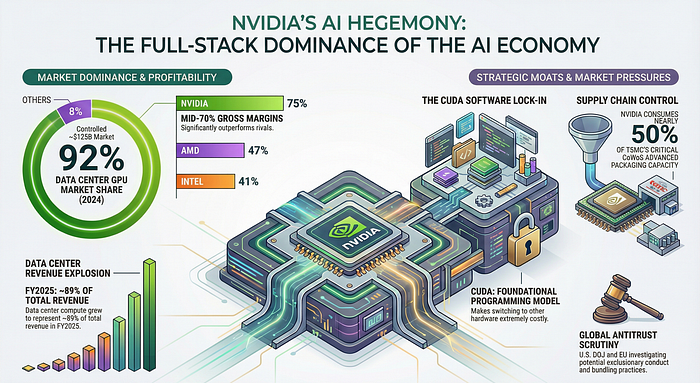
In the gold rush of artificial intelligence, NVIDIA isn’t selling shovels — it owns the mines, the refineries, and the roads connecting them. With a 92% stranglehold on the data center GPU market, the company has become something unprecedented: a near-monopoly at the heart of humanity’s most transformative technology.
NVIDIA’s dominance extends beyond chip manufacturing to encompass strategic control over software and supply chains, making competition challenging. While it holds a significant market share, the company’s resilience comes from its software moat, pricing power, and deep integration with the AI ecosystem. All these aspects not only solidify NVIDIA’s leading position but also raise questions among regulators regarding potential anti-competitive practices, especially as the global AI landscape evolves rapidly and faces geopolitical pressures.
Read the full blog for free on Medium.
Join thousands of data leaders on the AI newsletter. Join over 80,000 subscribers and keep up to date with the latest developments in AI. From research to projects and ideas. If you are building an AI startup, an AI-related product, or a service, we invite you to consider becoming a sponsor.
Published via Towards AI
Towards AI Academy
We Build Enterprise-Grade AI. We'll Teach You to Master It Too.
15 engineers. 100,000+ students. Towards AI Academy teaches what actually survives production.
Start free — no commitment:
→ 6-Day Agentic AI Engineering Email Guide — one practical lesson per day
→ Agents Architecture Cheatsheet — 3 years of architecture decisions in 6 pages
Our courses:
→ AI Engineering Certification — 90+ lessons from project selection to deployed product. The most comprehensive practical LLM course out there.
→ Agent Engineering Course — Hands on with production agent architectures, memory, routing, and eval frameworks — built from real enterprise engagements.
→ AI for Work — Understand, evaluate, and apply AI for complex work tasks.
Note: Article content contains the views of the contributing authors and not Towards AI.
Related posts
Recent Posts






