


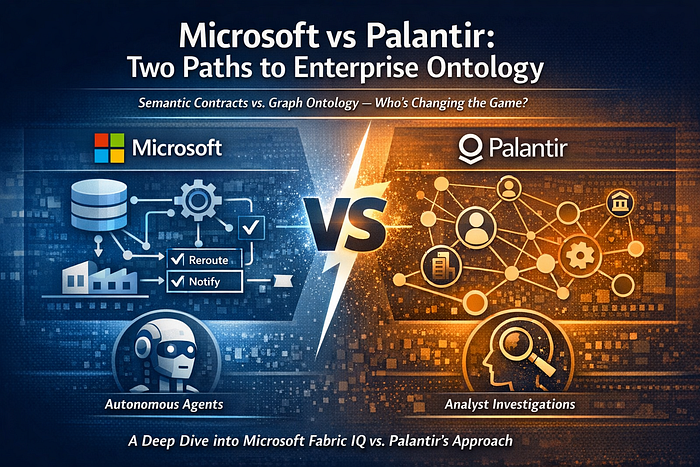
Microsoft vs Palantir: Two Paths to Enterprise Ontology (And Why Microsoft’s Bet on Semantic Contracts Changes the Game)
Author(s): Pankaj Kumar
Originally published on Towards AI.
A technical deep-dive into how Microsoft Fabric IQ actually implements ontology — and why it’s fundamentally different from Palantir’s approach
🚀 NEW: I just built OntoGuard in 48 hours — an ontology firewall
for AI agents that prevents $4.6M mistakes. See the build story →
The article discusses the contrasting approaches of Microsoft and Palantir in utilizing ontology within enterprise systems, emphasizing that Microsoft aims to empower AI agents to operate autonomously through semantic contracts, while Palantir focuses on enabling human analysts to explore graph-based data relationships. The article further elaborates on the technical frameworks and philosophies underpinning each company’s strategy, evaluating the implications for enterprises considering these technologies.
Read the full blog for free on Medium.
Join thousands of data leaders on the AI newsletter. Join over 80,000 subscribers and keep up to date with the latest developments in AI. From research to projects and ideas. If you are building an AI startup, an AI-related product, or a service, we invite you to consider becoming a sponsor.
Published via Towards AI
Towards AI Academy
We Build Enterprise-Grade AI. We'll Teach You to Master It Too.
15 engineers. 100,000+ students. Towards AI Academy teaches what actually survives production.
Start free — no commitment:
→ 6-Day Agentic AI Engineering Email Guide — one practical lesson per day
→ Agents Architecture Cheatsheet — 3 years of architecture decisions in 6 pages
Our courses:
→ AI Engineering Certification — 90+ lessons from project selection to deployed product. The most comprehensive practical LLM course out there.
→ Agent Engineering Course — Hands on with production agent architectures, memory, routing, and eval frameworks — built from real enterprise engagements.
→ AI for Work — Understand, evaluate, and apply AI for complex work tasks.
Note: Article content contains the views of the contributing authors and not Towards AI.
Related posts
Recent Posts






