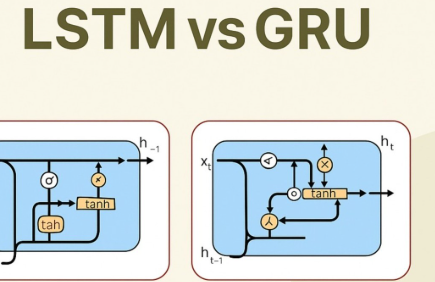
LSTM vs GRU: Architecture, Performance, and Use Cases
Author(s): Rashmi
Originally published on Towards AI.
LSTM vs GRU: Architecture, Performance, and Use Cases
Imagine you’re reading a long book and trying to remember key plot points:
The article delves into the comparison between Long Short-Term Memory (LSTM) and Gated Recurrent Unit (GRU) architectures, exploring their distinct structural components and functionalities, performance aspects, and practical use cases across various domains. It discusses scenarios where LSTM excels due to its complex state control while emphasizing GRU’s advantages in speed and efficiency, particularly in real-time applications. The piece also provides insights on implementation through various models, concluding with recommendations for when to use each architecture and how they fit into modern machine learning contexts, including their relevance in applications like natural language processing and time series analysis.
Read the full blog for free on Medium.
Join thousands of data leaders on the AI newsletter. Join over 80,000 subscribers and keep up to date with the latest developments in AI. From research to projects and ideas. If you are building an AI startup, an AI-related product, or a service, we invite you to consider becoming a sponsor.
Published via Towards AI
Towards AI Academy
We Build Enterprise-Grade AI. We'll Teach You to Master It Too.
15 engineers. 100,000+ students. Towards AI Academy teaches what actually survives production.
Start free — no commitment:
→ 6-Day Agentic AI Engineering Email Guide — one practical lesson per day
→ Agents Architecture Cheatsheet — 3 years of architecture decisions in 6 pages
Our courses:
→ AI Engineering Certification — 90+ lessons from project selection to deployed product. The most comprehensive practical LLM course out there.
→ Agent Engineering Course — Hands on with production agent architectures, memory, routing, and eval frameworks — built from real enterprise engagements.
→ AI for Work — Understand, evaluate, and apply AI for complex work tasks.
Note: Article content contains the views of the contributing authors and not Towards AI.
Related posts
Recent Posts