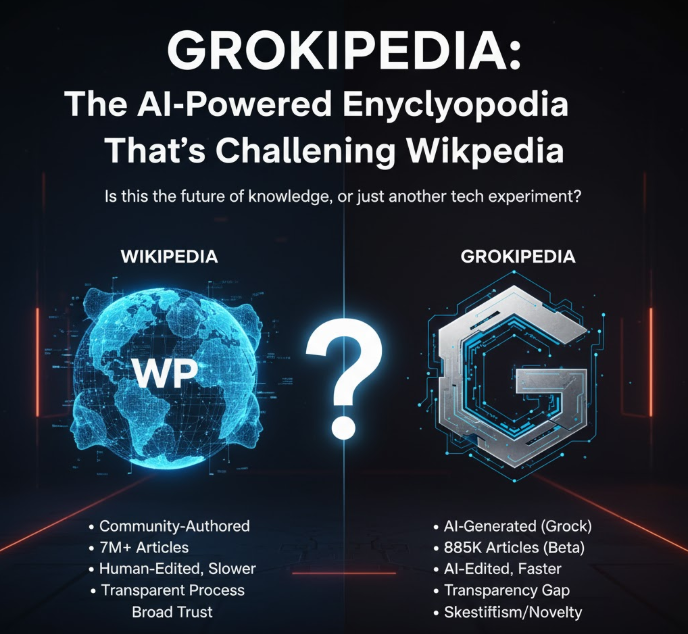
Grokipedia: The AI-Powered Encyclopedia That’s Challenging Wikipedia
Last Updated on November 6, 2025 by Editorial Team
Author(s): Baivab Mukhopadhyay
Originally published on Towards AI.
Is this the future of knowledge, or just another tech experiment?

On October 27, 2025, Elon Musk’s AI company XAI launched something that’s making waves in the world of online knowledge: Grokipedia. It’s an AI-generated encyclopedia that aims to rival Wikipedia, and it’s raising some fascinating — and concerning — questions about how we create, consume, and trust information in the age of artificial intelligence.
What Exactly Is Grokipedia?
The name “Grokipedia” comes from “Grock,” which means to deeply understand something. It’s also the name of the AI language model that powers the entire platform. Unlike Wikipedia, which relies on thousands of volunteer editors around the world, Graipedia’s articles are written entirely by AI.

At launch, the platform featured approximately 885,000 articles — impressive, but still dwarfed by Wikipedia’s nearly 7 million English articles. What Graipedia lacks in quantity, it claims to make up for in speed, objectivity, and innovation.
Why Did Musk Create This?
Musk has been vocal about his belief that Wikipedia suffers from ideological bias, calling it “woke” and arguing that it skews content toward particular political viewpoints. Graipedia, he claims, will be a more objective alternative — a neutral ground for knowledge seekers.
But here’s the paradox: Can an AI system created by one billionaire entrepreneur truly be more neutral than a platform built by a global community of diverse contributors? That’s one of the central debates surrounding Graipedia.
Wikipedia vs. Grokipedia: What’s Different?
Let’s break down the key differences:
The Head-to-Head Comparison

The fundamental shift here isn’t just technological — it’s philosophical. We’re moving from community-created knowledge to AI-generated knowledge. That’s a big deal.
Taking Graipedia for a Test Drive
I explored Grokipedia to see how it performs in real-world use, and the results were… mixed.
The Good
Search 1: LIONEL MESSI

Searching for LIONEL MESSI returned a comprehensive article with extensive information, references, and a familiar Wikipedia-like layout. The navigation felt intuitive, and the content was detailed and well-structured.
Search 2: COVID-19 Pandemic
This was where things got interesting. Searching for a controversial topic like COVID-19 revealed Graipedia’s approach to handling contentious subjects. The article covered:

- Biology and origins
- Diagnosis and prevention
- Controversies and debates
- The lab leak hypothesis
Graipedia didn’t shy away from controversial angles, which aligns with its mission to be less editorially filtered than Wikipedia.
The Standout Feature: Interactive AI Assistant
Here’s where Grokipedia truly differentiates itself. You can highlight any section of an article and ask Grock, the AI assistant, to explain or clarify specific points.

For example, I highlighted “alternative treatments for COVID-19” and asked about the controversy. Grock provided a detailed, nuanced analysis that went beyond the article itself. This is genuinely useful for research — it’s like having an expert available to answer follow-up questions.

The Not-So-Good
The search functionality felt buggy. When looking for the COVID-19 article, the suggestions were sometimes unrelated or confusing. The interface needs refinement to compete with Wikipedia’s polished user experience.

The Bigger Picture: What Does This Mean?
Encyclopedias aren’t just reference tools — they shape how we understand the world. They influence education, professional work, and everyday learning. When the method of creating that knowledge changes fundamentally, we need to pay attention.
The Potential Benefits
1. Speed and Scale
AI can generate and update articles far faster than human editors. This could mean more timely coverage of emerging topics and events.
2. Competition Drives Innovation
Having an alternative to Wikipedia could push both platforms to improve — better technology, faster updates, and perhaps more balanced coverage.
3. Interactive Learning
The Grock assistant feature is genuinely innovative. Being able to drill down into complex topics with AI-powered explanations could transform how people learn.
The Serious Concerns
1. Accuracy Without Accountability
AI can confidently present incorrect information — what researchers call “hallucinations.” Without human editors to catch these errors, misinformation could spread unchecked.
2. Bias in a Different Package
Grokipedia claims to counter Wikipedia’s bias, but it may simply introduce Musk’s own ideological slant. An AI trained on data selected and shaped by one company isn’t necessarily more neutral — it’s just differently biased.
3. Transparency Gap
Wikipedia’s strength lies in its openness: edit histories, discussion pages, and transparent processes. Grokipedia currently lacks this level of transparency. How does it fact-check? Who oversees the AI? These questions remain unanswered.
4. Source Attribution Issues
Some articles appear to be adapted from Wikipedia content, sometimes without clear attribution. This raises ethical and legal questions about intellectual property and proper sourcing.
Should You Use Graipedia?
Here’s my take: Use it, but with caution.
Graipedia is an interesting experiment and a valuable supplementary tool. The interactive AI assistant is particularly useful for understanding complex topics. However, it’s not yet reliable enough to be your sole source of information.
The Future of Knowledge?
Grokipedia represents a significant shift in how reference materials might be produced in the future. We’re witnessing the early stages of AI not just summarizing existing knowledge, but actively creating knowledge content.
This raises profound questions:
- Who controls the algorithms that generate knowledge?
- How do we ensure accuracy when AI is the primary author?
- What role should human oversight play in AI-generated encyclopedias?
- Can we trust a knowledge platform created by a single company or individual?
The answers to these questions will shape not just Graipedia’s future, but the future of how we access and trust information online.
Final Verdict
Graipedia is bold, innovative, and flawed.
It’s not the Wikipedia killer some might hope for, nor is it the disaster others might fear. It’s an experiment — one that’s worth watching, testing, and critiquing as it evolves.
The platform shows that AI can create comprehensive, detailed content at unprecedented speed. But it also reveals the limitations of removing human judgment, community input, and transparent editorial processes from knowledge creation.
The question isn’t whether Grokipedia will replace Wikipedia. The real question is: As AI becomes more powerful, how do we ensure that the knowledge it creates is accurate, unbiased, and serves humanity rather than specific agendas?
That’s a conversation we all need to be part of.

What are your thoughts on AI-generated knowledge? Should we embrace it, regulate it, or approach it with skepticism? The comment section is yours.
Join thousands of data leaders on the AI newsletter. Join over 80,000 subscribers and keep up to date with the latest developments in AI. From research to projects and ideas. If you are building an AI startup, an AI-related product, or a service, we invite you to consider becoming a sponsor.
Published via Towards AI
Towards AI Academy
We Build Enterprise-Grade AI. We'll Teach You to Master It Too.
15 engineers. 100,000+ students. Towards AI Academy teaches what actually survives production.
Start free — no commitment:
→ 6-Day Agentic AI Engineering Email Guide — one practical lesson per day
→ Agents Architecture Cheatsheet — 3 years of architecture decisions in 6 pages
Our courses:
→ AI Engineering Certification — 90+ lessons from project selection to deployed product. The most comprehensive practical LLM course out there.
→ Agent Engineering Course — Hands on with production agent architectures, memory, routing, and eval frameworks — built from real enterprise engagements.
→ AI for Work — Understand, evaluate, and apply AI for complex work tasks.
Note: Article content contains the views of the contributing authors and not Towards AI.
Related posts
Recent Posts