From Traditional AI to Agentic AI: How Machines Evolved from Prediction to Autonomous Action
Last Updated on May 29, 2026 by Editorial Team
Author(s): Swarup Dewanjee
Originally published on Towards AI.

From Traditional AI to Agentic AI: How Machines Evolved from Prediction to Autonomous Action
Understanding the evolution from predictive systems to autonomous AI architectures.
A few years ago, AI could recommend a movie on Netflix or detect fraudulent transactions in a bank account. Today, it can write essays, generate software code, create realistic images, summarize research papers, and assist doctors in diagnosis. But the next stage of AI evolution is even more transformative. Modern AI systems are beginning to use tools, browse the web, interact with APIs, manage workflows, and make decisions with increasing autonomy.
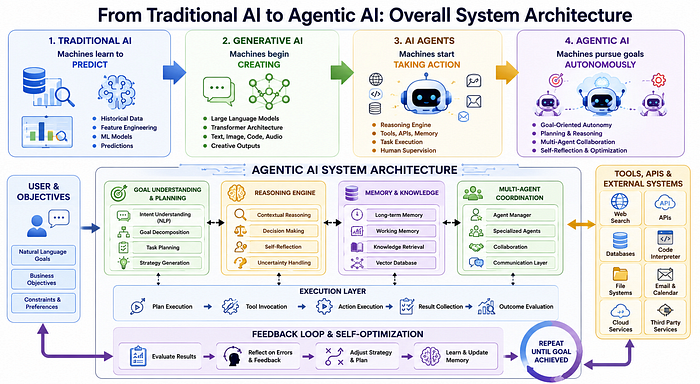
The shift happening right now is not simply about smarter chatbots. It is about software evolving from passive tools into active systems capable of pursuing goals. The history of AI is not just a story of increasing intelligence. It is a story of increasing agency. Machines first learned to predict, then create, then execute tasks, and now they are beginning to operate with growing autonomy. This evolution can be understood through four major phases:
- Traditional AI
- Generative AI
- AI Agents
- Agentic AI
Each phase represents a fundamental leap in capability and architectural complexity.
- Traditional AI: When Machines Learned to Predict
Traditional AI refers to machine learning systems trained on historical data to identify patterns and make predictions. These systems became the foundation of modern intelligent software long before the rise of ChatGPT and large language models. Industries rapidly adopted traditional AI because it excelled in structured environments. Recommendation systems, fraud detection engines, forecasting models, and search ranking systems all relied heavily on predictive machine learning.
A simple example can be seen in banking. A fraud detection model trained on millions of transaction records can identify suspicious behavior within milliseconds. If a customer suddenly makes purchases across multiple countries within a short period of time, the system flags the transaction as potentially fraudulent. The workflow of traditional AI is relatively straightforward.

The system learns statistical relationships from historical data and produces outputs such as classifications, predictions, or recommendations. Algorithms such as logistic regression, decision trees, random forests, and support vector machines became extremely effective at solving narrowly defined analytical tasks. Their strength came from precision and efficiency.
However, traditional AI had an important limitation. It could analyze information, but it could not create original content or deeply understand human language and context. A recommendation engine could suggest a movie, but it could not explain the emotional themes of the story or generate an original review. This limitation eventually led to the next major breakthrough in AI.
2. Generative AI: When Machines Began Creating
Generative AI transformed machines from analytical systems into creative systems. Instead of simply predicting outcomes, generative models produce entirely new content including text, images, code, audio, and video. Large Language Models such as GPT, Claude, and Gemini became possible because of transformer architectures introduced in the landmark paper Attention Is All You Need [1].
Transformer models enabled AI systems to process relationships between words in parallel, dramatically improving contextual understanding and scalability. The architecture of generative AI can be simplified into the following workflow.

This transition fundamentally changed how humans interact with software. A developer can now describe an application idea in plain English and receive functioning code. A designer can generate concept art within seconds. Researchers can summarize scientific papers almost instantly. For the first time, machines became capable of producing outputs that appeared creative and conversational. This was not merely a technological improvement. It changed user expectations completely. Software no longer felt like a rigid tool. It became interactive, adaptive, and collaborative.
Despite its extraordinary capabilities, generative AI still operates reactively. A chatbot waits for a prompt. An image generation model waits for instructions. A coding assistant waits for a request. Generative AI creates outputs, but it does not independently pursue objectives or manage workflows autonomously. That limitation led directly to the rise of AI agents.
The Shift from Creation to Execution
Before understanding AI agents, it is important to recognize the architectural shift taking place.
· Traditional AI systems focused on prediction.
· Generative AI systems focused on creation.
The next phase introduced something entirely different: execution. This transition can be summarized summarized as follows:

As AI systems gained access to tools, APIs, memory, and reasoning frameworks, they stopped being isolated models and started becoming operational systems.
3. AI Agents: When AI Started Taking Action
AI agents extend generative AI by integrating language models with external tools, APIs, databases, memory systems, and execution frameworks. An AI agent is no longer just a conversational assistant. It becomes a system capable of performing tasks and interacting with digital environments.
Imagine asking an AI assistant to organize an international business trip. Instead of only suggesting destinations, the agent can search flights, compare hotel prices, update calendars, book reservations, and send confirmation emails automatically. This marks a major transition from content generation to task execution.

The reasoning engine interprets the user’s objective and breaks it into smaller tasks. Tool integration enables the system to interact with APIs, databases, browsers, and external software. Memory helps retain context and improve continuity across multiple steps.
Real world examples of AI agents include:
- Coding assistants,
- Autonomous research systems,
- Customer support agents,
- Workflow automation tools,
- Browser operating AI systems.
A software engineering agent, for example, can read a bug report, inspect the codebase, generate fixes, run tests, debug failures, and create a pull request automatically. This represents a significant leap beyond traditional machine learning systems. However, modern AI agents still face major limitations. They often struggle with reliability, long horizon planning, and error recovery. Small reasoning mistakes can compound across complex workflows. Most importantly, they still operate under substantial human supervision. AI agents execute instructions efficiently, but they rarely pursue long term objectives independently. That is where the concept of Agentic AI emerges.
4. Agentic AI: When Systems Begin Pursuing Goals
Agentic AI represents the transition from task execution to autonomous goal completion. While AI agents perform tasks when instructed, agentic systems are designed to reason about objectives with increasing autonomy. They can adapt strategies, evaluate outcomes, coordinate multiple processes, and continuously optimize execution. This distinction is critical.
An AI agent behaves like an intelligent assistant following commands.
An agentic system behaves more like an autonomous operator managing outcomes. Consider an AI powered ecommerce company. An agentic system could monitor sales performance, identify declining conversions, optimize pricing, launch marketing campaigns, coordinate inventory requirements, generate reports, and adapt strategies continuously based on customer behavior. Instead of waiting for instructions, the system actively works toward business objectives.
This requires capabilities far beyond traditional automation:
- Long term memory,
- Adaptive reasoning,
- Self reflection,
- Planning,
- Tool orchestration,
- Multi agent collaboration.
The architecture of agentic systems becomes significantly more sophisticated.

Unlike earlier AI systems, agentic architectures operate through continuous feedback loops. They do not simply respond to prompts. They evaluate outcomes, adjust strategies, and improve execution over time. The operational workflow of an agentic system can be visualized as follows.

This iterative cycle is what differentiates agentic systems from conventional automation pipelines.
Frameworks such as LangChain, CrewAI, AutoGen, and Semantic Kernel are already enabling developers to build multi agent systems capable of collaborative reasoning and task coordination [2]. Although fully autonomous AI remains an evolving field, the direction is becoming increasingly clear. AI systems are gradually moving from passive response generation toward autonomous decision making and adaptive execution. At the same time, this evolution introduces serious concerns involving reliability, alignment, security, governance, and ethical oversight. The more autonomy AI gains, the more important responsible control becomes.
The Evolution of Intelligence
The progression of AI can ultimately be understood as an expansion of capability.
· Traditional AI gave machines analytical capability.
· Generative AI gave them creative capability.
· AI agents gave them operational capability.
· Agentic AI is pushing toward autonomous capability.
For decades, software waited for human commands. Today, software is beginning to reason about objectives and take action toward achieving outcomes. This shift may become one of the most important technological transformations of the century.
Conclusion
The future of AI is no longer limited to chatbots generating text or image models producing artwork. We are entering an era where intelligent systems can plan, coordinate, execute, evaluate, and optimize complex workflows with minimal human intervention. The next generation of AI will not simply answer questions. It will pursue objectives, coordinate actions, and continuously adapt to achieve outcomes. The shift from intelligent software to autonomous systems may become one of the defining technological transitions of our time.
References
[1] Vaswani et al., Attention Is All You Need, NeurIPS 2017.
[2] Microsoft Research, AutoGen: Enabling Next Generation LLM Applications via Multi Agent Conversation Frameworks, 2023.
Join thousands of data leaders on the AI newsletter. Join over 80,000 subscribers and keep up to date with the latest developments in AI. From research to projects and ideas. If you are building an AI startup, an AI-related product, or a service, we invite you to consider becoming a sponsor.
Published via Towards AI
Towards AI Academy
We Build Enterprise-Grade AI. We'll Teach You to Master It Too.
15 engineers. 100,000+ students. Towards AI Academy teaches what actually survives production.
Start free — no commitment:
→ 6-Day Agentic AI Engineering Email Guide — one practical lesson per day
→ Agents Architecture Cheatsheet — 3 years of architecture decisions in 6 pages
Our courses:
→ AI Engineering Certification — 90+ lessons from project selection to deployed product. The most comprehensive practical LLM course out there.
→ Agent Engineering Course — Hands on with production agent architectures, memory, routing, and eval frameworks — built from real enterprise engagements.
→ AI for Work — Understand, evaluate, and apply AI for complex work tasks.
Note: Article content contains the views of the contributing authors and not Towards AI.
Related posts
Recent Posts