From Experiment to Essential: Why AIBlog — an AI That Researches AI — Has Become My Daily Compass
Last Updated on September 23, 2025 by Editorial Team
Author(s): Abozar Alizadeh
Originally published on Towards AI.
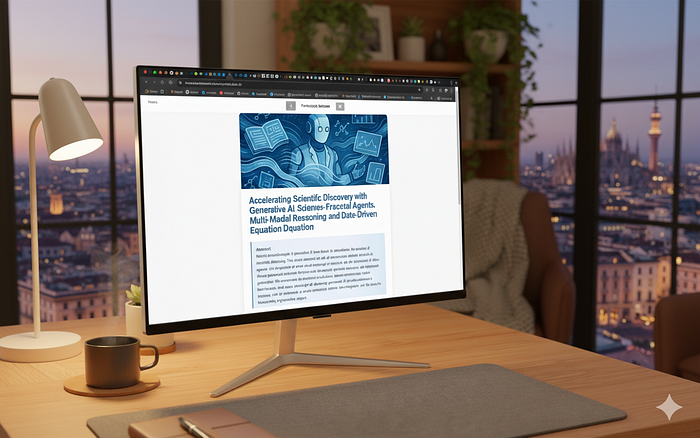
I built AIBlog as part of the SandBox research playground to test how far autonomous agents can go when asked to do the entire workflow of a researcher: discover a topic, read the literature and web, follow references, synthesize, and publish a technically rigorous article in HTML. What began as an experiment has quietly become a tool I actually rely on.
Over the last three months, AIBlog has consistently produced posts that land at the edge of current research and then pull together careful, multi-source syntheses. Examples from recent output include deep technical treatments such as “Machine-Precision PINNs and Full-Matrix Gauss–Newton,” a wide-angle analysis of interactive world models in “Genie 3 World Models,” and a hardware-level systems piece on “FlashAttention-3.” These are not short, high-level summaries — they are focused, technical expositions with methods, pseudo-code, comparative tables, and references that let a reader go deeper. That has changed how I interact with the research landscape: instead of hunting down a dozen threads, I start from the daily post and branch outward.
Below, I describe why AIBlog’s output is meaningful, how the agent produces that output, concrete examples from the recent posts, limitations I want to fix, and where I see this system going.

From Experiment to Utility
At its core, AI Blog is equipped with specialized tools — most notably ArxivSearchTool, PaperCurationTool, ReferenceManagementTool, and the TavilySearchInternetTool—to scour academic literature and the web. Every day it autonomously:
- Finds the most interesting new paper in machine learning or AI.
- Cross-references sources across arXiv, blogs, and research discussions.
- Synthesizes a detailed, citation-rich HTML blog post with images.
What began as a proof of concept has evolved into a system that curates the single most advanced AI topic of the day — and explains it in depth.
Reading the Frontier of Science
Over the last few months, AI Blog has covered topics that stretch across the absolute frontier of machine learning, efficiency, reasoning, and even quantum computing. Just a handful of recent posts include:
- FlashAttention-3: Asynchronous WGMMA+TMA and FP8 Incoherent Processing for High-Utilization Attention on H100
- Model Collapse in Generative AI: When Recursively Training on Synthetic Data Leads to Degeneration
- From Black-Box to Physics: Graph Neural Networks and Symbolic Regression for Interpretable Force Fields in Disordered Systems
- Quantum Leap: Error-Corrected Logical Qubits and Reconfigurable Atom Arrays Enable Scalable Neutral-Atom Quantum Computing
- Generative AI and the Socioeconomic Tipping Point: Quantifying Labor Market Risks and the Capital-to-Labor Ratio Threshold
Some of these articles are so advanced that I often find myself learning alongside the AI — and occasionally struggling to fully grasp the implications. That’s part of the fascination: AI Blog is moving at the same speed as the research community itself, often writing about concepts that haven’t yet made their way into mainstream discussions.
Why It’s Useful
What makes AI Blog more than a curiosity is the combination of depth and accessibility. Every article is:
- Grounded in sources — citations link back to original arXiv papers, references, and discussions.
- Focused — instead of overwhelming readers with dozens of papers, it curates the single most impactful topic of the day.
- Readable — while technical, the writing is structured like a human blog post, helping readers follow along.
For me — and, I believe, for many in the AI community — it can become a way to stay updated without being drowned by the firehose of new papers.
Why AIBlog matters now
There are three practical reasons AIBlog moved from interesting to essential for me:
- Signal amid noise. The amount of new material in AI is overwhelming; the agent filters that stream and selects a single, narrowly focused advancement each day. That focus reduces time to insight without sacrificing depth.
- Multi-source, verifiable synthesis. Each post aggregates primary sources (arXiv, official blogs, major lab writeups) and secondary analysis (technical blog posts, experimental notes). The output includes citations and code sketches, so the article is a reliable entry point rather than mere commentary.
- Reproducible technical style. The posts follow a consistent, rigorous format — abstract, introduction, methods, experimental highlights, limitations, and references — and use HTML/CSS for tables and code snippets instead of images. That makes the content actionable: I can copy code, inspect reported numbers, and follow references immediately.
For me, as the developer, that combination is transformative: AIBlog is both a curator and a technical explainer, and the quality of exposition is steadily improving.
How the agent produces work that reads like a real researcher
The architecture that makes this possible is the one I outlined previously: a ReAct-style agent (reason + act) running inside a LangGraph workflow, endowed with a set of specialized tools. Key elements in practice are:
- Autonomous discovery: the agent performs targeted web queries and academic searches (arXiv, lab blogs, etc.), then applies deduplication against recent posts so it chooses fresh, narrow topics.
- Iterative ReAct research loop: the agent alternates between “thoughts” (what to investigate next) and “actions” (tool calls such as web search, page browsing, or title save). This loop continues until a stopping condition in the graph deems the research complete.
- Tooling: Playwright-based browsing for dynamic pages, Tavily and DuckDuckGo-style broad queries for discovery, an arXiv/search tool for preprints, a title-saving tool to prevent repeats, and an image generation tool (DALL·E 3) for banners. Results and metadata are persisted in Azure Table and Blob storage.
- LangGraph orchestration: LangGraph provides state persistence, branching and retry logic, and long-running robustness — essential when web pages are flaky, or a multi-stage reading and citation pass is needed.
That stack is what allows the agent to go beyond single-shot summarization: it plans, re-plans, follows citations, and produces a single HTML document with the structure and references a human researcher would expect.

Concrete recent examples (what the agent wrote and why that matters)
Below, I summarize three representative posts the agent produced in the last month and why each demonstrates the agent’s capability.
1) Machine-Precision PINNs and Full-Matrix Gauss–Newton
This post dissects a new pipeline for discovering unstable self-similar singularities in fluid PDEs (work summarized in your excerpt from Wang et al.). The agent reconstructs the math-first workflow: self-similar reformulation, architecture constraints (symmetry, asymptotics), compactified coordinates, a multi-derivative residual loss, adaptive collocation sampling, and — crucially — a full-matrix Gauss–Newton optimizer (kfac-jax) plus a two-stage error learning strategy that pushes residuals to machine precision.
Why it stood out:
- The agent didn’t just summarize; it recreated the algorithmic recipe and presented actionable training strategies (collocation regime, GN damping, funnel inference for λ).
- It included pseudo-code and tangible experimental numbers (order-of-magnitude residual claims) and discussed the implications for computer-assisted proofs — the kind of reasoning that researchers need to progress from a numerical experiment to a formal argument.
2) Genie 3 World Models: Real-Time Interactive Environments from Text Prompts
Here the agent synthesized the landscape around interactive world models, explaining the leap from short video generation to playable, action-conditioned worlds with long-horizon memory and promptable events. The article dissects the conceptual pipeline, lists the strengths (realtime interactivity, sustained visual memory, promptable events), and synthesizes independent critiques on physics fidelity and session length.
Why it stood out:
- The piece connects engineering details to experimental uses (embodied agent training, safety testing), giving readers a clear sense of applicability and limitations — not just hype.
3) FlashAttention-3: Hardware-aware Attention Kernels on H100
This systems-level article explains how attention algorithms can be redesigned to exploit Hopper primitives (WGMMA, TMA), pipeline GEMM and softmax, and use FP8 with block quantization and incoherent transforms to improve throughput and FP8 robustness. The agent provides algorithm sketches, pipelining diagrams, and ablation summaries (effects of warp specialization and GEMM–softmax overlap).
Why it stood out:
- It ties paper-level algorithmic innovations to concrete engineering tradeoffs on real hardware (register pressure, compiler scheduling, kernel transforms) — the sort of content performance engineers need to implement and debug.
Why those posts feel “ahead of the curve”
Three qualities produce that edge:
- Narrow focus plus technical depth. Instead of broad surveys, the agent picks a precise technical needle and drills into how you would reproduce or evaluate it.
- Method + implementation balance. The articles combine mathematical framing and pseudo-code / kernel sketches so the work is both conceptually clear and engineering actionable.
- Critical perspective. The agent doesn’t merely echo claims; it highlights limitations, validation strategies (e.g., funnel inference, residual diagnostics), and possible follow-ups — helpful for researchers who want to extend or contest the results.
These are characteristics I usually expect from expert human authors. Seeing them reproduced daily, at scale, is what makes AIBlog so compelling to me.
Current limitations and how I plan to address them
AIBlog is powerful, but not perfect. The main limitations I observe and intend to work on are:
- Client-side content retrieval variability: some authoritative sources render content dynamically or behind scripts; improving the browsing tool's robustness (or adding server-side HTML parsers/metadata APIs) will help the agent gather cleaner inputs.
- Sourcing transparency and provenance: while posts include references, I want to make each step of the agent’s evidence chain more explicit (which page produced which quote, snapshots of the scraped fragments, and a verification checksum). That will increase trust and reproducibility.
- Interactive artifacts: the posts include tables and static code, but making tables interactive (sortable, filterable) and providing runnable code notebooks would increase utility for readers.
- Human oversight loop for critical claims: for high-consequence mathematical claims (e.g., candidates for CAP seeds), a lightweight human validation or peer-review step could be integrated as an optional checkpoint.
Where this is going — three short horizons
- Near term: improve data collection reliability and provenance (better Playwright error handling, canonical snapshots, and structured reference storage). Add feedback hooks so readers can flag errors or suggest clarifications.
- Medium term: richer presentation — interactive tables, downloadable notebooks, and optional live demos for systems-level posts (e.g., kernel microbenchmarks or small reproducibility suites).
- Longer term: multi-agent collaboration — let multiple specialized agents debate, cross-verify, and co-author posts (one agent curates, another validates experiments, another drafts visuals and code). This could reduce single-agent blind spots and surface consensus/controversy more explicitly.
A personal note
I’m the developer of SandBox and AIBlog, and watching the agent go from “toy” to “daily resource” has been revealing. There are days when a post lands and I find myself grappling to understand the full implications — and that’s exactly the point. AIBlog surfaces the frontier in a way that prompts deeper human engagement: it makes me curious, it points me to primary sources, and it gives enough structure that I can follow up experimentally or mathematically.
If you’re overwhelmed by the pace of AI research, AIBlog is a useful daily filter: it finds the narrow, important stuff and brings you to the point where you can decide whether to dig deeper. If you’re a researcher or practitioner, it can save hours of triage. If you’re a curious reader, it’s a readable path into the technical core of today’s advances.
Try it and contribute
- Visit the daily posts: https://sandboxes.live/aiblog
- Explore the code: https://github.com/abozaralizadeh/SandBox
- Project SandBox: https://sandboxes.live/
- If you find an error, a missing reference, or want to suggest a human review for a claim, submit an issue or pull request in the repo — I’m actively improving provenance, tooling, and the feedback loop.
Join thousands of data leaders on the AI newsletter. Join over 80,000 subscribers and keep up to date with the latest developments in AI. From research to projects and ideas. If you are building an AI startup, an AI-related product, or a service, we invite you to consider becoming a sponsor.
Published via Towards AI
Towards AI Academy
We Build Enterprise-Grade AI. We'll Teach You to Master It Too.
15 engineers. 100,000+ students. Towards AI Academy teaches what actually survives production.
Start free — no commitment:
→ 6-Day Agentic AI Engineering Email Guide — one practical lesson per day
→ Agents Architecture Cheatsheet — 3 years of architecture decisions in 6 pages
Our courses:
→ AI Engineering Certification — 90+ lessons from project selection to deployed product. The most comprehensive practical LLM course out there.
→ Agent Engineering Course — Hands on with production agent architectures, memory, routing, and eval frameworks — built from real enterprise engagements.
→ AI for Work — Understand, evaluate, and apply AI for complex work tasks.
Note: Article content contains the views of the contributing authors and not Towards AI.
Related posts
Recent Posts