


Can My Autonomous AI Agent Solve a Millennium Problem and Win $1,000,000?
Last Updated on October 13, 2025 by Editorial Team
Author(s): Abozar Alizadeh
Originally published on Towards AI.
Mathematics is a landscape of unsolved mysteries — problems that have resisted the world’s brightest minds for centuries. From the Riemann Hypothesis to the P vs NP Problem, these open questions shape the boundaries of human knowledge and computational possibility. What if an autonomous AI could join the quest, not just as a tool, but as a persistent, self-improving research collaborator?
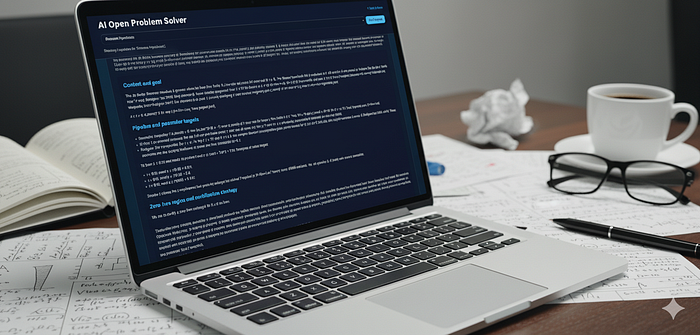
AI Open Problem Solver is a new project within the SandBox suite, designed to push the frontier of agentic AI in mathematical research. It’s not just a proof-of-concept — it’s a live, evolving system that tackles the world’s hardest math problems, records its progress, and invites you to follow along: Live Demo.

The Vision: Autonomous Mathematical Research
Traditional mathematical research is slow, iterative, and deeply human. AI Open Problem Solver reimagines this process by combining:
- LangGraph’s recursive agent architecture for long-horizon reasoning.
- Azure OpenAI for state-of-the-art language modeling.
- Web-scale search and browsing tools for real-time research.
- Persistent memory via Azure Table Storage, enabling the agent to resume and build on prior work.
The goal: create an AI that doesn’t just answer questions, but collaborates on open problems, learning from its own history and planning new avenues of attack.
The Problems: Mathematics’ Greatest Challenges
AI Open Problem Solver is preloaded with a catalog of legendary unsolved problems, each with global significance:
- Riemann Hypothesis
Statement: All non-trivial zeros of the Riemann zeta function lie on the critical line (real part = ½).
Why it matters: Governs the distribution of prime numbers.
Tools: Complex analysis, number theory, computation.
Reward: $1,000,000 (Clay Millennium Prize). - P vs NP Problem
Statement: Can every problem whose solution can be verified quickly also be solved quickly?
Why it matters: Determines the fundamental limits of computation and cryptography.
Tools: Theoretical computer science, logic, combinatorics.
Reward: $1,000,000 (Clay Millennium Prize). - Birch and Swinnerton-Dyer Conjecture
Statement: Relates the number of rational points on an elliptic curve to a special value of its L-function.
Why it matters: Deep connection between algebraic geometry and number theory.
Tools: Algebraic geometry, modular forms, arithmetic geometry.
Reward: $1,000,000 (Clay Millennium Prize). - Hodge Conjecture
Statement: Determines which kinds of cohomology classes on algebraic varieties come from algebraic cycles.
Why it matters: Fundamental to understanding complex geometry and topology.
Tools: Algebraic topology, complex geometry.
Reward: $1,000,000 (Clay Millennium Prize). - Goldbach’s Conjecture
Statement: Every even integer greater than 2 is the sum of two primes.
Why it matters: Elegant and ancient, yet unsolved since 1742.
Tools: Analytic number theory, computational verification. - Twin Prime Conjecture
Statement: There are infinitely many pairs of primes that differ by 2.
Why it matters: Related to the structure of prime gaps.
Tools: Analytic number theory, sieve methods, computational tests. - Collatz Conjecture (3n + 1 Problem)
Statement: Start with any positive integer; repeatedly apply the rule n → n/2 if even, 3n+1 if odd — do you always reach 1?
Why it matters: Extremely simple to state, but resists all proofs.
Tools: Elementary number theory, computation, dynamical systems. - Existence and Smoothness of Navier–Stokes Equations
Statement: Do solutions to the equations of fluid dynamics always exist and remain smooth in 3D?
Why it matters: Critical for understanding turbulence and stability.
Tools: Partial differential equations, functional analysis.
Reward: $1,000,000 (Clay Millennium Prize). - Yang–Mills Existence and Mass Gap
Statement: Show that quantum Yang–Mills theory exists and exhibits a mass gap.
Why it matters: Foundation of quantum field theory.
Tools: Pure mathematics and mathematical physics (no lab work).
Reward: $1,000,000 (Clay Millennium Prize).
Architecture: How Does It Work?
- LangGraph Agentic Workflow
At its core, AI Open Problem Solver uses LangGraph — a stateful, multi-actor framework for building recursive agent workflows. The Open Deep Research agent operates in cycles:
– Ingests the problem statement and historical progress.
– Plans new research directions.
– Uses web search and browsing tools to gather new information.
– Synthesizes findings into structured HTML lab notes.
– Records next steps and citations.
This recursive loop allows the agent to build on its own work, simulating the iterative nature of human research. - OpenAI Integration
The agent leverages OpenAI large language models for natural language understanding, synthesis, and reasoning. It’s capable of:
– Parsing complex mathematical statements.
– Generating proofs, counterexamples, and heuristics.
– Citing external sources with live web links. - Tooling: Search and Browsing
The agent is equipped with a suite of research tools:
– DuckDuckGo and Tavily search for web-scale information retrieval.
– Playwright-based browsing for reading academic papers, blog posts, and technical documentation.
– Custom tools for parsing and summarizing mathematical content. - Persistent Memory: Azure Table Storage
Every daily update is stored in Azure Table Storage, including:
. Summary: Concise overview of progress.
. HTML Content: Rich, semantic lab notes.
. Next Steps: Concrete follow-up actions.
. References: Inline citations with URLs.
This persistent memory enables the agent to resume work on any problem, building a timeline of progress that’s visible in the UI.
The User Experience: Infinite Timeline UI
Visit the Live Demo and you’ll find a modern, infinite-scroll interface:
- Dynamic Problem Picker: Instantly switch between tracked problems.
- Progress Timeline: See the latest breakthroughs first, with earlier milestones loaded as you scroll.
- Rich HTML Lab Notes: Each entry is a fully formatted research update, complete with references and next steps.
- Responsive Design: Optimized for desktop and mobile.
The UI is powered by Flask and streams updates directly from Azure Table Storage, ensuring real-time access to the agent’s evolving research.
Technical Deep Dive: Key Components
- Agent Prompt Engineering
The agent receives a carefully crafted system prompt, instructing it to:
. Review historical progress.
. Plan new research avenues.
. Output valid JSON with summary, HTML content, next steps, and references.
. Cite every external claim with links.
This ensures outputs are structured, verifiable, and easy to render in the UI. - Problem Catalog Table
Problems are registered in a dedicated Azure Table, allowing for:
. Easy addition/removal of problems.
. Dynamic population of the problem picker in the UI.
. Centralized management of problem metadata. - Resumable Research
On each run, the agent:
. Ingests the historical context for the selected problem.
. Advances the same research thread, rather than starting from scratch.
. Records new findings, enabling infinite, collaborative progress. - Tooling Reuse
The agent shares its search and browsing stack with other SandBox projects (like AI Blog), ensuring consistent capabilities and code reuse.
Why It Matters: Toward Autonomous Mathematical Discovery
AI Open Problem Solver is more than a technical demo — it’s a step toward autonomous, collaborative mathematical research. By combining persistent memory, recursive reasoning, and real-time web research, it simulates the workflow of a human research group, but with the tireless persistence of AI.
- Accelerates progress on unsolved problems.
- Creates a transparent, auditable research timeline.
- Invites mathematicians and enthusiasts to follow, critique, and build on the agent’s work.
Future Directions
- Human-in-the-Loop Collaboration: Enable users to suggest new avenues, critique agent findings, and guide research.
- Advanced Mathematical Tooling: Integrate symbolic computation, theorem provers, and visualization tools.
- Cross-Problem Reasoning: Allow the agent to transfer insights between related problems.
- Open API: Expose endpoints for programmatic access to research updates.

Conclusion
AI Open Problem Solver is a bold experiment in autonomous mathematical research. By blending state-of-the-art AI, recursive agent workflows, and persistent memory, it aims to make tangible progress on the world’s hardest problems — and to do so transparently, collaboratively, and at scale.
Ready to see AI tackle the frontiers of mathematics? Explore the live demo: https://sandboxes.live/ai-open-problem-solver
If you’re interested in agentic AI or the future of autonomous systems, follow the SandBox project for more innovations at the intersection of AI and discovery.
Tags: #AI #Mathematics #OpenProblems #AutonomousAgents #LangGraph #AzureOpenAI #Research #SandBox #DeepSearch #GPT5 #Flask #TableStorage #Medium
Join thousands of data leaders on the AI newsletter. Join over 80,000 subscribers and keep up to date with the latest developments in AI. From research to projects and ideas. If you are building an AI startup, an AI-related product, or a service, we invite you to consider becoming a sponsor.
Published via Towards AI
Towards AI Academy
We Build Enterprise-Grade AI. We'll Teach You to Master It Too.
15 engineers. 100,000+ students. Towards AI Academy teaches what actually survives production.
Start free — no commitment:
→ 6-Day Agentic AI Engineering Email Guide — one practical lesson per day
→ Agents Architecture Cheatsheet — 3 years of architecture decisions in 6 pages
Our courses:
→ AI Engineering Certification — 90+ lessons from project selection to deployed product. The most comprehensive practical LLM course out there.
→ Agent Engineering Course — Hands on with production agent architectures, memory, routing, and eval frameworks — built from real enterprise engagements.
→ AI for Work — Understand, evaluate, and apply AI for complex work tasks.
Note: Article content contains the views of the contributing authors and not Towards AI.
Related posts
Recent Posts


