
Building a FastAPI CRUD with ML‑Ready API: A Complete Theoretical and Practical Guide
Last Updated on December 4, 2025 by Editorial Team
Author(s): Faizulkhan
Originally published on Towards AI.
FastAPI has become the go‑to framework for Machine Learning deployment and modern backend development. This article is a complete lab-style walkthrough that teaches us FastAPI from theoretical foundations to production deployment.
Why FastAPI? The Theoretical Foundation
FastAPI isn’t just another Python web framework — it’s built on solid theoretical principles that make it exceptionally powerful:
1. Type System Integration
FastAPI leverages Python’s type hints (PEP 484) to provide automatic validation. This isn’t just syntactic sugar — it’s a compile-time and runtime validation system that catches errors before they reach your business logic.
2. ASGI Architecture
Built on ASGI (Asynchronous Server Gateway Interface), FastAPI inherits the power of async/await patterns. Unlike WSGI (which handles one request at a time), ASGI can handle:
- Multiple concurrent requests
- WebSocket connections
- Long-polling
- Server-sent events
3. Pydantic Models
Pydantic uses Python’s data classes and type hints to provide:
- Automatic data validation (type checking, constraint validation)
- Serialization/deserialization (JSON ↔ Python objects)
- Schema generation (OpenAPI/Swagger documentation)
4. OpenAPI Standard
FastAPI automatically generates OpenAPI 3.0 schemas, which means:
- Interactive API documentation (Swagger UI)
- Client code generation
- API contract validation
- Integration with API gateways
Key Advantages:
- ⚡ Performance: Comparable to Node.js and Go.
- 🔒 Type Safety: Catch errors at development time.
- 📚 Auto Documentation: Never write API docs manually again.
- 🚀 Async Support: Handle thousands of concurrent requests.
- 🤖 ML-Ready: Perfect for deploying ML models as APIs.
System Architecture: From Theory to Practice
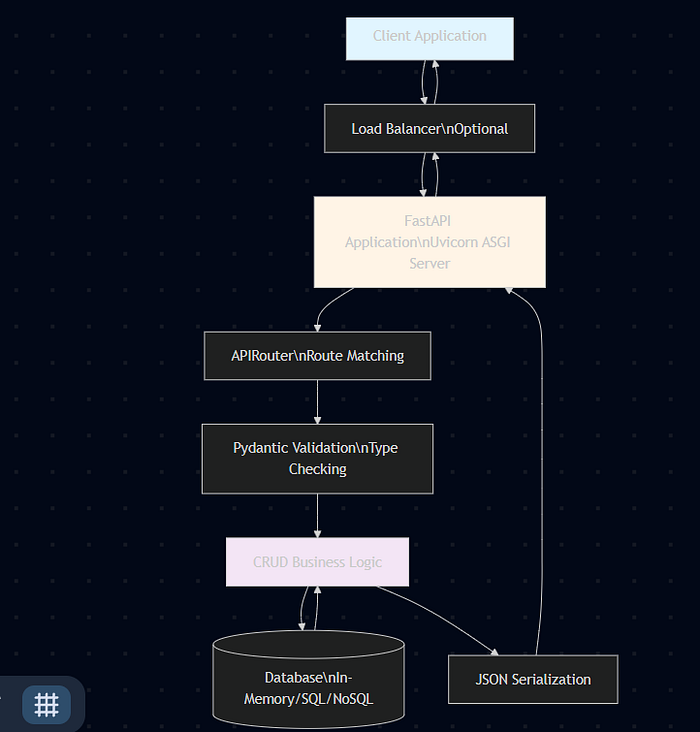
High-Level Architecture

Network Architecture Diagram

Request Flow Sequence Diagram

Project Structure: ML-Ready Architecture
fastapi-fundamentals-lab/
├── app/
│ ├── __init__.py # Package initialization
│ ├── main.py # FastAPI app instance & configuration
│ ├── routes.py # API endpoint definitions
│ ├── models.py # Pydantic models (schemas)
│ ├── crud.py # Business logic layer
│ └── database.py # Data access layer
├── requirements.txt # Python dependencies
├── docker-compose.yml # Multi-container orchestration
├── Dockerfile # Container image definition
├── README.md # Project documentation
└── medium.md # This article
Architecture Pattern: Layered Architecture
This structure follows the Layered Architecture Pattern, which provides:
- Separation of Concerns: Each layer has a single responsibility
- Testability: Each layer can be tested independently
- Maintainability: Changes in one layer don’t affect others
- Scalability: Easy to replace layers (e.g., swap in-memory DB with PostgreSQL)

Deep Theoretical Breakdown
1. FastAPI Application (main.py)
Theoretical Concept: FastAPI uses the Application Factory Pattern and Dependency Injection.
from fastapi import FastAPI
from .routes import router as api_router

app = FastAPI(
 title="FastAPI Fundamentals Lab",
 description="Lab project to learn FastAPI basics, CRUD, and API design.",
 version="0.1.0",
)

@app.get("/")
async def root():
 return {"message": "Welcome to the FastAPI Fundamentals Lab API"}

app.include_router(api_router)
Key Concepts:
- FastAPI Instance: Creates an ASGI application
- Router Inclusion: Modularizes endpoints using
APIRouter - Async Functions: Enables non-blocking I/O operations
- Automatic JSON: FastAPI serializes Python dicts to JSON automatically
Flow:
FastAPI()creates an ASGI application- Decorators (
@app.get) register routes include_router()adds modular route groups- Uvicorn serves the ASGI app
2. Pydantic Models (models.py)
Theoretical Concept: Schema Validation and Data Transformation using Python’s type system.
from pydantic import BaseModel
from typing import Optional

class Item(BaseModel):
 """
 Pydantic model representing an item in our API.

 Fields:
 - id: unique integer identifier
 - name: short name of the item
 - description: optional text describing the item
 """
 id: int
 name: str
 description: Optional[str] = None

 class Config:
 orm_mode = True
How Pydantic Works:

Validation Process:
- Type Checking: Ensures
idis int,nameis str - Constraint Validation: Can add validators (e.g.,
id > 0) - Default Values:
descriptiondefaults toNoneif not provided - Serialization: Converts Python objects back to JSON
3. CRUD Operations (crud.py)
Theoretical Concept: abstracts data access logic.
from typing import List, Optional
from .models import Item
from .database import items_db

def get_items() -> List[Item]:
 return items_db

def get_item(item_id: int) -> Optional[Item]:
 for item in items_db:
 if item.id == item_id:
 return item
 return None

def create_item(item: Item) -> Item:
 items_db.append(item)
 return item

def update_item(item_id: int, updated_item: Item) -> Optional[Item]:
 for index, item in enumerate(items_db):
 if item.id == item_id:
 items_db[index] = updated_item
 return updated_item
 return None

def delete_item(item_id: int) -> bool:
 for index, item in enumerate(items_db):
 if item.id == item_id:
 del items_db[index]
 return True
 return False
CRUD Flow Diagram:

4. API Routes (routes.py)
Theoretical Concept: RESTful API Design and HTTP Method Semantics.
from fastapi import APIRouter, HTTPException
from typing import List, Optional
from .models import Item
from . import crud

router = APIRouter()

@router.get("/items/", response_model=List[Item])
async def read_items():
 return crud.get_items()

@router.get("/items/{item_id}", response_model=Item)
async def read_item(item_id: int):
 item = crud.get_item(item_id)
 if not item:
 raise HTTPException(status_code=404, detail="Item not found")
 return item

@router.post("/items/", response_model=Item, status_code=201)
async def create_item(item: Item):
 return crud.create_item(item)

@router.put("/items/{item_id}", response_model=Item)
async def update_item(item_id: int, updated_item: Item):
 item = crud.update_item(item_id, updated_item)
 if not item:
 raise HTTPException(status_code=404, detail="Item not found")
 return item

@router.delete("/items/{item_id}")
async def delete_item(item_id: int):
 success = crud.delete_item(item_id)
 if not success:
 raise HTTPException(status_code=404, detail="Item not found")
 return {"detail": "Item deleted"}

Route Matching Flow:

End-to-End Request Flow: Complete Theoretical Journey
Example: Creating an Item (POST /items/)
Let’s trace a complete request from client to response:
Step 1: Client Sends Request
POST /items/ HTTP/1.1
Host: localhost:8000
Content-Type: application/json

{
 "id": 4,
 "name": "Item Four",
 "description": "Great item"
}
Step 2: Network Layer Processing

Step 3: FastAPI Processing

Step 4: Response Generation
HTTP/1.1 201 Created
Content-Type: application/json

{
 "id": 4,
 "name": "Item Four",
 "description": "Great item"
}
Complete Flow Diagram

Testing: Theory and Practice
Swagger UI: Interactive API Documentation
FastAPI automatically generates OpenAPI 3.0 schema, which Swagger UI renders as interactive documentation.
Theoretical Foundation:
- OpenAPI Specification: Industry-standard API description format
- Schema Generation: FastAPI introspects your code to generate schemas
- Interactive Testing: Swagger UI provides a built-in API client
Access: http://localhost:8000/docs
Postman: Advanced API Testing
Postman allows you to:
- Create test suites
- Automate API testing
- Mock APIs
- Generate client code
Best Practices:
- Use environment variables for base URLs
- Create collections for organized testing
- Add test scripts for automated validation
- Export collections for team sharing
Docker Deployment: Containerization Theory
Why Docker?
Containerization Benefits:
- Isolation: Each container runs in its own environment
- Portability: “Works on my machine” → “Works everywhere”
- Scalability: Easy to spin up multiple instances
- Consistency: Same environment in dev, staging, production
Docker Architecture

Docker Compose: Multi-Container Orchestration

Deployment Command:
docker compose up -d --build
ML-Ready API Pattern: Extending for Machine Learning
Architecture for ML Deployment

Example ML Endpoint
from fastapi import APIRouter
from pydantic import BaseModel
import joblib

router = APIRouter()

class Features(BaseModel):
 feature1: float
 feature2: float
 feature3: float

# Load model at startup
model = joblib.load("model.pkl")

@router.post("/predict/")
async def predict(features: Features):
 prediction = model.predict([[features.feature1,
 features.feature2,
 features.feature3]])
 return {"prediction": float(prediction[0])}
Key Concepts:
- Model Loading: Load models at application startup
- Feature Validation: Use Pydantic to validate input features
- Async Processing: Handle prediction requests asynchronously
- Response Format: Return predictions as JSON
Performance Considerations
Async vs Sync: When to Use What

Scalability Architecture

Final Thoughts: From Theory to Production
FastAPI represents a perfect blend of:
- Theoretical Soundness: Built on proven standards (ASGI, OpenAPI, Pydantic)
- Practical Simplicity: Easy to learn, powerful to use
- Production Readiness: Handles real-world requirements (async, validation, docs)
Key Takeaways
- Type Hints = Automatic Validation: Leverage Python’s type system
- ASGI = Performance: Async I/O for high concurrency
- Pydantic = Data Integrity: Automatic validation and serialization
- OpenAPI = Documentation: Never write API docs manually
- Modular Architecture = Maintainability: Separate concerns for scalability
Next Steps
- Replace in-memory database with PostgreSQL/SQLite
- Add authentication (JWT tokens)
- Implement rate limiting
- Add logging and monitoring
- Deploy to cloud (AWS, GCP, Azure)
- Add ML model endpoints
Github link: https://github.com/faizulkhan56/fastapi-fundamentals-lab
Join thousands of data leaders on the AI newsletter. Join over 80,000 subscribers and keep up to date with the latest developments in AI. From research to projects and ideas. If you are building an AI startup, an AI-related product, or a service, we invite you to consider becoming a sponsor.
Published via Towards AI
Towards AI Academy
We Build Enterprise-Grade AI. We'll Teach You to Master It Too.
15 engineers. 100,000+ students. Towards AI Academy teaches what actually survives production.
Start free — no commitment:
→ 6-Day Agentic AI Engineering Email Guide — one practical lesson per day
→ Agents Architecture Cheatsheet — 3 years of architecture decisions in 6 pages
Our courses:
→ AI Engineering Certification — 90+ lessons from project selection to deployed product. The most comprehensive practical LLM course out there.
→ Agent Engineering Course — Hands on with production agent architectures, memory, routing, and eval frameworks — built from real enterprise engagements.
→ AI for Work — Understand, evaluate, and apply AI for complex work tasks.
Note: Article content contains the views of the contributing authors and not Towards AI.
Related posts
Recent Posts