Automation Prompting: The Key to Scalable AI Workflows
Last Updated on October 18, 2025 by Editorial Team
Author(s): Felix Pappe
Originally published on Towards AI.

AI ChatBots have already been integrated into many of our lives, and if that’s not the case for you yet, perhaps this blog post will help you start using them to free up time from tasks you don’t enjoy.
In many situations, I’ve found myself using Large Language Models for the same tasks every day, such as correcting my English spelling, learning a third language, summarising long texts I don’t have time to read, or brainstorming ideas for projects.
But always starting from scratch with an empty prompt bar is time-consuming and inefficient.
Sometimes, it even takes longer to write a decent prompt than to do the actual task.
The solution to this problem is automated prompting.
Instead of writing the same prompt over and over again with varying results, you can create innovative, reusable instruction prompts that you refine over time. This improves the quality of outputs and saves both time and effort.
In this blog post, I share my thoughts on building automation prompts, improving them continuously, and what to keep in mind when creating such prompts.
What Is Automation Prompting?
Automation prompts give AI models a clear, reusable set of instructions.
These instructions can be run manually or automatically based on external triggers, such as a message or at a specific time.
This post will focus on the manual execution of automation prompts, as we must first understand the process and complete it manually before automating it.
The idea of automation prompting is that you write a smart prompt once that leads to the expected result, and then reuse and improve this prompt continuously.
Even if the creation of such a prompt might cost you hours, it’s worth the time investment in the long run.
Any time in the future when you are facing the same problem again, you can copy and paste the prompt and avoid starting from a blank prompt input field for repetitive tasks.

Uncomfortable Truth About Automation Prompts
The open secret about automation prompt generation, which nobody wants to hear, is that you must first complete the entire process manually before you can define an effective prompt.
Once you’ve performed a process several times, you gradually refine it.
All the knowledge you gather from repeatedly performing the task should then be integrated into the automation prompt.
The key to a successful system prompt is effectively translating your experience into clear instructions.
However, it’s easy to mistakenly include too much detail, attempting to verbalise everything in your mind.
Imagine the LLM as an intern in a large enterprise. If you want to guide this intern effectively through the enterprise, you must provide detailed instructions.
However, too much information will confuse the intern, preventing effective action.
There will always be this trade-off between providing too much and too little instruction.
The same principle holds true when working with AI chatbots.
Example for automation prompting
Let’s examine one of my simplest automation prompts, which I use daily and perhaps you soon will as well.
Initially, there is always an exploratory prompting phase.
As someone deeply curious about AI, I actively try to keep up with the latest news.
However, if you’ve attempted this yourself, you’ve probably noticed it’s a challenging task due to the daily flood of information, product releases, and breakthroughs.
Faced with this challenge, I had the choice to either give up or transform this task into an automation prompt.
Having already performed the process multiple times, it was straightforward for me to condense my most crucial insights into a concise prompt.
You can see this prompt below.
What are the most recent developments in artificial intelligence today?
Divide the output into the following sections:# Research & Breakthroughs
New papers, model releases, or notable academic findings.# Industry & Product News
Announcements from major tech companies, startups, or product launches.# Policy & Ethics
Government regulations, ethical debates, or updates to global AI governance.# Societal Impact
Stories about how AI is affecting jobs, education, media, or daily life.# Noteworthy Quotes or Commentary
Key insights from thought leaders, CEOs, or researchers.”Write a paragraph of at least three sentences for each news item that you found. It’s okay if you don’t find anything for a category.
Now, I use this prompt daily to get up to speed in the world of AI.
A part of the result you can see here.

Of course, this is not nearly as detailed as a manual web search for the latest news.
However, this generation took me less than a minute, and I can even listen to it.
In this way, I turned it into a more sustainable habit instead of giving up and doing nothing.
Furthermore, if you want to listen to the output in a more entertaining way, you can turn this news into your own podcast episode.
This can be achieved with the next follow-up prompt.
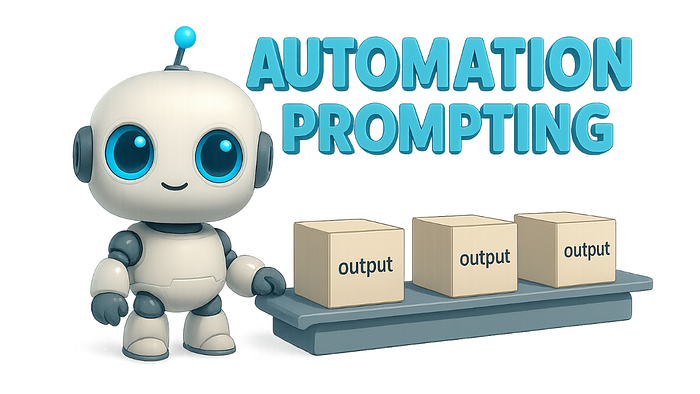
Cartoon robot automating task outputs with labeled boxes on a conveyor belt under the title ‘Automation Prompting’
A part of the output from this follow-up prompt is depicted in the next image.

This is a first example of a prompting chain and AI workflow.
In such a workflow, you take the output from one model and use it as the input for the next one.
However, it doesn’t have to be the same model.
For example, you could even extend this prompt automation chain by copying the podcast script into a text-to-speech model, such as ElevenLabs, which has shown astonishing results with its latest V3 update.

Suppose your manual prompt automation workflow, which consists of various prompts, improves over time, along with the quality of those prompts.
In that case, you can begin to automate the entire process using tools such as Make, n8n, or Zapier.
However, don’t rush this process. Many prompt automation projects fail because people try to automate something they’ve never done manually before.
Tips and Tricks
Tip 1: Don’t have too high expectations on your first prompt version
Don’t expect a perfect prompt template from the start.
Prompt automation begins with the simplest possible template and gradually improves, adjusting step by step to better fit your needs.
The Japanese principle of Kaizen might help you when building your set of automation prompts.
It means “continuous improvement” and focuses on making small, incremental changes over time.
I always think of Kaizen when experimenting with my prompts.
Tip 2: Save your prompts in one place
Make sure to save your prompts somewhere. I personally use Notion to store all my prompts, but any other note-taking application works as well — such as OneNote, GoodNotes, Notability, etc.
Tip 3: Use your copy History
Did you know that the copy-and-paste function on Windows doesn’t just allow you to insert the most recent copy?
Pressing Windows key + V opens the Windows Clipboard History.

If you’ve never used this before, Windows will ask you to enable it.
This feature saves your recent copied items and allows you to select the one you need. You can even pin your most important copies. I use this to pin my most recent prompts, so I can access them with a single shortcut.
Unfortunately, as far as I know, macOS doesn’t have a built-in feature like this.
You’ll need third-party applications such as Paste, Raycast’s Clipboard History extension, or Maccy.
Final Words
Think of your prompts like tools: the more you sharpen them, the better they serve you. Over time, well-crafted prompts can save you hundreds of hours.
But where should I begin? Start small. Choose one task you find yourself repeating often, and write your first automation prompt for it today.
Don’t worry about making it perfect. The magic lies in iteration.
Just get started, and improve as you go.
We’re all learning this, one prompt at a time.
If this post helped you, share it with someone who’s still writing the same prompt from scratch every day.
Help them turn repetition into automation.
Follow & Connect
felix-pappe.medium.com/subscribe 🔔
www.linkedin.com/in/felix-pappe 🔗
https://felixpappe.de🌐
Join thousands of data leaders on the AI newsletter. Join over 80,000 subscribers and keep up to date with the latest developments in AI. From research to projects and ideas. If you are building an AI startup, an AI-related product, or a service, we invite you to consider becoming a sponsor.
Published via Towards AI
Towards AI Academy
We Build Enterprise-Grade AI. We'll Teach You to Master It Too.
15 engineers. 100,000+ students. Towards AI Academy teaches what actually survives production.
Start free — no commitment:
→ 6-Day Agentic AI Engineering Email Guide — one practical lesson per day
→ Agents Architecture Cheatsheet — 3 years of architecture decisions in 6 pages
Our courses:
→ AI Engineering Certification — 90+ lessons from project selection to deployed product. The most comprehensive practical LLM course out there.
→ Agent Engineering Course — Hands on with production agent architectures, memory, routing, and eval frameworks — built from real enterprise engagements.
→ AI for Work — Understand, evaluate, and apply AI for complex work tasks.
Note: Article content contains the views of the contributing authors and not Towards AI.
Related posts
Recent Posts