Alibaba’s Voice AI Runs at 5Hz and Still Beats 25Hz Models
Last Updated on December 29, 2025 by Editorial Team
Author(s): Gowtham Boyina
Originally published on Towards AI.
The Voice AI Compute Problem
Most large audio language models process speech at 12.5Hz or 25Hz frame rates — 12.5 to 25 audio features per second. Higher frame rates capture more detail but require more compute. For real-time voice interactions, this creates a problem: you need fast responses (low latency), but processing high-frame-rate audio on GPUs is expensive.
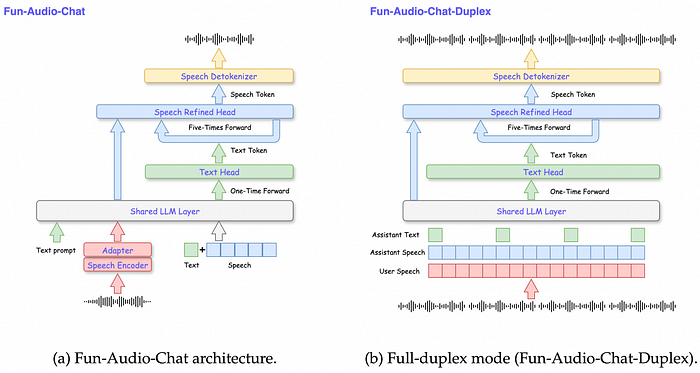
In this article, Alibaba’s Fun-Audio-Chat presents a novel approach to voice AI that combines a low-resolution backbone with high-resolution refinement to reduce computational costs while maintaining voice quality. The model’s design not only aims to minimize processing demands by operating at a lower base frame rate but also utilizes advanced training techniques to ensure that text comprehension capabilities are preserved while integrating audio understanding. This innovative dual-resolution method results in significant compute savings, improved response times, and enhanced NLP capabilities, making it suitable for real-time applications like voice assistants and customer service, despite its heavy infrastructure requirements.
Read the full blog for free on Medium.
Join thousands of data leaders on the AI newsletter. Join over 80,000 subscribers and keep up to date with the latest developments in AI. From research to projects and ideas. If you are building an AI startup, an AI-related product, or a service, we invite you to consider becoming a sponsor.
Published via Towards AI
Towards AI Academy
We Build Enterprise-Grade AI. We'll Teach You to Master It Too.
15 engineers. 100,000+ students. Towards AI Academy teaches what actually survives production.
Start free — no commitment:
→ 6-Day Agentic AI Engineering Email Guide — one practical lesson per day
→ Agents Architecture Cheatsheet — 3 years of architecture decisions in 6 pages
Our courses:
→ AI Engineering Certification — 90+ lessons from project selection to deployed product. The most comprehensive practical LLM course out there.
→ Agent Engineering Course — Hands on with production agent architectures, memory, routing, and eval frameworks — built from real enterprise engagements.
→ AI for Work — Understand, evaluate, and apply AI for complex work tasks.
Note: Article content contains the views of the contributing authors and not Towards AI.
Related posts
Recent Posts