AI Agents Are Not Just Chatbots Anymore: Real Stories, Lessons and a DIY Framework
Last Updated on May 29, 2026 by Editorial Team
Author(s): Isaac Mcfadden
Originally published on Towards AI.
AI Agents Are Not Just Chatbots Anymore: Real Stories, Lessons and a DIY Framework
Think chatbots are still the big story? Think again. Scroll through your favourite apps in 2026 and you’ll bump into AI agents everywhere including handling refunds, writing code and even listening to doctor‑patient conversations. This isn’t hype: a Google Cloud survey of over 3 400 senior leaders found that 52 % of executives already have agents in production, and 39 % are running more than ten. Early adopters are seeing pay‑offs too: 88 % report positive ROI. So what’s driving this surge, where are agents actually working, and why do some projects flop? Let’s dive in.
Why this matters
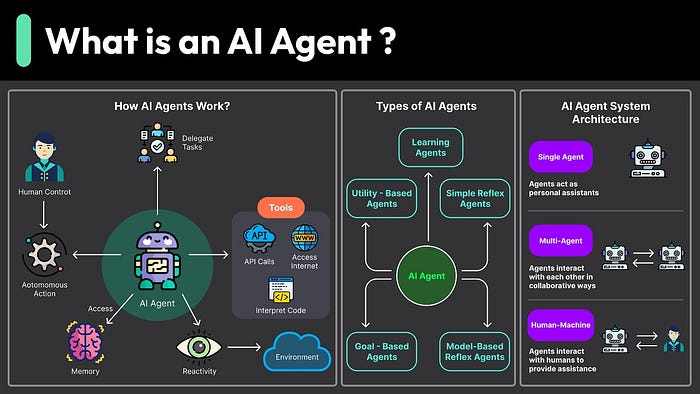
The jump from simple chatbots to fully fledged agents means software that can plan, reason, use tools and act on our behalf. Instead of spitting out canned responses, these systems check databases, invoke APIs, schedule tasks and adapt over time. That autonomy is reshaping workflows across customer support, sales, coding, finance, healthcare and supply chains. If you’re a builder, a decision‑maker or just curious about where AI is headed, understanding agents is now table stakes.
This shift from “response only” to “autonomous action” shows up in both enterprise systems and tools targeted at everyday workflows. For example, platforms like a zero‑setup agent platform based on the OpenClaw framework. They will let you deploy truly autonomous agents that connect to messaging channels (Telegram, WhatsApp, Discord, etc.) and execute tasks such as inbox automation, scheduled actions and multi‑step workflows with virtually no configuration. Rather than acting as passive chatbots, EasyClaw, AutoGPT, and CrewAI agents plan and run tasks behind the scenes, illustrating how agent technology is becoming accessible outside of deep engineering contexts.

Stories across industries
Customer service: faster than brewing coffee Remember the endless wait times on support lines? Fintech giant Klarna rolled out an OpenAI‑powered assistant in February 2024 and changed the game. In its first month the agent handled 2.3 million chats, or about two‑thirds of all requests, doing work equivalent to 700 humans. It slashed average resolution time from 11 minutes to under 2 minutes and now chats in 35+ languages across 23 markets. And yes, customers can still ask for a human, but most don’t need to.
Sales: an AI sidekick for B2B teams Canned outreach emails rarely work. Some B2B teams now lean on agents that read LinkedIn profiles, CRM notes and recent news to write personal emails and follow up automatically. One case study reported that reps saved 10–15 hours per week and booked three times more demos. It’s like giving every salesperson a tireless research assistant.
Coding: half the code and counting Developers used to worry that autocomplete tools would slow them down. Today the bigger concern is keeping up. GitHub Copilot and similar assistants now have 15 million active users. Telemetry shows they contribute to around 46 % of code lines, with Java projects hitting 61 %. Microsoft’s CEO even noted that around 30 % of the company’s code is AI‑generated. Meanwhile, tools like Cursor and Replit’s agents can refactor multiple files or build a complete app from a natural‑language spec. Developers are becoming architects and reviewers rather than pure coders.
Finance: banks hire AI detectives Fraud doesn’t sleep, and neither do agents. JPMorgan reports that its generative‑AI initiatives have already saved nearly $1.5 billion through fraud prevention, personalised client interactions and operational efficiencies. Analysts expect another billion in gains as these systems expand. Agents monitor transactions 24/7, flag anomalies, and even draft advisory insights, a high‑stakes application that demonstrates how much trust institutions are placing in autonomy.
Healthcare: the scribe that never quits Burnt‑out clinicians spend too much time typing notes. Enter ambient scribing. Kaiser Permanente deployed Abridge’s generative‑AI solution across 40 hospitals and more than 600 medical offices as the largest rollout of its kind. The system listens to doctor‑patient conversations and drafts clinical notes, letting physicians focus on patients instead of paperwork. The wider healthcare sector is adopting AI at over twice the rate of the broader economy, with 22 % of organisations running domain‑specific AI tools.
Supply chain: closing the insight–action gap Supply‑chain dashboards are great at telling managers there’s a problem; they’re less helpful at fixing it. Agentic process automation (APA) changes that. Research from Automation Anywhere shows that supply‑chain teams using agents cut forecast errors by 20–50 %, reduced manual planning time by 40 %, lowered operating costs by 24 % and halved unplanned downtime. Agents now reconcile demand and supply in real time, manage shipment exceptions and chase suppliers automatically. It’s the difference between watching a storm on radar and having a co‑pilot who adjusts course for you.
Why some agent projects flop
Not every agent makes it into production. After testing dozens of agent projects, developer Daniil Kornilov spotted four recurring mistakes:
- Over‑engineering: Teams design elaborate multi‑agent systems before proving the core task works. Start simple.
- Lazy prompting: Agents need well‑crafted instructions. Ambiguous prompts lead to hallucinations and odd behaviour.
- Wrong architecture: Not every problem needs autonomy. If a linear pipeline works, use it. Agents introduce unpredictability.
- No evaluation: If you don’t measure accuracy, latency and cost, you won’t know when the agent fails until users complain.
LangChain’s 2026 survey backs this up: 57 % of respondents have agents in production, but quality remains the number‑one barrier. Observability is becoming standard (89 %), yet formal evaluation lags. Latency is another challenge; complex agents often trade speed for better answers.
A DIY framework: PTME (Plan → Tools → Memory → Evaluation)
So how do you avoid those pitfalls? Kornilov’s PTME framework is a refreshingly practical approach:
- Plan: Map out the agent’s decision points before coding. Ask what decisions it makes, what information it needs and how it should handle uncertainty.
- Tools: Give the agent atomic tools — functions that do one thing well, with clear descriptions. Structured returns (think JSON) make life easier for the model.
- Memory: Decide how the agent remembers past interactions. This could be a simple key‑value store or a vector database. Good memory prevents context overflow and repetition.
- Evaluation: Build a test suite. Measure accuracy, latency and cost. Use synthetic test cases and real user feedback to improve over time. Tools like LangSmith or OpenAI’s eval APIs help capture traces and diagnose failures.
Start with a single agent solving a narrow problem. Only add more autonomy when the benefits are clear. The PTME framework forces you to think about design, guardrails and measurement up front rather than as an afterthought.
Governance and the human‑in‑the‑loop
As agents touch critical workflows, governance and security matter more than ever. Supply‑chain experts recommend logging every agent action in a command centre. Define human oversight protocols so that high‑impact decisions require approval. Watch out for model drift and your agent’s performance can degrade as underlying data or models change. In regulated industries like finance and healthcare, these safeguards aren’t optional.
What’s next?
The growth curve suggests that agents will be everywhere by 2027. Expect to see:
- New use cases: research assistants, procurement bots, legal document reviewers and internal productivity agents are growing fast.
- Multi‑model strategies: Organisations increasingly combine models from OpenAI, Google, Anthropic and open‑source providers, choosing the best tool for each task.
- Agentic process automation (APA): The supply‑chain revolution will inspire similar approaches in finance (automated compliance) and healthcare (clinical decision support).
- ROI & governance focus: Executives care less about novelty and more about return on investment and security. Privacy and integration with existing systems are top criteria when picking providers.
Final thoughts
AI agents are no longer science fiction. They’re handling millions of customer interactions, writing swaths of code, catching fraud and helping doctors spend more time with patients. But building reliable agents takes discipline: clear prompts, sensible architecture, rigorous evaluation and thoughtful governance. Follow the PTME framework, learn from the pioneers highlighted here, and your next AI agent might just make the jump from demo to production without the drama.
Join thousands of data leaders on the AI newsletter. Join over 80,000 subscribers and keep up to date with the latest developments in AI. From research to projects and ideas. If you are building an AI startup, an AI-related product, or a service, we invite you to consider becoming a sponsor.
Published via Towards AI
Towards AI Academy
We Build Enterprise-Grade AI. We'll Teach You to Master It Too.
15 engineers. 100,000+ students. Towards AI Academy teaches what actually survives production.
Start free — no commitment:
→ 6-Day Agentic AI Engineering Email Guide — one practical lesson per day
→ Agents Architecture Cheatsheet — 3 years of architecture decisions in 6 pages
Our courses:
→ AI Engineering Certification — 90+ lessons from project selection to deployed product. The most comprehensive practical LLM course out there.
→ Agent Engineering Course — Hands on with production agent architectures, memory, routing, and eval frameworks — built from real enterprise engagements.
→ AI for Work — Understand, evaluate, and apply AI for complex work tasks.
Note: Article content contains the views of the contributing authors and not Towards AI.
Related posts
Recent Posts