


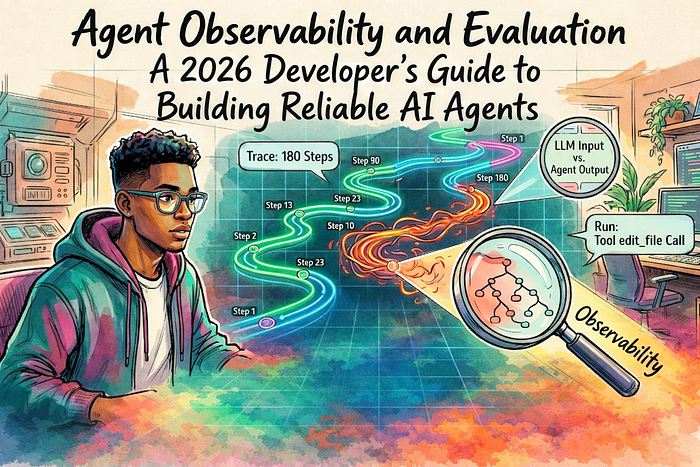
Agent Observability and Evaluation: A 2026 Developer’s Guide to Building Reliable AI Agents
Last Updated on March 4, 2026 by Editorial Team
Author(s): Divy Yadav
Originally published on Towards AI.
Why building agents without this layer is like driving blind. And how to fix it.
You know exactly where to look when traditional software malfunctions. line number, stack trace, and error log. You’ll find the culprit in thirty seconds.
This article discusses the importance of agent observability and evaluation in the development of AI agents, emphasizing that, unlike traditional software, agents present unique challenges in debugging due to their non-deterministic nature. It outlines the need for observability practices, which enable developers to understand the discrepancies between an agent’s actual actions and expected behaviors, and highlights the contrast between traditional software testing and the evaluation of agents, stressing that a new framework is necessary for addressing agent failures and ensuring reliability in production environments. The article also presents various evaluation techniques for agents, such as single-step and multi-turn evaluations, providing insights into how these methods can be effectively implemented.
Read the full blog for free on Medium.
Join thousands of data leaders on the AI newsletter. Join over 80,000 subscribers and keep up to date with the latest developments in AI. From research to projects and ideas. If you are building an AI startup, an AI-related product, or a service, we invite you to consider becoming a sponsor.
Published via Towards AI
Towards AI Academy
We Build Enterprise-Grade AI. We'll Teach You to Master It Too.
15 engineers. 100,000+ students. Towards AI Academy teaches what actually survives production.
Start free — no commitment:
→ 6-Day Agentic AI Engineering Email Guide — one practical lesson per day
→ Agents Architecture Cheatsheet — 3 years of architecture decisions in 6 pages
Our courses:
→ AI Engineering Certification — 90+ lessons from project selection to deployed product. The most comprehensive practical LLM course out there.
→ Agent Engineering Course — Hands on with production agent architectures, memory, routing, and eval frameworks — built from real enterprise engagements.
→ AI for Work — Understand, evaluate, and apply AI for complex work tasks.
Note: Article content contains the views of the contributing authors and not Towards AI.
Related posts
Recent Posts


