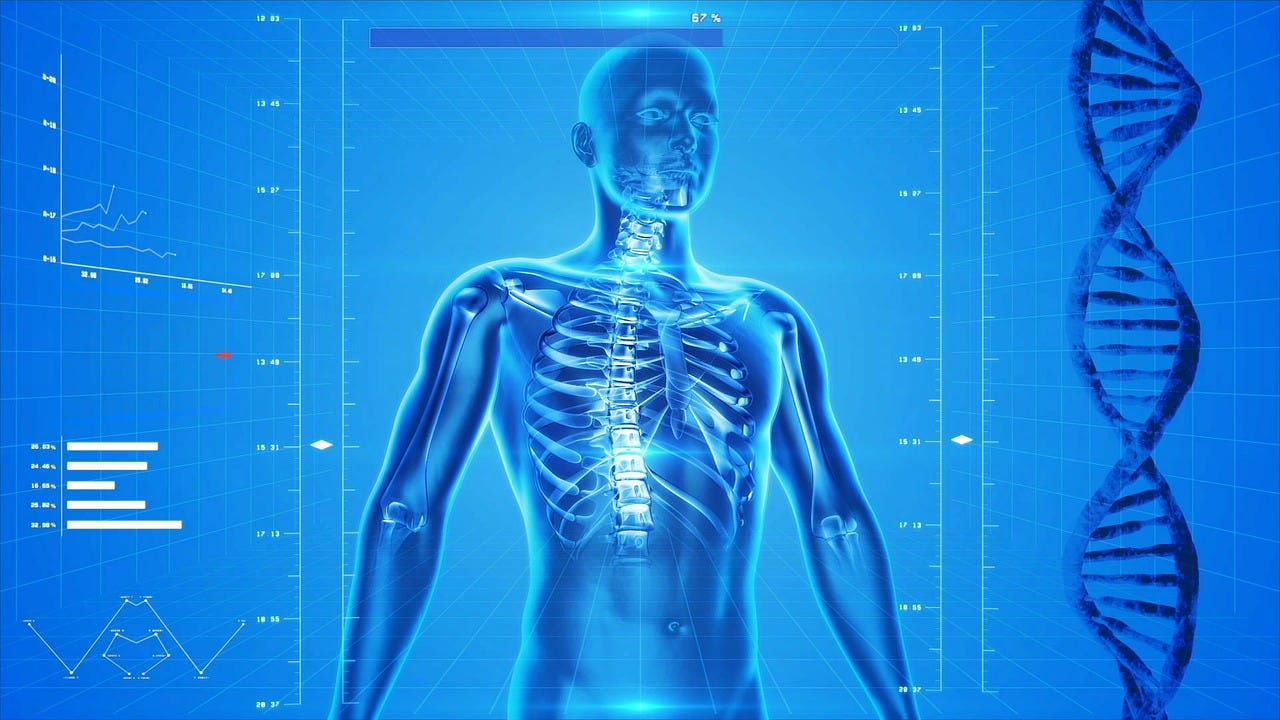
Prediction of Relative Locations of CT Slices in CT Images
Last Updated on July 20, 2023 by Editorial Team
Author(s): Avishek Nag
Originally published on Towards AI.
Predicting the relative location of CT slices on the axial axis of the human body using regression techniques on very high-dimensional data
Regression is one of the most fundamental techniques in Machine Learning. In simple terms, it means, ‘predicting a continuous variable by other independent categorical/continuous variables’. Challenge comes, when we have high-dimensionality i.e. too many independent variables. In this article, we will discuss a technique of regression modeling with high-dimensional data using Principal Components and ElasticNet. We will also see how to save that model for future use.
We will use Python 3.x as the programming language and ‘sci-kit learn’, ‘seaborn’ as libraries for this article.
Data used here can be found at the UCI Machine Learning Repository. Dataset name is “Relative location… Read the full blog for free on Medium.
Join thousands of data leaders on the AI newsletter. Join over 80,000 subscribers and keep up to date with the latest developments in AI. From research to projects and ideas. If you are building an AI startup, an AI-related product, or a service, we invite you to consider becoming a sponsor.
Published via Towards AI
Towards AI Academy
We Build Enterprise-Grade AI. We'll Teach You to Master It Too.
15 engineers. 100,000+ students. Towards AI Academy teaches what actually survives production.
Start free — no commitment:
→ 6-Day Agentic AI Engineering Email Guide — one practical lesson per day
→ Agents Architecture Cheatsheet — 3 years of architecture decisions in 6 pages
Our courses:
→ AI Engineering Certification — 90+ lessons from project selection to deployed product. The most comprehensive practical LLM course out there.
→ Agent Engineering Course — Hands on with production agent architectures, memory, routing, and eval frameworks — built from real enterprise engagements.
→ AI for Work — Understand, evaluate, and apply AI for complex work tasks.
Note: Article content contains the views of the contributing authors and not Towards AI.
Related posts
Recent Posts