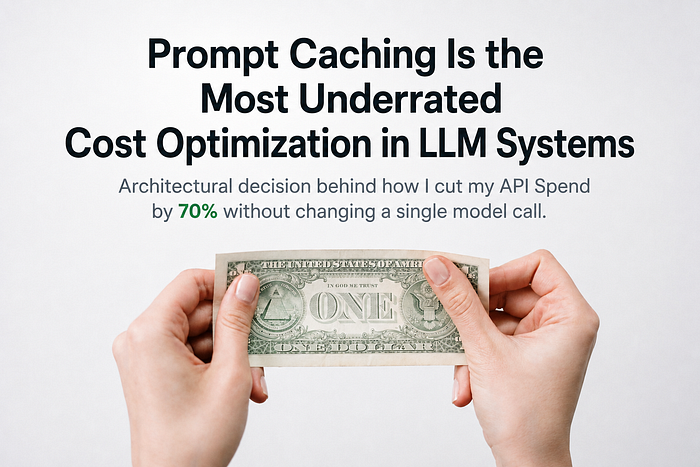
Prompt Caching Is the Most Underrated Cost Optimization in LLM Systems
Last Updated on June 3, 2026 by Editorial Team
Author(s): Satyam Sahu
Originally published on Towards AI.
I cut my API spend by 70% without changing a single model call. Here’s the architectural decision that made it possible.
You’re probably doing cost optimization wrong.
After the intro, the author explains how prompt caching works (reusing KV-cache for a stable prompt prefix), why most teams miss it (they treat caching as a per-call feature rather than a call-pattern architecture problem), and the key implementation idea: place static context first and keep it deterministic while relegating dynamic content to later. They provide pricing math and real before/after figures from their document analysis workload, discuss Anthropic’s explicit cache_control approach versus OpenAI’s more automatic caching, outline where caching helps most and least, and highlight the cache invalidation pitfalls (even whitespace, timestamps, UUIDs, environment/config changes, and model-version differences). The piece concludes with a practical checklist and operational advice like monitoring cache_read_input_tokens to verify savings.
Read the full blog for free on Medium.
Join thousands of data leaders on the AI newsletter. Join over 80,000 subscribers and keep up to date with the latest developments in AI. From research to projects and ideas. If you are building an AI startup, an AI-related product, or a service, we invite you to consider becoming a sponsor.
Published via Towards AI
Towards AI Academy
We Build Enterprise-Grade AI. We'll Teach You to Master It Too.
15 engineers. 100,000+ students. Towards AI Academy teaches what actually survives production.
Start free — no commitment:
→ 6-Day Agentic AI Engineering Email Guide — one practical lesson per day
→ Agents Architecture Cheatsheet — 3 years of architecture decisions in 6 pages
Our courses:
→ AI Engineering Certification — 90+ lessons from project selection to deployed product. The most comprehensive practical LLM course out there.
→ Agent Engineering Course — Hands on with production agent architectures, memory, routing, and eval frameworks — built from real enterprise engagements.
→ AI for Work — Understand, evaluate, and apply AI for complex work tasks.
Note: Article content contains the views of the contributing authors and not Towards AI.
Related posts
Recent Posts