Two HTML Attributes Now Turn Your Website Into an AI Agent Tool — Inside Chrome’s WebMCP
Last Updated on May 27, 2026 by Editorial Team
Author(s): Chew Loong Nian – AI ENGINEER
Originally published on Towards AI.
Two HTML Attributes Now Turn Your Website Into an AI Agent Tool — Inside Chrome's WebMCP
At Google I/O 2026, buried under Gemini 3.5 and a press release bragging about “100 announcements,” Chrome’s team shipped the thing that actually changes how AI agents use the web. Almost nobody covered it. It is called WebMCP, it landed in a Chrome 149 origin trial on May 19, and it quietly rewrites the contract between websites and the agents crawling them.
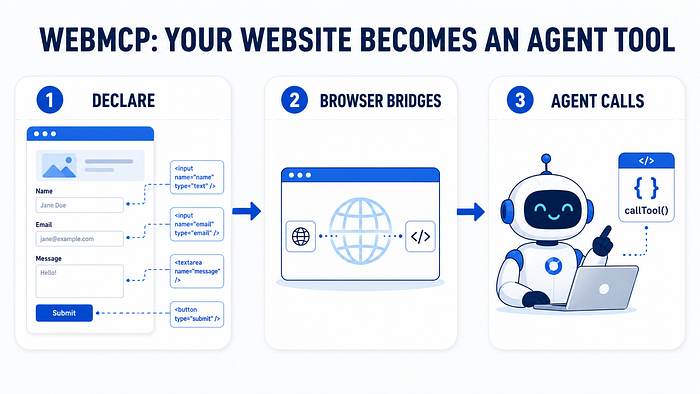
After the introduction, the article explains that WebMCP replaces today’s “actuation” approach—where agents infer the right UI element by screenshotting, vision-model guessing, and then clicking—by letting pages explicitly declare structured, typed “tools” the browser agent can call. It details two APIs: a declarative one for HTML forms using attributes like toolname and tooldescription, which auto-generates a JSON Schema and lets agents invoke the real form in the user’s session, and an imperative one for apps where developers register tools via navigator.modelContext (including dynamic tool registration/unregistration tied to page state). The piece argues these changes bring speed, durability across UI redesigns, and stronger control/ownership, shifting the agent to operate as a “guest” on the site rather than having the site be effectively reverse-engineered from pixels. It clarifies WebMCP isn’t a replacement for MCP but complements it (server-side backbone vs in-tab contextual execution), then lays out caveats: it requires an open tab (no headless execution), requires real app work to expose state, and introduces security considerations because tool outputs can be an attack surface. The author concludes by framing WebMCP as an important near-term primitive for an agentic web: sites that declare proper tools will be usable by agents, while those that don’t will stay stuck in slower screenshot-and-guess behavior.
Read the full blog for free on Medium.
Join thousands of data leaders on the AI newsletter. Join over 80,000 subscribers and keep up to date with the latest developments in AI. From research to projects and ideas. If you are building an AI startup, an AI-related product, or a service, we invite you to consider becoming a sponsor.
Published via Towards AI
Towards AI Academy
We Build Enterprise-Grade AI. We'll Teach You to Master It Too.
15 engineers. 100,000+ students. Towards AI Academy teaches what actually survives production.
Start free — no commitment:
→ 6-Day Agentic AI Engineering Email Guide — one practical lesson per day
→ Agents Architecture Cheatsheet — 3 years of architecture decisions in 6 pages
Our courses:
→ AI Engineering Certification — 90+ lessons from project selection to deployed product. The most comprehensive practical LLM course out there.
→ Agent Engineering Course — Hands on with production agent architectures, memory, routing, and eval frameworks — built from real enterprise engagements.
→ AI for Work — Understand, evaluate, and apply AI for complex work tasks.
Note: Article content contains the views of the contributing authors and not Towards AI.
Related posts
Recent Posts