Sqribble’s Template‑Driven Document Automation
Last Updated on April 13, 2026 by Editorial Team
Author(s): idibaliban75
Originally published on Towards AI.
Introduction
Digital document creation has evolved from a manual, design‑heavy process into a workflow increasingly shaped by automation, templates, and no‑code systems. As document automation systems continue to evolve, the distinction between rule‑based engines and emerging AI‑assisted workflows becomes increasingly relevant to understanding how modern composition tools operate. Instead of relying on traditional desktop publishing tools, modern platforms integrate content ingestion, layout rules, and export pipelines into unified environments.
Sqribble is one example of this shift. While often presented as a simple ebook generator, it is more accurately understood as a structured automation layer for document composition. Its architecture combines rule‑based formatting, template‑driven design, and cloud‑native workflows to reduce the operational overhead of producing structured digital documents.
This article examines Sqribble from a systems and automation perspective: how its components interact, how its workflows reduce friction, and what its design reveals about the broader evolution of no‑code publishing tools. Rather than evaluating the platform commercially, the goal is to analyze the mechanisms, constraints, and implications of a template‑driven document engine in a world increasingly shaped by automation.


Sections 1 to 7
- Architecture: a cloud-native ebook studio
From an architectural standpoint, Sqribble can be viewed as a modular, cloud-hosted document composition system. Instead of running locally, the platform operates in the browser, with the core logic and data storage residing on remote servers. This design choice removes installation friction and ensures that updates, templates, and assets are centrally managed.
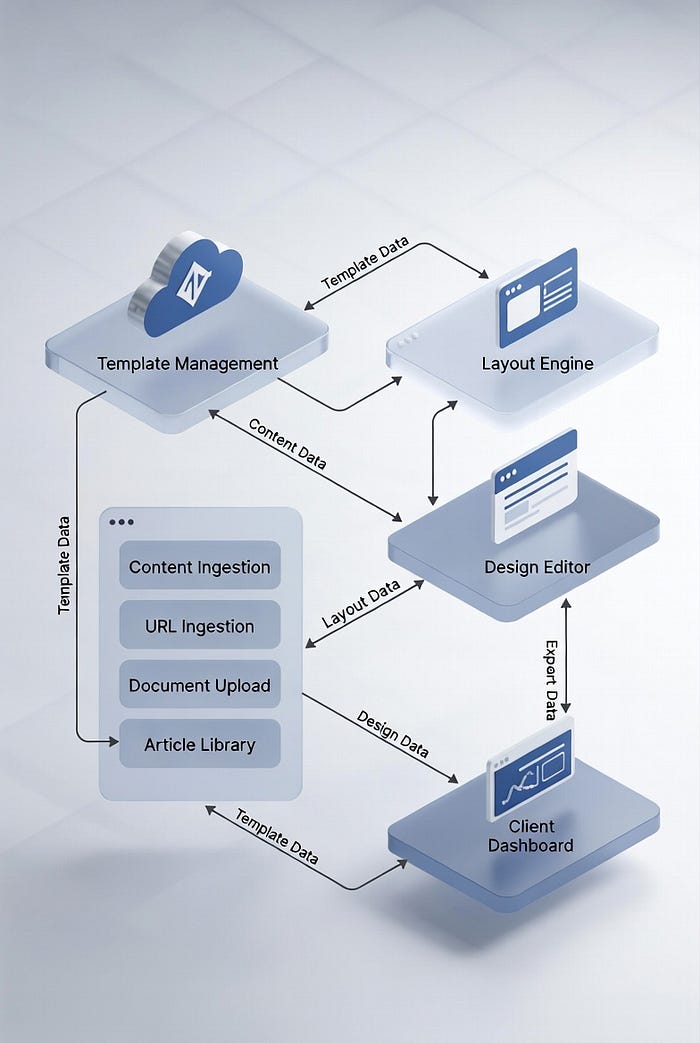
At a high level, the architecture can be decomposed into several subsystems:
– Template and asset management: a repository of ebook templates, layouts, fonts, icons, and stock images.
– Content ingestion and transformation: modules that pull content from URLs, internal article libraries, or uploaded documents, then normalize it into a structured internal format.
– Layout and rendering engine: a rules-based engine that maps structured content into page layouts, applying typography, spacing, and visual hierarchy.
– Interactive editor: a browser-based UI that exposes drag-and-drop operations, style controls, and page management to the user.
– Export and delivery layer: services that compile the designed document into a PDF and optionally generate shareable links or downloadable files.
This modular architecture allows Sqribble to behave like a specialized, domain-focused design system rather than a general-purpose graphics tool. The platform constrains the design space through templates and predefined components, trading off absolute flexibility for speed, consistency, and lower cognitive load. For non-designers, this constraint is not a limitation but a guardrail that keeps outputs structurally coherent.
From an integration perspective, the cloud-native model also simplifies multi-device access. Users can start a project on one machine and continue on another without manual file synchronization. The trade-off is a dependency on network connectivity and the platform’s own availability, which we will revisit in the limitations section.
2. Internal functioning: templates, content engines, and layout rules
Internally, Sqribble operates as a composition engine that combines three main ingredients: templates, content sources, and layout rules. Templates encode visual structure — cover designs, typography choices, page grids, and recurring elements such as headers, footers, and tables of contents. These templates are not just static images; they are parameterized layouts that can be populated with arbitrary text and media.
The content engine is responsible for ingesting and transforming text. According to the public description, Sqribble can:
– Pull content from a URL (for example, a blog post or article).
– Use a built-in library of niche articles.
– Import content from a Word document.
– Accept manually written or pasted text.
In all cases, the system must normalize the input into an internal representation — typically a structured document model with paragraphs, headings, lists, and images. This normalization is essential for the layout engine to operate deterministically.
The layout engine then maps this structured content onto the chosen template. It applies rules for:
– Pagination: how much content fits on a page before a break.
– Hierarchy: how headings, subheadings, and body text are styled.
– Repetition: automatic insertion of headers, footers, and page numbers.
– Navigation: generation of a table of contents based on heading structure.
This is not “AI” in the generative sense; it is closer to a rule-based formatting system with some automation around content sourcing. However, from a user’s perspective, the effect is similar to having a layout specialist and a basic content assistant embedded in the same tool. The complexity is encapsulated behind a simplified interface, which is a recurring pattern in modern no-code platforms.
2.1 Algorithmic Logic
Although Sqribble is often perceived as a simple content‑to‑PDF tool, its internal behavior is closer to a deterministic document engine built on rule‑based automation. At its core, the platform relies on a structured document model that standardizes headings, paragraphs, lists, and media elements before layout is applied. This internal model enables a predictable pipeline: a rules engine governs pagination, enforces typographic hierarchy, and applies consistent spacing across pages. Unlike generative systems that rely on probabilistic inference, Sqribble’s automation is fully deterministic — identical inputs always produce identical layouts. This distinction matters from a systems‑engineering perspective: Sqribble illustrates how far non‑generative automation can go when supported by a well‑defined schema and a rule‑driven rendering engine.
2.2 Rule‑Based vs AI‑Driven Systems
Sqribble’s automation pipeline is fundamentally rule‑based, meaning its behavior is governed by deterministic formatting rules rather than probabilistic inference. In a rule‑driven system, pagination, hierarchy, and layout decisions follow predefined constraints: the same input always yields the same output. By contrast, AI‑driven document systems rely on machine‑learning models capable of interpreting semantic structure, reorganizing content, or generating new text based on contextual patterns. These systems introduce adaptability but also variability, since outputs depend on probabilistic reasoning rather than fixed rules. Understanding this distinction clarifies why Sqribble is not a generative AI tool: it does not infer meaning, restructure content, or optimize layout dynamically. Instead, it applies a stable set of formatting rules. However, this boundary also highlights where future AI integration could emerge — for example, through semantic content analysis, adaptive layout suggestions, or automated restructuring of long‑form documents.
2.3 Future of Document Automation
The evolution of document automation is moving toward hybrid systems that combine deterministic rule‑based engines with AI‑driven components. Large Language Models could augment platforms like Sqribble by performing semantic analysis of long‑form content, detecting structural inconsistencies, or suggesting adaptive layout variations based on context. Future engines may generate responsive page compositions, validate narrative coherence, or automatically restructure documents for different formats such as PDF, EPUB, or web‑native outputs. In this hybrid model, rule‑based logic would continue to guarantee structural stability, while AI layers would introduce adaptability and semantic awareness. This trajectory suggests that document automation is shifting from static template application toward intelligent, context‑sensitive composition pipelines.
3. Mechanisms: automation, constraints, and user control
The mechanisms that make Sqribble usable for non-technical users revolve around three principles: automation of repetitive tasks, constraint of the design space, and selective exposure of controls.
Automation of repetitive tasks
Sqribble automates several operations that are traditionally manual:
– Generating a table of contents from headings.
– Inserting consistent headers and footers across pages.
– Numbering pages automatically.
– Applying global style changes (fonts, colors, themes) across the document.
These automations reduce the need for users to understand low-level layout mechanics. Instead of manually adjusting each page, users operate at a higher abstraction level — choosing a theme or layout variant and letting the system propagate changes.
Constraint of the design space
By providing predefined templates and components, Sqribble constrains what users can do. This is a deliberate mechanism: fewer degrees of freedom mean fewer ways to break the layout. Users can still customize fonts, colors, and content blocks, but within a framework that preserves structural integrity.
Selective exposure of controls
The drag-and-drop editor exposes only the controls that are relevant to the ebook context: adding pages, inserting text blocks, images, buttons, or lists, and adjusting basic styling. Advanced design operations — custom grids, complex vector editing, or scripting — are intentionally absent. This keeps the cognitive load low and aligns the tool with its target audience: people who need functional, readable ebooks rather than fully bespoke art-directed layouts.
Together, these mechanisms create a system where the user’s primary responsibility is content selection and light customization, while the platform handles the structural and repetitive aspects of document production.
4. Workflows: from idea to exported PDF
From a workflow perspective, Sqribble can be modeled as a linear but configurable pipeline. A typical sequence looks like this:
– Template selection
The user chooses a template from a catalog organized by niche or style. This decision sets the initial visual language: cover design, typography, and page structure.
– Content sourcing
The user selects how to populate the ebook: importing from a URL, choosing from the internal article library, uploading a document, or writing directly in the editor. The system ingests and structures the content accordingly.
– Automatic layout generation
Once content is available, Sqribble applies the template’s layout rules to generate a first version of the ebook. This includes pagination, table of contents creation, and insertion of headers, footers, and page numbers.
– Manual refinement
The user then enters an editing phase: adjusting headings, rewriting sections, replacing images, adding or removing pages, and fine-tuning the visual hierarchy. The drag-and-drop interface allows reordering of elements without dealing with low-level formatting.
– Export and distribution
Finally, the user exports the ebook as a PDF. In some scenarios, the platform also provides a direct sharing link or a way to host the document for online viewing.
Within this pipeline, the role of the platform is to minimize friction at each step. For example, automatic content import from a URL can turn an existing article into a formatted ebook in a single operation, which is particularly relevant for content repurposing strategies.
For teams or agencies, additional workflows emerge around client collaboration. Sqribble’s client dashboard and feedback mechanisms allow designers to share drafts via private links, collect comments directly on the pages, and iterate without exchanging static files. This shifts ebook production from a file-based workflow to a link-based, collaborative one, which is more aligned with modern SaaS practices.
5. Technical and economic implications
From a technical standpoint, Sqribble illustrates how domain-specific platforms can abstract away complexity that would otherwise require multiple tools and specialized skills. Instead of teaching users desktop publishing software, the platform encodes best practices into templates and layout rules. This has several implications.
Lower barrier to entry
Non-designers and non-writers can produce structured ebooks without deep expertise in typography, layout, or document engineering. This democratization is similar to what website builders did for web design: they compress the learning curve by embedding patterns and constraints.
Standardization of outputs
Because many users rely on the same templates and mechanisms, the resulting ebooks share structural similarities. This standardization can be beneficial for readability and maintenance but may reduce visual differentiation across projects.
Shift in cost structure
Economically, Sqribble replaces a combination of freelance design, writing, and formatting work with a software subscription or one-time license. For organizations that produce many ebooks, the marginal cost per document decreases significantly once the platform is adopted. The trade-off is a dependency on the vendor’s infrastructure, pricing model, and long-term viability.
Impact on service providers
For agencies and freelancers, tools like Sqribble change the nature of the service offered. Instead of billing primarily for manual layout work, providers can focus on strategy, content quality, and distribution, while using the platform to accelerate production. The inclusion of a commercial license and an agency website template in Sqribble’s bundle reflects this shift: the tool is not only for internal use but also as a production engine behind client-facing services.
Overall, the technical and economic implications converge on the same point: ebook creation becomes less about low-level formatting and more about content strategy and workflow orchestration.
6. Limitations and trade-offs
No system-level analysis is complete without examining limitations. Sqribble’s design choices introduce several trade-offs that are important to understand before integrating it into a production workflow.
Template-driven constraints
While templates accelerate production, they also constrain originality. Highly customized brand systems with strict design guidelines may find the available templates insufficient. In such cases, Sqribble is better suited for internal documents, lead magnets, or standardized reports than for flagship, heavily art-directed publications.
Dependence on PDF export
Sqribble currently focuses on PDF as the primary export format. PDF is widely supported but not inherently responsive. For reading on small screens or within adaptive web environments, HTML or EPUB formats may be more appropriate. Organizations that require multi-channel publishing (web, mobile, print) may need additional tools or custom pipelines beyond Sqribble.
Content quality is still a human responsibility
The platform can import and structure content, but it does not guarantee conceptual quality, narrative coherence, or factual accuracy. Automated content engines and article libraries can provide a starting point, yet editorial oversight remains essential. From an AI architect’s perspective, Sqribble solves layout and workflow problems more than it solves deep content generation or validation.
Vendor lock-in and data portability
Because the platform is cloud-based, projects are stored on the vendor’s infrastructure. While PDFs can be exported, the underlying structured document model and templates may not be easily portable to other systems. This is a common trade-off with SaaS tools: convenience and speed in exchange for some degree of lock-in.
Understanding these limitations helps position Sqribble correctly: as a high-speed, template-driven ebook studio rather than a universal replacement for all forms of document design and publishing.
7. Use cases: where Sqribble fits in a real workflow
When evaluated through a systems lens, Sqribble aligns well with several concrete use cases.
Lead magnets and list-building assets
Marketing teams frequently need short ebooks, checklists, and reports to use as lead magnets. These assets must look professional but do not always justify a full design cycle. Sqribble’s template-driven approach and fast content import make it suitable for producing such materials at scale.
Repurposing existing content
Organizations with blogs, knowledge bases, or training materials can repurpose existing articles into ebooks. By importing content from URLs or documents, Sqribble can assemble curated collections — such as “best of” guides or topic-specific handbooks — without rewriting everything from scratch.
Internal documentation and user manuals
Some testimonials highlight the use of Sqribble for user manuals and internal documentation. In these scenarios, the priority is clarity and structure rather than highly customized branding. The automatic table of contents, page numbering, and consistent headers/footers are particularly useful here.
Freelance and agency services
For freelancers and agencies, Sqribble can function as a production backend. The client management dashboard and feedback engine support iterative collaboration: clients comment directly on the ebook pages, and designers adjust layouts within the same environment. This reduces friction compared to exchanging static PDFs via email.
Educational materials and info products
Educators, coaches, and course creators often need to package knowledge into structured documents — workbooks, guides, or supplementary reading. Sqribble’s combination of templates and content import can shorten the time from outline to deliverable, especially when the goal is to provide clear, readable materials rather than highly customized design.
In all these cases, the platform is most effective when used as part of a broader content strategy: ideation, drafting, review, and distribution still require human judgment, but the mechanical aspects of ebook production are significantly compressed.
For readers who want to examine the platform directly, the official page of the Sqribble ebook creator provides detailed feature descriptions, pricing information, and user testimonials.
Conclusion:
Viewed through the lens of systems architecture, Sqribble is less a “magic button” and more a specialized orchestration layer for ebook production. It integrates template management, content ingestion, layout automation, and export into a single cloud-based environment, with a user interface designed for non-specialists. By constraining the design space and automating repetitive tasks, it shifts the user’s focus from formatting to content and structure.
The platform’s strengths lie in speed, standardization, and accessibility: it enables individuals and small teams to produce structurally coherent ebooks without deep expertise in design or desktop publishing. At the same time, its template-driven nature, reliance on PDF, and dependence on vendor infrastructure introduce clear trade-offs that must be acknowledged.
For practitioners who need a repeatable, low-friction way to generate ebooks, reports, and info products — especially in contexts like lead generation, internal documentation, and educational materials — Sqribble represents a pragmatic, systematized approach. This trajectory points toward hybrid AI‑assisted document engines, where deterministic rule‑based structures provide stability while machine‑learning layers introduce semantic awareness and adaptive layout intelligence. The most effective use of such a tool is not to replace editorial thinking, but to pair it with a disciplined content strategy, where human judgment defines the message and the platform handles the mechanics of turning that message into a structured, publishable artifact.
Join thousands of data leaders on the AI newsletter. Join over 80,000 subscribers and keep up to date with the latest developments in AI. From research to projects and ideas. If you are building an AI startup, an AI-related product, or a service, we invite you to consider becoming a sponsor.
Published via Towards AI
Towards AI Academy
We Build Enterprise-Grade AI. We'll Teach You to Master It Too.
15 engineers. 100,000+ students. Towards AI Academy teaches what actually survives production.
Start free — no commitment:
→ 6-Day Agentic AI Engineering Email Guide — one practical lesson per day
→ Agents Architecture Cheatsheet — 3 years of architecture decisions in 6 pages
Our courses:
→ AI Engineering Certification — 90+ lessons from project selection to deployed product. The most comprehensive practical LLM course out there.
→ Agent Engineering Course — Hands on with production agent architectures, memory, routing, and eval frameworks — built from real enterprise engagements.
→ AI for Work — Understand, evaluate, and apply AI for complex work tasks.
Note: Article content contains the views of the contributing authors and not Towards AI.
Related posts
Recent Posts