


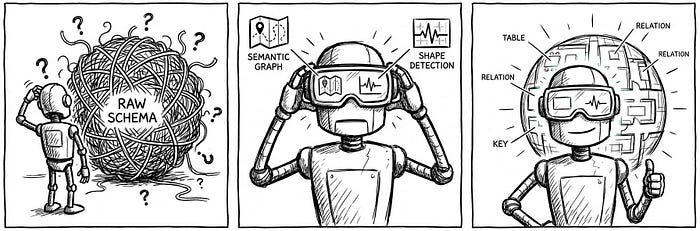
Engineering the Semantic Layer: Why LLMs Need “Data Shape,” Not Just “Data Schema
Last Updated on February 19, 2026 by Editorial Team
Author(s): Shreyash Shukla
Originally published on Towards AI.

The “Context Window” Economy
In the world of Large Language Models (LLMs), attention is a finite currency. While context windows are expanding, the “Lost in the Middle” phenomenon remains a persistent architectural challenge. Research from Stanford University demonstrates that as the amount of retrieved context grows, the model’s ability to accurately extract specific constraints significantly degrades [Lost in the Middle: How Language Models Use Long Contexts].
This creates a critical problem for enterprise analytics. The standard industry approach — Retrieval-Augmented Generation (RAG) — often involves stuffing the prompt with hundreds of CREATE TABLE statements (DDL) in hopes that the LLM figures it out. This leads to "Context Rot." The model becomes overwhelmed by irrelevant columns and foreign keys, losing focus on the user's actual question.
Furthermore, relying on raw schema introduces the “Raw Schema Fallacy.” A DDL statement describes structure, not content. It tells the agent that a column named status exists, but not what values live inside it. Does it contain "Active/Inactive"? "Open/Closed"? "1/0"? Without this knowledge, the agent is forced to hallucinate filters, producing SQL that is syntactically perfect but semantically dead. DataCamp notes that this lack of semantic context is a primary driver of the 20-40% failure rate in text-to-SQL applications [State of Data & AI Literacy 2024].
To solve this, we must abandon “Passive RAG” in favor of a “Just-in-Time” architecture that provides rich, targeted context only for the specific tables involved.

Pillar 1 — The Enterprise Semantic Graph
The first pillar of accuracy is the Enterprise Semantic Graph. We cannot rely on static documentation or manual wiki pages, which go stale the moment they are written. Instead, we must treat the SQL ETL scripts themselves as the source of truth.
By parsing the scripts that create the tables, we generate a structured, JSON-based map of the data universe. This moves us away from a flat list of tables to a Semantic Layer — a concept that Databricks argues is essential for AI, as it “translates raw data into business concepts” [The Importance of a Semantic Layer for AI].
This structure allows the agent to navigate Data Lineage — understanding not just that a table exists, but identifying its upstream dependencies and downstream consumers. Crucially, it provides the agent with Verified Logic. Instead of guessing how to calculate “Churn,” the agent reads the simplified_sql_logic directly from the metadata, ensuring the math is identical to the official reporting.
The Artifact: The Knowledge Object
Instead of just indexing schema, we index the logic.
{
 "table_name": "revenue_daily_snapshot",
 "lineage": {
 "upstream_tables": [
 { "table_name": "raw_bookings"},
 { "table_name": "currency_conversion_rates" }
 ]
 },
 "metrics": [
 {
 "name": "Net_Revenue_Retention",
 "definition": "Revenue from existing customers excluding new sales.",
 "simplified_sql_logic": "SUM(renewal_revenue) + SUM(upsell_revenue) - SUM(churn_revenue)",
 "key_filters_and_conditions": ["is_active_contract = TRUE", "region != 'TEST'"]
 }
 ]
}

Pillar 2 — Statistical Shape Detection
The second pillar of accuracy is Statistical Shape Detection. While the Semantic Graph provides the map of the data, Shape Detection provides the terrain. To write accurate SQL, an agent needs to know the statistical signature of the data columns before it attempts to query them.
Without this, LLMs fall into the “Cardinality Trap.” For example, if a user asks to “Group customers by type,” and the customer_type column actually contains unique IDs (high cardinality) instead of categories (low cardinality), the resulting GROUP BY query could crash the database cluster. This is why Gartner predicts that organizations adopting "active metadata" analysis will decrease the time to delivery of new data assets by as much as 70% [Harnessing Active Metadata for Data Management]. By proactively scanning for data shape, the agent removes the friction of trial-and-error querying.
To prevent this, our architecture pre-computes a “Shape Definition” for every critical column. The agent references these metrics “Just-in-Time” to validate its logic:
The Artifact: The Shape Definition
Before writing a single line of SQL, the agent consults these pre-computed signals:
DISTINCT VALUE COUNT: The agent checks this to decide if a column is safe for aGROUP BYclause (Low Cardinality) or should be treated as an identifier (High Cardinality).FREQUENT VALUES OCCURRENCES: This prevents "Value Hallucination." If the user asks for "United States" data, the agent checks this list to see if the actual value in the database is'USA','US', or'United States'.QUANTILES&MIN/MAX VALUE: These allow the agent to detect outliers. If a revenue figure is outside the 99th percentile, the agent can flag it as an anomaly rather than reporting it as a trend.ROW COUNT: These serve as "Health Checks." If theROW_COUNThas dropped by 50% since yesterday, the agent knows the data pipeline is broken.
This approach aligns with IDC’s findings that “mature data intelligence organizations” — those that actively manage metadata context — achieve 3x better business outcomes compared to their peers [IDC Snapshot: Data Intelligence Maturity Drives Three Times Better Business Outcomes].

The Result — Deterministic SQL Generation
When we combine these two pillars — the Enterprise Semantic Graph and Statistical Shape Detection — we achieve a fundamental shift in how the agent operates. We move from Probabilistic Text Generation to Deterministic SQL Assembly.
In a standard LLM workflow, the model guesses the query based on patterns it learned during training. In our architecture, the agent acts more like a compiler. It does not guess; it assembles the query based on verified constraints:
- Selection (The Map): The Semantic Graph explicitly identifies
my_company_data.revenueas the correct table for "Sales," rejecting similar-sounding but irrelevant tables. - Filtering (The Terrain): The Shape Detector confirms that the
regioncolumn contains'NA', not'North America', ensuring theWHEREclause actually returns data. - Logic (The Rule): The Knowledge Object provides the exact formula for “Net Revenue,” preventing the agent from inventing its own math.
This “Constraint-Based” approach mirrors the evolution of Self-Driving Cars, which rely on high-definition maps (Semantic Layer) and real-time sensor data (Shape Detection) to navigate safely. According to Databricks, this shift toward compound AI systems — where models are guided by external tools and valid data — is the only viable path to state-of-the-art accuracy in enterprise applications [The Shift to Compound AI Systems].

From Generation to Reasoning
The era of “chatting with data” casually is over. To build an agent that a CEO can trust, we must treat the “Prompt” not as a magic spell, but as a software engineering problem.
By engineering a Semantic Layer that provides “Just-in-Time” context and a Shape Detection layer that provides statistical reality, we stop asking the LLM to remember the world and start teaching it to observe it. This is the difference between an agent that generates text and an agent that reasons about data.
In the next article, we will examine the Tool-Driven Backbone — the specific orchestration architecture that allows the agent to wield these powerful tools in real-time.
Build the Complete System
This article is part of the Cognitive Agent Architecture series. We are walking through the engineering required to move from a basic chatbot to a secure, deterministic Enterprise Consultant.
To see the full roadmap — including Semantic Graphs (The Brain), Gap Analysis (The Conscience), and Sub-Agent Ecosystems (The Organization) — check out the Master Index below:
The Cognitive Agent Architecture: From Chatbot to Enterprise Consultant
Join thousands of data leaders on the AI newsletter. Join over 80,000 subscribers and keep up to date with the latest developments in AI. From research to projects and ideas. If you are building an AI startup, an AI-related product, or a service, we invite you to consider becoming a sponsor.
Published via Towards AI
Towards AI Academy
We Build Enterprise-Grade AI. We'll Teach You to Master It Too.
15 engineers. 100,000+ students. Towards AI Academy teaches what actually survives production.
Start free — no commitment:
→ 6-Day Agentic AI Engineering Email Guide — one practical lesson per day
→ Agents Architecture Cheatsheet — 3 years of architecture decisions in 6 pages
Our courses:
→ AI Engineering Certification — 90+ lessons from project selection to deployed product. The most comprehensive practical LLM course out there.
→ Agent Engineering Course — Hands on with production agent architectures, memory, routing, and eval frameworks — built from real enterprise engagements.
→ AI for Work — Understand, evaluate, and apply AI for complex work tasks.
Note: Article content contains the views of the contributing authors and not Towards AI.
Related posts
Recent Posts


