Top 20 K-means Clustering Interview Questions and Answer (Part 1 of 2)
Last Updated on February 6, 2026 by Editorial Team
Author(s): Shahidullah Kawsar
Originally published on Towards AI.
Machine Learning Interview Preparation Part 19
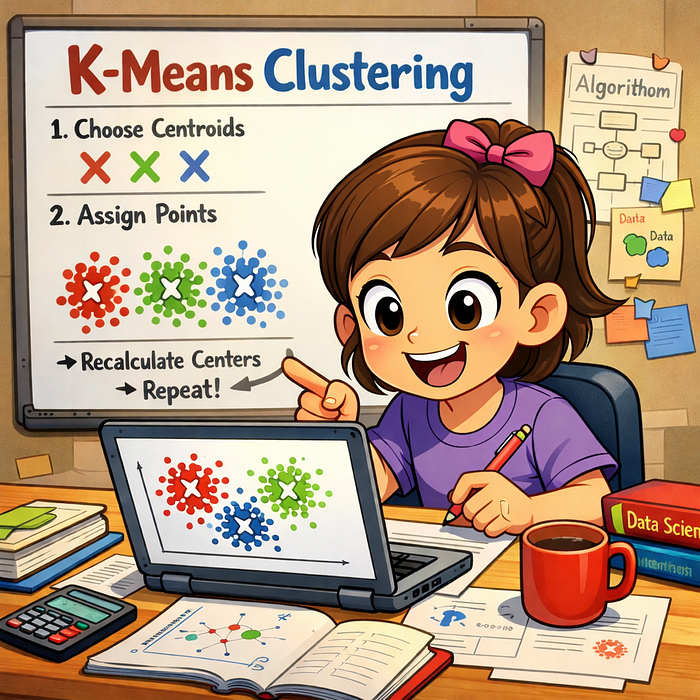
K-means clustering is an unsupervised machine learning method used to group similar data points into clusters. The algorithm starts by choosing a fixed number of clusters, called K. It then assigns each data point to the nearest cluster center based on distance. After assignment, the cluster centers are updated by calculating the average of all points in each cluster. This process repeats until the cluster centers no longer change significantly. K-means is commonly used for customer segmentation, pattern discovery, and data grouping, but it requires choosing K in advance and works best with well-separated clusters.
The article consists of a comprehensive overview of K-means clustering, detailing its methodology, applications, advantages, and drawbacks. It explains how K-means groups data points into clusters, the importance of selecting the right number of clusters (K), and various methods for determining optimal K values. The text highlights K-means’ flexibility and efficiency in applications such as customer segmentation, image compression, and anomaly detection while also addressing its limitations, including sensitivity to initial conditions, the need for predefined cluster numbers, and challenges with non-spherical clusters.
Read the full blog for free on Medium.
Join thousands of data leaders on the AI newsletter. Join over 80,000 subscribers and keep up to date with the latest developments in AI. From research to projects and ideas. If you are building an AI startup, an AI-related product, or a service, we invite you to consider becoming a sponsor.
Published via Towards AI
Towards AI Academy
We Build Enterprise-Grade AI. We'll Teach You to Master It Too.
15 engineers. 100,000+ students. Towards AI Academy teaches what actually survives production.
Start free — no commitment:
→ 6-Day Agentic AI Engineering Email Guide — one practical lesson per day
→ Agents Architecture Cheatsheet — 3 years of architecture decisions in 6 pages
Our courses:
→ AI Engineering Certification — 90+ lessons from project selection to deployed product. The most comprehensive practical LLM course out there.
→ Agent Engineering Course — Hands on with production agent architectures, memory, routing, and eval frameworks — built from real enterprise engagements.
→ AI for Work — Understand, evaluate, and apply AI for complex work tasks.
Note: Article content contains the views of the contributing authors and not Towards AI.
Related posts
Recent Posts