UrduBench
Author(s): ML Point
Originally published on Towards AI.
Measuring What AI Actually Understands About Urdu
As large language models increasingly market themselves as multilingual, one critical question often remains unanswered: how do we verify that claim for languages outside the English-centric core? Urdu, despite being spoken by tens of millions and carrying a deep literary and cultural tradition, has historically been evaluated through borrowed or translated benchmarks. UrduBench emerges as a corrective to this practice.
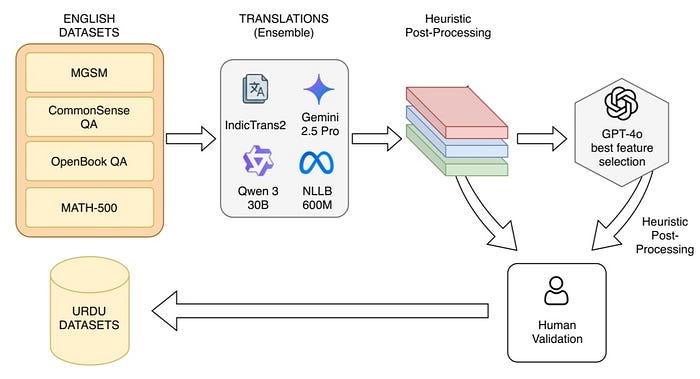
UrduBench is a benchmarking framework specifically for Urdu, aiming to accurately assess how well NLP systems handle the language by focusing on native datasets instead of translated ones. It highlights the importance of proper evaluation methodologies and exposes the limitations of multilingual models when handling the unique linguistic characteristics of Urdu, thereby contributing to more inclusive and accurate AI evaluations.
Read the full blog for free on Medium.
Join thousands of data leaders on the AI newsletter. Join over 80,000 subscribers and keep up to date with the latest developments in AI. From research to projects and ideas. If you are building an AI startup, an AI-related product, or a service, we invite you to consider becoming a sponsor.
Published via Towards AI
Towards AI Academy
We Build Enterprise-Grade AI. We'll Teach You to Master It Too.
15 engineers. 100,000+ students. Towards AI Academy teaches what actually survives production.
Start free — no commitment:
→ 6-Day Agentic AI Engineering Email Guide — one practical lesson per day
→ Agents Architecture Cheatsheet — 3 years of architecture decisions in 6 pages
Our courses:
→ AI Engineering Certification — 90+ lessons from project selection to deployed product. The most comprehensive practical LLM course out there.
→ Agent Engineering Course — Hands on with production agent architectures, memory, routing, and eval frameworks — built from real enterprise engagements.
→ AI for Work — Understand, evaluate, and apply AI for complex work tasks.
Note: Article content contains the views of the contributing authors and not Towards AI.
Related posts
Recent Posts