


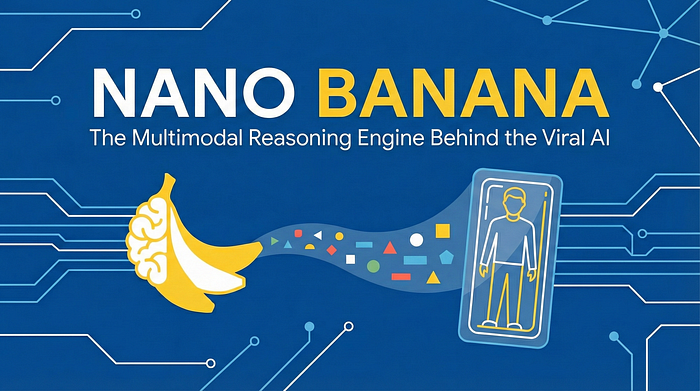
This is How Google Finally Fixed AI Images: The Secret Sauce Behind “Nano Banana”
Last Updated on January 5, 2026 by Editorial Team
Author(s): Sayan Chowdhury
Originally published on Towards AI.
This is How Google Finally Fixed AI Images: The Secret Sauce Behind “Nano Banana”
If you’ve been on the internet in the last six months, you’ve seen them: those hyper-realistic 3D figurines of your friends, the “past forward” aging time-lapses, and the uncanny “haircut try-ons.” They are everywhere.
The article details the technological advancements behind Google’s AI image generation model, Nano Banana, illustrating how it combines multimodal reasoning with diffusion processes to create remarkably realistic images. It emphasizes features such as semantic parsing, physics simulation, and identity locking that enhance the consistency and creativity of generated images, while allowing for natural language editing that simplifies user interaction. Ultimately, the piece celebrates the balance between AI control and artistic expression, highlighting how the future of image generation lies not just in aesthetic appeal but in the understanding of context and logic.
Read the full blog for free on Medium.
Join thousands of data leaders on the AI newsletter. Join over 80,000 subscribers and keep up to date with the latest developments in AI. From research to projects and ideas. If you are building an AI startup, an AI-related product, or a service, we invite you to consider becoming a sponsor.
Published via Towards AI
Towards AI Academy
We Build Enterprise-Grade AI. We'll Teach You to Master It Too.
15 engineers. 100,000+ students. Towards AI Academy teaches what actually survives production.
Start free — no commitment:
→ 6-Day Agentic AI Engineering Email Guide — one practical lesson per day
→ Agents Architecture Cheatsheet — 3 years of architecture decisions in 6 pages
Our courses:
→ AI Engineering Certification — 90+ lessons from project selection to deployed product. The most comprehensive practical LLM course out there.
→ Agent Engineering Course — Hands on with production agent architectures, memory, routing, and eval frameworks — built from real enterprise engagements.
→ AI for Work — Understand, evaluate, and apply AI for complex work tasks.
Note: Article content contains the views of the contributing authors and not Towards AI.
Related posts
Recent Posts


