


What Mistakes Did I Make in Vibe Coding Genie-Hi
Last Updated on January 2, 2026 by Editorial Team
Author(s): Gabrielle Y
Originally published on Towards AI.

The First Leap: When Vibe Coding Feels Like Magic
When I first started vibe coding Genie-Hi, I genuinely thought it would simply help me move faster. I typed a few sentences describing what I wanted, pressed Enter, and watched a functional product appear on the screen. For a brief moment I thought: so this is what 0→1 feels like in the AI era.
But the magic was only the beginning. The real work — the messy, unpredictable, deeply educational part — came right after.
Where the Challenges Start to Reveal Themselves
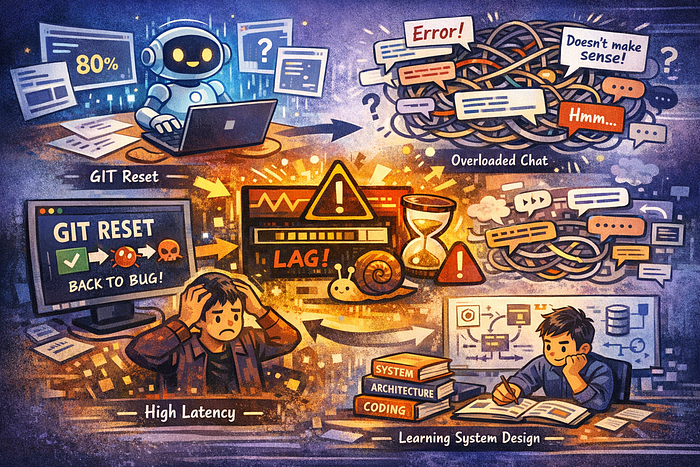
1. Vibe coding is extraordinary at getting to the first 80%. The remaining 20%, however, hides every trap you can imagine. Whenever I asked the model to “adjust a small detail,” something much larger shifted. It felt like asking someone to tighten a screw in your kitchen only to discover the next morning that they change your house entirely and you cannot even get out of your bedroom.
2. And then came the long-thread trap. Keeping everything in one conversation seemed efficient at first, but after dozens of turns, the model’s coherence deteriorated. Instructions were misread, constraints forgotten, hallucinations sprinkled in unexpected places. Fixing issues inside that drifting thread only made it drift more.
3. Another mistake: I delayed Git. When you’re building alone, it’s easy to assume version control can wait — until it can’t. I spent hours debugging issues that were instantly undone by a single new prompt. Without Git, vibe coding becomes a cycle of creation, destruction, and reluctant acceptance that AI can undo your work just as quickly as it creates it.
But none of these challenges compared to what came next.
4. Latency wasn’t an issue during Genie-Hi’s early demo phase. Back then, the product was a lot simpler, but once Genie-Hi grew into a more real product — with multiple flows, richer logic, and user-facing features stacked together — performance signals began to surface. The app started feeling slower, and latency became the earliest indicator that the system was hitting a complexity threshold.
With AI tools, I began investigating the patterns behind the slowdown and gradually uncovered what was happening. As more features piled up, small architectural decisions accumulated into noticeable friction:
- some API calls were unintentionally running in series instead of parallel
- certain React components were re-rendering more than necessary
- the front-end bundle had grown large enough to block the main thread
- ……
None of this is unusual, however, A demo can get away with anything; a product can’t. While my background is in data science, I found myself learning system design concepts out of necessity. Latency was a message that told me that engineering fundamentals become essential the moment a product grows beyond its demo phase.
That realization shifted how I thought about building Genie-Hi or any apps with vibe coding: It wasn’t just about adding features — it was about ensuring the system underneath could support them.
What I Learned: The Practices That Actually Work
Eventually, after enough trial, error, and accidental UI transformations, I developed a set of survival techniques that are now essential to how I vibe code.
1. Keep changes atomic and aggressively scoped.
“Atomic” means painfully specific. Generative models don’t understand locality, so if you give them room, they rewrite the whole neighborhood.
I now always specify:
- the exact block — I paste only the relevant function, never the whole file
- what is allowed — e.g., “You may update the
handleSubmitfunction only.” - what is forbidden — “Do NOT modify any other component or file.” (This single sentence prevents 70% of chaos.)
Necessary? Absolutely. It’s the only way to stop Genie-Hi from morphing into a different app every time I blink.
2. Don’t let one model do everything. Treat AI tools as a distributed team.
I used to think one powerful model could handle everything. Now I know better. Each tool has a specialty, and development becomes far more stable when you respect that.
Here is the distributed “AI org chart” for Genie-Hi:

- ChatGPT → my thought partner
- AI Studio → my developers
- Gemini → my ui crew
- Copilot → qa department
- NotebookLM → my marketing and secretary crew
- and more to discover
Once I split responsibilities like this, the chaos dropped dramatically.
It became (ironically) the modular engineering workflow we all wish we had.
3. Use multi-language prompting as a precision tool.
Who can ever realize that bilingual has its power in vibe coding? Unexpectedly, switching between English and Chinese made development much more accurate. When something isn’t landing in English, Chinese disambiguates it instantly — and vice versa. Multi-language prompting became my debugging strategy for human-AI communication.
4. Build E2E experience as you go.
Vibe coding makes every gap visible — immediately. Genie-Hi forced me to learn in real world where:
- ui/ux flow only is the beginning of a product — a true ux comes from actually using the product and feel it
- Feature requests are not always progress — they can expose structural debt.
- Architecture becomes a product constraint whether you like it or not.
- Debugging is not a detour; it is the work.
- Prototyping mindset and engineering mindset must coexist, but not in the same moment.
- E2E thinking means connecting vertical insight with horizontal flow.
None of this came from textbooks. Vibe coding didn’t replace engineering — it made engineering irresistible.
Where Genie-Hi Is Now
Somewhere in the middle of all this learning, frustration, rebuilding, and redesigning, Genie-Hi quietly leveled up. We polished the flows, fixed the architecture, reduced the latency, simplified the UI, and rebuilt sections that weren’t scalable.
The new version isn’t ready for a full reveal yet — but it feels alive, intentional, and much closer to the product I originally envisioned.
Consider this a soft teaser:
something exciting is coming, and we can’t wait to share it soon.
Join thousands of data leaders on the AI newsletter. Join over 80,000 subscribers and keep up to date with the latest developments in AI. From research to projects and ideas. If you are building an AI startup, an AI-related product, or a service, we invite you to consider becoming a sponsor.
Published via Towards AI
Towards AI Academy
We Build Enterprise-Grade AI. We'll Teach You to Master It Too.
15 engineers. 100,000+ students. Towards AI Academy teaches what actually survives production.
Start free — no commitment:
→ 6-Day Agentic AI Engineering Email Guide — one practical lesson per day
→ Agents Architecture Cheatsheet — 3 years of architecture decisions in 6 pages
Our courses:
→ AI Engineering Certification — 90+ lessons from project selection to deployed product. The most comprehensive practical LLM course out there.
→ Agent Engineering Course — Hands on with production agent architectures, memory, routing, and eval frameworks — built from real enterprise engagements.
→ AI for Work — Understand, evaluate, and apply AI for complex work tasks.
Note: Article content contains the views of the contributing authors and not Towards AI.
Related posts
Recent Posts


