Meet MCP: Why Every AI Tool Just Got Its USB-C Moment
Last Updated on September 29, 2025 by Editorial Team
Author(s): Deepshikha Chhaperia
Originally published on Towards AI.
Okay, real talk — how many chargers do you carry in your bag? Two? Three? Basically a mini electronics shop? Now imagine doing that same juggling act every time an AI wants to do something useful for you.
Enter MCP (Model Context Protocol), the USB-C moment for AI.
If you’ve ever rolled your eyes at needing one charger for your phone, another for your camera, and yet another for your laptop (pre-USB-C chaos days), you already get the struggle. Each device had its own connector, just like each tool today has its own API.
Then came USB-C: one charger to rule them all.
That’s exactly what MCP does for AI — one common “language” that lets models like ChatGPT, Claude, or Gemini connect seamlessly with different tools, without needing a fresh integration every single time.
Here’s the Problem
You ask an AI: “Book me a flight to Paris tomorrow and add it to my calendar.”
Before MCP: The AI would need one translator for IndiGo, another for Google Calendar, one for Outlook, and a few ad‑hoc duct tapes in between.
After MCP: The AI just speaks one language. It’s like using a single USB‑C cable instead of a drawer of incompatible chargers.
So What Is MCP?
MCP is a standardized way for AI models (think ChatGPT, Claude, Gemini, etc.) to talk to external tools and services. It doesn’t replace those tools’ APIs, it wraps them in a neat, common format so the model doesn’t have to learn a dozen different dialects.
Bottom line: AI speaks MCP → Tools implement MCP servers → Everyone gets along.
Why Should You Care?
• Less chaos for developers: no more writing bespoke integrations for every new tool.
• Faster UX wins: your assistant can actually do multi‑step tasks across apps without crying for help.
• Model‑agnostic: whether someone uses ChatGPT, Claude, or Gemini, the interaction looks familiar.
In plain English: MCP makes assistants useful, not just chatty.
Let’s See It in Action
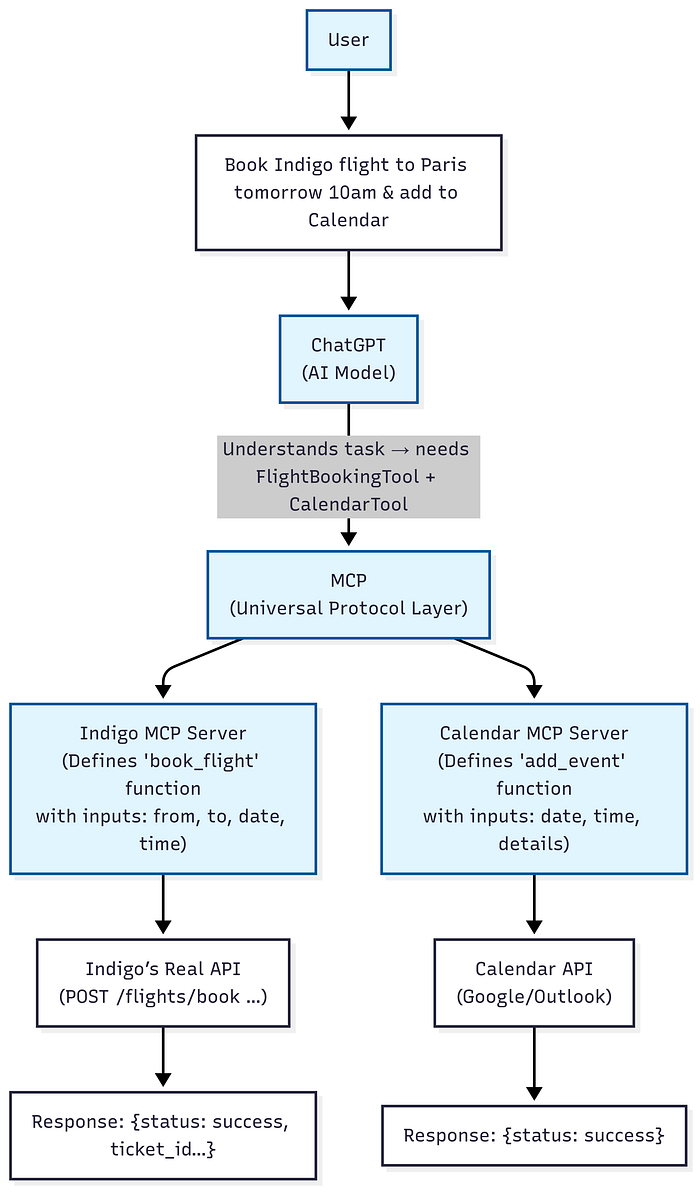
Here’s exactly how the magic happens:

You say: “Book me a flight tomorrow at 10 AM on IndiGo and add it to my Google Calendar.”
- The AI figures out: book_flight + add_event.
- It turns those intents into MCP calls, structured data that says which tool, which function, and what parameters.
- IndiGo’s MCP server translates that MCP call into IndiGo’s actual API and books your ticket.
- Google Calendar’s MCP server receives an MCP call to add the event and creates it.
- You get the message: “Flight booked. Event added.” And you can go back to planning croissants.
Can You Build Your Own?
Absolutely! Have a weird internal tool with a messy API? Wrap it in an MCP server that exposes clean functions like create_event, book_flight, or get_balance. Once it speaks MCP, any compatible AI model can use it, no sweat.
It’s basically: hide the messy plumbing, show a pretty, consistent interface.
A Few Important Details
• MCP isn’t a central database of all APIs, each tool still runs its own server.
• Tool names disambiguate (e.g., google-calendar vs microsoft-calendar). If you say “add to my calendar,” the AI may ask which one unless a default is set.
• Security, auth, and rate limits still matter — MCP standardizes structure, not policy.
Final Thought
MCP feels obvious in hindsight, the kind of idea you slap your forehead at and say, “Why didn’t we do this sooner?” If it becomes widely adopted, AI assistants won’t just answer; they’ll actually help you get stuff done across your apps.
The USB-C moment for AI is here, and it’s about time.
Join thousands of data leaders on the AI newsletter. Join over 80,000 subscribers and keep up to date with the latest developments in AI. From research to projects and ideas. If you are building an AI startup, an AI-related product, or a service, we invite you to consider becoming a sponsor.
Published via Towards AI
Towards AI Academy
We Build Enterprise-Grade AI. We'll Teach You to Master It Too.
15 engineers. 100,000+ students. Towards AI Academy teaches what actually survives production.
Start free — no commitment:
→ 6-Day Agentic AI Engineering Email Guide — one practical lesson per day
→ Agents Architecture Cheatsheet — 3 years of architecture decisions in 6 pages
Our courses:
→ AI Engineering Certification — 90+ lessons from project selection to deployed product. The most comprehensive practical LLM course out there.
→ Agent Engineering Course — Hands on with production agent architectures, memory, routing, and eval frameworks — built from real enterprise engagements.
→ AI for Work — Understand, evaluate, and apply AI for complex work tasks.
Note: Article content contains the views of the contributing authors and not Towards AI.
Related posts
Recent Posts