


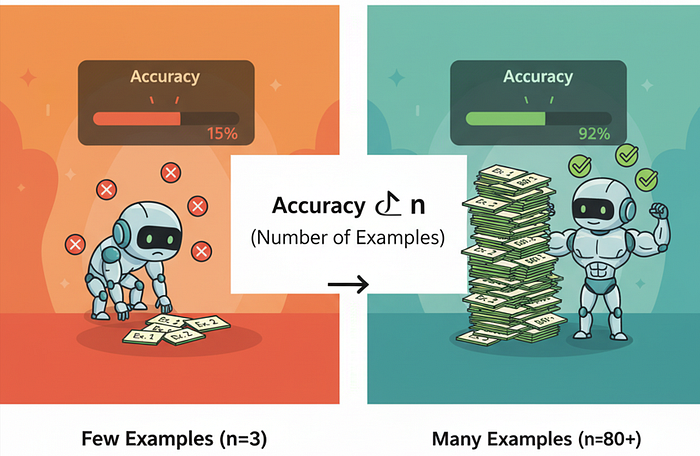
In-Context Learning Explained: Why LLMs Need 100 Examples, Not 5
Last Updated on September 25, 2025 by Editorial Team
Author(s): MKWriteshere
Originally published on Towards AI.
New research reveals the truth about few-shot learning and what it means for your AI applications
What happens when you feed ChatGPT examples in your prompts isn’t what you think
The article explores the concept of In-Context Learning (ICL) in AI and its implications on the performance of models like ChatGPT. It discusses findings from a comprehensive study conducted by Microsoft involving 1.89 million AI predictions, emphasizing that optimal performance requires significantly more examples (50-100) than what is commonly assumed in few-shot learning frameworks. The limitations of AI learning are highlighted, showing that while model performance improves with more data, they become less reliable when faced with varied inputs. The study concludes that current AI models excel in recognizing patterns but struggle with generalization, prompting a need for more robust strategies in AI deployment.
Read the full blog for free on Medium.
Join thousands of data leaders on the AI newsletter. Join over 80,000 subscribers and keep up to date with the latest developments in AI. From research to projects and ideas. If you are building an AI startup, an AI-related product, or a service, we invite you to consider becoming a sponsor.
Published via Towards AI
Towards AI Academy
We Build Enterprise-Grade AI. We'll Teach You to Master It Too.
15 engineers. 100,000+ students. Towards AI Academy teaches what actually survives production.
Start free — no commitment:
→ 6-Day Agentic AI Engineering Email Guide — one practical lesson per day
→ Agents Architecture Cheatsheet — 3 years of architecture decisions in 6 pages
Our courses:
→ AI Engineering Certification — 90+ lessons from project selection to deployed product. The most comprehensive practical LLM course out there.
→ Agent Engineering Course — Hands on with production agent architectures, memory, routing, and eval frameworks — built from real enterprise engagements.
→ AI for Work — Understand, evaluate, and apply AI for complex work tasks.
Note: Article content contains the views of the contributing authors and not Towards AI.
Related posts
Recent Posts






